family health
What Are the Safest Disinfectant Sprays for Kids and Pets? EPA Reg, DfE, Cleaner
Most sprays labeled 'disinfectant' aren't, and most that are cost more than they need to. Here's how to read the EPA number, what's genuinely safer, and when you don't need to disinfect at all.

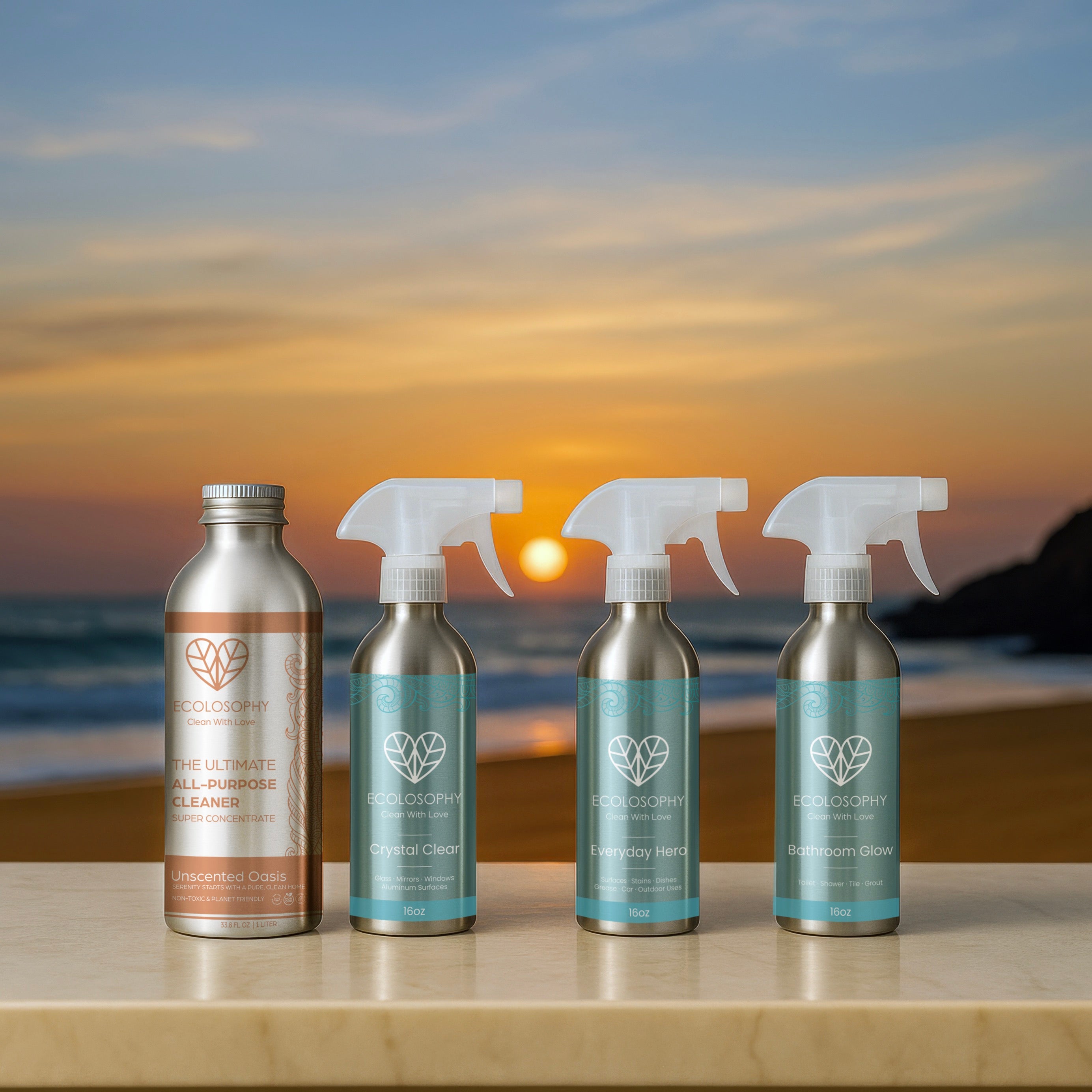
Short answer: Only EPA-registered antimicrobial pesticides may claim germ-kill — look for an EPA Reg. No. For safer picks, prefer Design for the Environment (DfE) disinfectants, full contact time, and ventilation. For everyday messes, a plant-based Ecolosophy concentrate — small-batch, made with care — is a cleaner, not a disinfectant.
The message always arrives the same way. A friend standing in the cleaning aisle, phone in one hand, toddler in the cart, texting me a photo of two bottles: which one of these is actually safe?
And I always want to answer a slightly different question first, because it’s the one that unlocks everything: do you even need a disinfectant right now?
Most of the time, the honest answer is no. And when the answer is yes, the way to pick one has almost nothing to do with the front of the bottle.
That’s the whole thing. Now let me show you how to use it, and why I’m going to spend the rest of this article talking you out of disinfecting as often as you probably do.
The short answer
If you read nothing else:
- Flip the bottle over and look for “EPA Reg. No.” If it’s there, the product is a registered antimicrobial pesticide and the germ-kill claims on the label have been reviewed. If it isn’t there, you’re holding a cleaner. Cleaners are good. They’re just not the same thing.
- If it’s there, look for the DfE logo too. That’s the EPA’s Design for the Environment mark, and per the EPA, seeing it means the product “meets stringent EPA criteria for efficacy and effects on human health and the environment.” It’s the only U.S. government mark I know of that does both jobs at once for a disinfectant.
- Read the contact time. Every registered disinfectant has one. The surface has to stay visibly wet for that long or the product hasn’t done what the label promises. Spraying and immediately wiping is the single most common way people accidentally get zero disinfection.
- Ventilate, and keep kids and pets off the surface until it’s fully dry. The American Lung Association’s language is direct: “When using cleaning or household products, keep the area well ventilated. Open windows and doors. Never use cleaning products in a small, enclosed space.”
- Never mix products. Especially never bleach with ammonia.
If you want the cleaner instead of the disinfectant for everyday messes — which is what I use in my own house most days — our unscented plant-based concentrate is the version I’d hand a family with a crawling baby and a shedding dog. It’s a cleaner. It is not a disinfectant, and I’ll keep saying that, because the whole point of this article is that the difference matters.
Cleaner, sanitizer, disinfectant, sterilant: four different words that are not synonyms
This is where nearly every “is X safe” question actually goes wrong. People compare products that aren’t in the same category.
The EPA draws the lines like this:
| Term | What the EPA says it does | Registered as a pesticide? |
|---|---|---|
| Cleaner | Physically removes soil, grease, and — with it — germs. Not an EPA term at all. | No |
| Sanitizer | ”Used to reduce, but not necessarily eliminate, microorganisms from the inanimate environment to levels considered safe as determined by public health codes or regulations.” | Yes |
| Disinfectant | ”Used on nonliving surfaces and objects to destroy or irreversibly inactivate infectious fungi and bacteria but not necessarily their spores.” | Yes |
| Sterilant | ”Used to eliminate or destroy fungi, fungal spores, viruses, vegetative bacteria, bacterial spores.” | Yes |
Two things jump out of that table.
First: only the bottom three are regulated words. “Cleaner” is a marketing word. “Natural,” “green,” “plant-based,” “eco,” “non-toxic” — all marketing words. But disinfectant is a legal claim with a paper trail behind it.
Second: notice what a disinfectant explicitly does not promise. Not necessarily spores. That’s why there’s a separate EPA list (List K) just for products effective against Clostridioides difficile spores. The category is more precise than the marketing.
The EPA notes that more than 4,000 antimicrobial products are currently registered. So this isn’t a small, obscure regulatory corner — it’s the entire disinfectant aisle.
The five-second label check that beats every “best of” list
You don’t need me to rank sprays. You need to be able to rank them yourself in a store aisle in five seconds. Here’s the sequence.
Step 1: Find the EPA Reg. No. It’s on the back, usually near the precautionary statements, in small type. The EPA is explicit about why it matters: “the same product can have different names and be sold under a variety of company names.” The registration number is the fingerprint. The name is not.
Step 2: Read the number’s shape. Per EPA, a two-part number (like 1234-12) is a primary registration. A three-part number (like 1234-12-123) is a supplemental distributor product — the same composition as a primary product, sold under a different brand. This is genuinely useful in a store: a store-brand spray with a three-part number is often chemically identical to the name brand next to it at twice the price.
Step 3: Look for the DfE logo. Small green-and-blue mark. This is where the safety-conscious shopper wins. The EPA’s own description is that consumers seeing it “can feel confident that the product meets stringent EPA criteria for efficacy and effects on human health and the environment.” Efficacy and health and environment. That’s the combination you were trying to eyeball from the front label, and here it is, decided by a regulator instead of a marketing department.
Step 4: Read the contact time. Somewhere on the label it will say the surface must remain wet for some number of minutes. Ten minutes is common. Four is common. Thirty seconds is rare. If you spray and wipe in eight seconds, you cleaned. You did not disinfect.
Step 5: Read what surfaces it’s approved for. Registered disinfectant labels are specific — hard, non-porous surfaces, usually. Toys, upholstery, and food-contact surfaces have separate instructions (food-contact surfaces almost always require a potable water rinse afterward).
A quick note on what not to use as a shortcut: the EPA’s Safer Choice program is a different thing from DfE-for-antimicrobials. Safer Choice, in the EPA’s words, “helps consumers, businesses, and purchasers find products that perform and contain ingredients that are safer for human health and the environment.” It’s an excellent mark — but it’s the mark for cleaning products. For disinfectants specifically, the DfE antimicrobial logo is the one you want.
Is ammonia a disinfectant?
This one comes up constantly, and it deserves a plain answer.
Household ammonia is a strong alkaline degreaser. It cuts grease and leaves glass streak-free, and generations of people learned to clean with it because it works.
But it is not, as sold in a typical household bottle, an EPA-registered disinfectant. And that’s not a technicality: federal law “requires all pesticides sold or distributed in the United States (including imported pesticides) to be registered by EPA,” and a pesticide is “any substance or mixture of substances intended for preventing, destroying, repelling or mitigating any pest.” A product intended to destroy microorganisms is squarely inside that definition. If a bottle carries no registration number, it cannot legally carry germ-kill claims — so it isn’t one.
Now the part that matters more than the classification. The American Lung Association’s warning is one of the most important sentences in home safety: “Never mix bleach or any bleach-containing product with any cleaner containing ammonia. The gases created from this combination can lead to chronic breathing problems and even death.”
This is not a theoretical hazard. It happens in real bathrooms, when someone sprays one product on a surface that already has another on it, or combines two cleaners in a bucket to “make it stronger.” Never do it. And a practical corollary: if you don’t know what’s in a product, you can’t know whether it’s safe to use after another one. That’s one more reason full ingredient disclosure isn’t a luxury.
The uncomfortable truth: most days, you should be cleaning, not disinfecting
Here’s the part the cleaning-product industry will never put in an ad.
Cleaning physically removes germs. Water, surfactant, and friction lift soil off a surface and carry the microorganisms in it down the drain. That’s not a consolation prize; it’s the primary mechanism of household hygiene, and it’s what you’re doing every time you wipe a counter properly.
Disinfecting is a targeted intervention for situations where removal isn’t enough. In a normal home, those are:
- Surfaces that contacted raw meat, poultry, fish, or eggs
- The kitchen and bathroom during and after a stomach illness
- Diaper-change surfaces and litter-box areas
- Cleanup of blood, vomit, urine, or feces
- Shared high-touch surfaces when someone in the house is sick or immunocompromised
That’s the list. It’s short on purpose.
Everything else — the crumbs, the dust, the sticky spot on the cabinet door, the muddy paw prints in the hallway, the fingerprints on the fridge — is a soil problem. Reaching for a registered disinfectant on all of it means you’re putting an antimicrobial pesticide into your indoor air multiple times a day to solve a problem that soap and water already solved.
And indoor air is exactly the thing families with young children and pets have the least margin on. The American Lung Association notes that VOCs “vaporize at room temperature” and are associated with “chronic respiratory problems, allergic reactions and headaches,” and makes a point that surprises most people: “Even natural fragrances such as citrus can react to produce dangerous pollutants indoors.” Natural does not mean inert. Less product in the air is less product in the air, regardless of its origin story.
So my actual recommendation to that friend in the aisle is usually two products, not one: a good plant-based cleaner for the ninety-five percent, and one DfE-certified registered disinfectant kept under the sink for the five percent. Not a disinfectant used for everything.
If you want the everyday one, that’s what our concentrate is built for — one bottle dilutes into 100+ spray bottles, every ingredient published, and no undisclosed “fragrance” line hiding a list you’re not allowed to see. And to be completely clear, because this is the exact honesty the category is missing: it is a cleaner. It is not EPA-registered as a disinfectant. It does not kill germs, it removes them.
The pets question, specifically
Pets change the calculation in three ways that people underestimate.
They live at floor level. Whatever settles, settles where they breathe. A cat spends most of its day within eighteen inches of a surface you just sprayed.
They groom. Dogs lick paws. Cats groom their entire body, constantly, with their tongue. Residue that a human would never ingest gets eaten by a cat as a matter of daily routine. This is why “let it dry, then rinse with plain water” is such a good habit on floors — it converts a residue question into a non-question.
Their metabolisms differ. Cats in particular process some compounds differently than humans or dogs do, which is why blanket “safe for pets” claims deserve skepticism no matter who’s making them.
Practical protocol for disinfecting in a home with animals: confine the pet to another room, ventilate, apply the product, respect the full contact time, wipe, then rinse the surface with plain water and let it dry completely before the pet comes back. That sequence is compatible with every registered disinfectant I’ve read the label on, and it removes almost all of the realistic exposure.
And keep this number where you can find it under stress: the ASPCA Animal Poison Control Center hotline is (888) 426-4435, staffed 24 hours. Program it now, not during the emergency. There’s a consultation fee, which the ASPCA frames as “a small fee that can prevent a big bill.”
For the floor specifically, we went deep on this in pet-safe disinfecting floor cleaner, and on where the two audiences diverge in pet-safe vs. kid-safe cleaning.
The kids question, specifically
Same logic, different biology. Small children breathe faster relative to body size, spend more time close to the floor, have more permeable skin, and put their hands in their mouths constantly. None of that makes a properly used registered disinfectant dangerous. All of it means the margin for misuse is smaller.
The misuse patterns I’d watch for:
- Spraying in a closed bathroom. The ALA guidance — never in a small, enclosed space — exists for a reason. Open the window or run the fan.
- Spraying toys. Most registered disinfectant labels are written for hard, non-porous surfaces. A plush toy is neither. Wash it instead.
- Skipping the rinse on anything mouthed. High chairs, tray tables, crib rails, teething-adjacent surfaces. Rinse them.
- Using disinfectant as an air freshener. It is not one. Spraying a room to make it “smell clean” is putting a pesticide into the air for a scent effect.
For the everyday cleaner half of the setup — the one you’ll actually reach for most days — the full buying guide is the best non-toxic all-purpose cleaner.
If you’re comparing against the specific brand most families default to, we broke it down in a natural alternative to Lysol, are disinfectant sprays safe and is Clorox safe for homes with kids. And if your real question is whether the strong smell of a floor cleaner means the floor is sanitized, the answer is no, and does Fabuloso kill germs walks through why.
A worked example of reading a label honestly
Let me do one out loud, because it shows how much the label actually tells you when you know where to look.
Force of Nature is an appliance-based system that a lot of parents ask me about. The company’s own site says the device turns “salt, water, and vinegar into an all-in-one cleaner, deodorizer and EPA-registered disinfectant,” states federal EPA registration number 93040-1, and says the resulting solution “kills 99.9% of viruses, bacteria, mold, and mildew when used as directed.”
So I looked up 93040-1 in the EPA’s Pesticide Product Label System. What’s registered under that number is the Force of Nature Activator Capsule, with an active ingredient of sodium chloride at 20.9% — plain salt — and alternate brand names “Force of Nature” and “Force of Nature Pro.”
That’s a real registration, and it checks out. It’s also more interesting than the marketing: the registered article is the capsule you drop into the device, and the listed active ingredient is salt, because the germ-killing agent is generated by electrolysis at the moment of use rather than shipped in the bottle. That’s an unusual and genuinely clever regulatory shape, and it’s exactly the kind of thing you’d never learn from the front of the box.
I’m not telling you to buy it or not buy it. I’m showing you that five minutes with a free government database turns a marketing claim into a verifiable fact — and that a company willing to print its registration number is handing you the tool to check its work. That’s a good sign in any brand. It’s the same reason we publish every ingredient in our own bottle.
What I actually keep under my sink
Two things.
One plant-based cleaner concentrate, unscented, diluted into a couple of spray bottles. Counters, floors, cabinets, the dog’s water bowl area, the highchair, the hundred small messes a day generates. Full ingredient disclosure, no undisclosed fragrance, no dyes doing nothing but making the liquid look blue.
One registered disinfectant with the DfE logo, used maybe twice a week, on the cutting board after raw chicken and in the bathroom when someone’s sick. Full contact time. Windows open. Kids and dog out of the room. Rinse after.
That’s it. Not a shelf of eleven specialized sprays. Two products, used for what they’re each actually for.
The reason I’m confident in that setup isn’t that plant-based is inherently superior — it isn’t, and I’d distrust anyone who told you otherwise. It’s that the categories are real, the label tells you which category you’re in, and matching the product to the actual job is the entire skill. Everything else is packaging.
The offer, plainly
If you want the everyday cleaner half of that setup, that’s what we make. Ecolosophy’s plant-based concentrate is sugar-derived surfactants, published ingredients, no undisclosed fragrance, no unnecessary dyes, no isothiazolinone preservatives. One bottle makes 100+ spray bottles, which is also a lot less plastic and a much lower cost per use than buying a new jug every month.
- Unscented Oasis kit — no scent at all. What I’d hand a family with a crawling baby, a cat, or anyone fragrance-sensitive.
- Pure Serenity concentrate — lightly scented with real essential oils, named on the label.
- Trial kit trio — if you’d rather try before committing to a full-size bottle. This is the one I’d pick if you found this article by comparison-shopping.
And the sentence I want you to remember from a brand trying to sell you something: our concentrate is a cleaner, not a disinfectant. When you need to disinfect, use a registered disinfectant and follow its label. We’d rather be the product you trust than the product that overpromised once.
You don’t need a shelf of sprays. You need one cleaner you trust for the ninety-five percent, and one registered disinfectant for the five. Start with the trial kit trio → — or go straight to the unscented concentrate if there’s a baby or a cat in the house.
#cleanwithlove #ecolosophy #nontoxichome #petsafecleaning #detoxyourlife
Sources cited
- U.S. EPA — What Are Antimicrobial Pesticides? — Sanitizers are 'used to reduce, but not necessarily eliminate, microorganisms'; disinfectants are 'used on nonliving surfaces and objects to destroy or irreversibly inactivate infectious fungi and bacteria but not necessarily their spores'; sterilants 'eliminate or destroy fungi, fungal spores, viruses, vegetative bacteria, bacterial spores'; more than 4,000 antimicrobial products are registered with EPA
- U.S. EPA — About Pesticide Registration — Federal law 'requires all pesticides sold or distributed in the United States (including imported pesticides) to be registered by EPA'; a pesticide is 'any substance or mixture of substances intended for preventing, destroying, repelling or mitigating any pest'
- U.S. EPA — Selected EPA-Registered Disinfectants — EPA maintains pathogen-specific lists (List N for SARS-CoV-2, G for norovirus, H for MRSA/VRE, K for C. difficile spores, S for bloodborne pathogens); the registration number identifies a product because 'the same product can have different names and be sold under a variety of company names'; two-part numbers are primary registrations, three-part numbers are supplemental distributor products
- U.S. EPA — Design for the Environment Logo for Antimicrobial Pesticide Products — Consumers seeing the DfE logo 'can feel confident that the product meets stringent EPA criteria for efficacy and effects on human health and the environment'
- U.S. EPA — Safer Choice — 'Safer Choice helps consumers, businesses, and purchasers find products that perform and contain ingredients that are safer for human health and the environment'
- American Lung Association — Cleaning Supplies and Household Chemicals — 'Never mix bleach or any bleach-containing product with any cleaner containing ammonia. The gases created from this combination can lead to chronic breathing problems and even death.' Also: 'When using cleaning or household products, keep the area well ventilated. Open windows and doors. Never use cleaning products in a small, enclosed space.' And: 'Even natural fragrances such as citrus can react to produce dangerous pollutants indoors.'
- ASPCA Animal Poison Control Center — 24-hour Animal Poison Control Center hotline: (888) 426-4435
- U.S. EPA Pesticide Product Label System — EPA Reg. No. 93040-1 — Registration 93040-1 is the 'Force of Nature Activator Capsule,' active ingredient sodium chloride 20.9%, with alternate brand names 'Force of Nature' and 'Force of Nature Pro'