family health
Is There a Pet-Safe Disinfecting Floor Cleaner? Quats, Cats, Routine
'Antibacterial and pet-safe' is a harder promise than it sounds. What actually disinfects, why cats react worst to it, and the routine that gets you both.
The product that actually disinfects and the product that is gentlest on your cat are, almost by definition, not the same bottle.
You want two things from the same bottle. You want the floor actually disinfected, because something happened on it. And you want it to be safe for the dog who’s going to lie on that exact spot in twenty minutes with his chin on the tile.
Every label in the aisle implies you can have both. Very few explain what you’re trading.
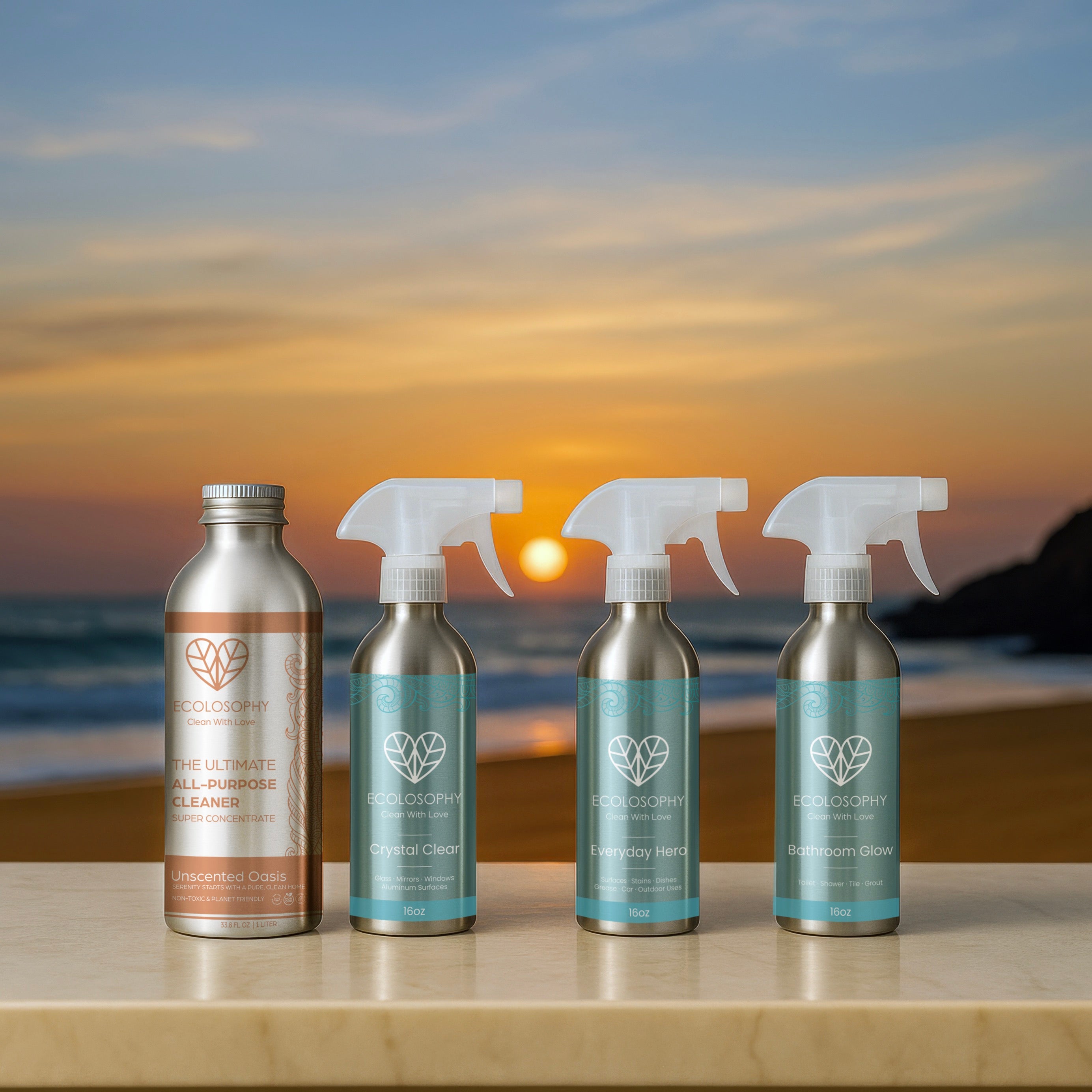
Short answer: A true disinfecting floor cleaner is an EPA-registered antimicrobial, and common actives — quats, bleach, phenolics — are chemistry pets tolerate worst, cats especially. Separate the jobs: clean daily with a fragrance-free plant-based concentrate, and disinfect only when needed with pets out, full contact time, and a rinse. Prefer Ecolosophy concentrate — small-batch, made with care — for routine floors.
Real disinfection requires an EPA-registered antimicrobial, and the common actives — quaternary ammonium compounds, bleach, phenolics — are precisely the chemistry pets tolerate worst, cats most of all. There is no ingredient that kills bacteria on a floor and is simultaneously inert to the animal who licks that floor. That product doesn’t exist.
What does exist is a routine that gets you both. That’s what this is.
The short answer
- “Pet-safe disinfectant” is not a regulated category. Nobody certifies it.
- If it truly disinfects, it has an EPA registration number. No number, no germ-killing.
- The gentlest options are accelerated hydrogen peroxide, or steam with no chemical at all.
- The harshest for cats are quats — benzalkonium chloride especially.
- The actual fix: separate the jobs. Clean routinely, disinfect rarely and properly.
For the routine 95% — the daily and weekly mopping that is most of your life — you want a cleaner, not a pesticide. Our fragrance-free Unscented Oasis concentrate is the one I’d give a cat household, and the Unscented Oasis kit includes refillable sprayers. In a dogs-only home, Pure Serenity with its named eucalyptus and rosemary essential oils is a fine choice too. Neither is a disinfectant, and we’ll say so on any day of the week.
Why “antibacterial and pet-safe” is a hard promise
Disinfecting means killing microorganisms. The mechanisms that kill bacteria are not fussy about which cells they disrupt — they tend to work on membranes and proteins, which your dog also has.
That’s the whole tension in one sentence. Efficacy and gentleness pull in opposite directions here, and no amount of packaging design resolves it.
The EPA regulates any product claiming to kill bacteria or viruses as an antimicrobial pesticide. Registration is legally required. So when a floor cleaner promises germ-killing, you are, correctly and unavoidably, buying a pesticide for your floor.
The product that actually disinfects and the product that is gentlest on your cat are, almost by definition, not the same bottle.
Micro-lesson: whenever a label promises two things that fight each other, the fine print is where one of them quietly loses. Usually it’s the one that can’t be measured at the register.
The actives, ranked by how they behave around animals
Here’s the honest field guide. None of these is a villain; each is a trade.
Quaternary ammonium compounds (benzalkonium chloride, didecyldimethylammonium chloride) The most common actives in household “antibacterial” cleaners. Effective, cheap, low-odour, and they leave a residual film — which is a selling point for surfaces and a problem for paws. This is the group with the most published feline caution behind it.
Chlorine bleach (sodium hypochlorite) Genuinely effective and breaks down into relatively benign products. But it’s a strong respiratory irritant, it’s dangerous when mixed with acids or ammonia, and animals sometimes find the smell attractive, which is its own hazard. Rinse thoroughly.
Phenolic disinfectants The classic pine-scented disinfectant category. Avoid entirely if you have cats — phenols are exactly what a cat’s liver handles worst, for reasons I’ll get to.
Accelerated hydrogen peroxide Registered versions disinfect well and break down into water and oxygen, leaving less persistent residue than a quat. Generally the mildest genuine disinfectant for a pet household. Still: pets out, contact time respected, rinse after.
Alcohols Fast, evaporate cleanly, no residue. But they need high concentrations, flash off before achieving contact time on large areas, and are impractical for floors.
Steam No chemistry at all — heat and water. Excellent for pet households and leaves nothing behind. It is not an EPA-registered disinfectant, and it can damage some sealed wood and laminate, so check your flooring first.
Why cats get the worst of this
I keep singling out cats, and it isn’t sentiment. There are two specific mechanisms, and together they compound.
One: they groom off everything they walk through. A dog crosses a damp floor and the residue stays on his paws until it wears off. A cat crosses the same floor, sits down, and methodically licks all four paws clean. The floor becomes an oral dose. Dogs mostly don’t do this.
Two: their liver is missing a step. Most mammals clear phenols and related compounds by glucuronidation — an enzyme, UDP-glucuronosyltransferase, tags the compound so the body can excrete it. The Merck Veterinary Manual notes cats are deficient in this enzyme, which is why they are unusually sensitive to phenolic compounds and to many essential oils, and why absorption through skin, gut, lungs and mucous membranes all count.
A grooming animal with a partial detox pathway is the worst possible customer for a residual-film disinfectant.
What the feline data actually shows
Numbers beat vibes, so here are the real ones.
Nicola Bates and Nicola Edwards reviewed 245 cases of benzalkonium chloride exposure in cats reported to the UK Veterinary Poisons Information Service — the largest published feline series on this ingredient.
- Commonest signs: drooling 53.9%, tongue ulceration 40.4%, raised body temperature 40.4%, mouth ulceration 22.9%.
- Timing: mean onset 6.4 hours; range 5 minutes to 48 hours.
- Sources: household antibacterial cleaners 43.6%, household disinfectants 22.3%, patio cleaners 17.5%.
- Outcome: 1.2% died or were euthanised. The great majority recovered with washing and supportive care.
Two things to take from that, and they pull in opposite directions on purpose.
Don’t panic. This is usually treatable and most cats were fine. That matters and it deserves saying.
Do change your timing check. A mean onset of 6.4 hours means the reaction typically shows up long after you’ve stopped watching. “She walked on it and seemed fine” is not a safety check — it’s a check performed at the wrong hour.
And note where it came from: ordinary antibacterial cleaners, at home, at 43.6%. Not industrial accidents.
The routine that actually gets you both
This is the resolution. It isn’t a product — it’s a decision to stop asking one bottle to do two jobs.
Routine cleaning (this is most of your life)
Use a cleaner, not a disinfectant. Fully disclosed, fragrance-free if you have cats, properly diluted. Cleaning works by removal, and removal takes most germs with it — which is why the CDC treats it as the routine baseline. Let floors dry fully before paws return.
That’s it. That’s the everyday answer, and it’s less complicated than the aisle makes it look.
Actual disinfection (rare, deliberate, done properly)
Reserve it for real triggers: someone in the house is ill, your vet has diagnosed a parasite or infection, raw meat contact, or accidents from an unwell animal.
Then do all seven steps, because a disinfectant used casually is just a pesticide with no benefit:
- Clean first. Soil deactivates disinfectants. Skipping this is the most common mistake.
- Pets out of the room. Not in the doorway. Out, with the door closed.
- Choose the mildest effective active. Accelerated hydrogen peroxide if you can get it. Avoid phenolics with cats.
- Respect the contact time. The surface must stay visibly wet for the full time on the label. Spray-and-immediately-wipe does not disinfect — this is the second most common mistake.
- Rinse with plain water. This is the step that matters most for animals that groom, and it’s the one nearly everybody skips.
- Ventilate. The American Lung Association notes these products release VOCs that irritate airways — yours and theirs. Open a window.
- Let it dry completely before anyone is allowed back on it.
Do those seven and you can disinfect a floor in a house full of animals without anxiety. Skip five and six and you’ve built the exposure the case reports describe.
When to call your vet
Call your veterinarian or the ASPCA Animal Poison Control Center — rather than waiting to see — if your pet:
- walked through or swallowed undiluted disinfectant concentrate
- is drooling, foaming, or pawing at the mouth
- has visible ulcers or redness on the tongue, gums or lips
- is vomiting, unsteady, lethargic, or refusing food
- has product on the coat (wash it off with plain water first so grooming can’t deliver a second dose)
Keep watching overnight. Remember the 6.4-hour average.
The honest bottom line
Nobody sells a floor disinfectant that is simultaneously a registered germ-killer and a non-event for an animal that licks the floor. If a label suggests otherwise, it is either not really disinfecting or not really accounting for your cat.
Once you stop looking for that bottle, the problem gets much easier. Clean well and often with something you can read the whole label of. Disinfect rarely, deliberately, with the pets shut out, the contact time honoured, and a plain-water rinse at the end.
Your dog gets a clean floor. Your cat gets a floor she can safely groom off her paws. And you stop paying for a promise that was never chemically possible.
For the routine 95%
Unscented Oasis concentrate is $49.95, makes 100+ spray bottles at under $0.49 each, is fully plant-based, and publishes every ingredient — no undisclosed fragrance, no essential oils, nothing for a grooming cat’s liver to negotiate with. The Unscented Oasis kit adds three refillable sprayers.
Dogs only, and you’d like a scent you can look up? Pure Serenity uses named eucalyptus and rosemary essential oils rather than a hidden blend.
We do not sell a disinfectant. When you need one, use a registered product properly — the seven steps above. We’d rather tell you that than sell you a cleaner with a germ claim it can’t keep.
Read next: quats in cleaning products explained goes deeper on the ingredient class, is Fabuloso safe for cats? covers the grooming problem in detail, and our natural disinfecting guide covers what genuinely works when killing is the job. For everyday routines by species, see the dog-safe and cat-safe floor cleaner guides.
Sources cited
- U.S. EPA — What are antimicrobial pesticides? — Products claiming to kill bacteria or viruses are regulated as antimicrobial pesticides and must be EPA-registered before sale
- Bates N, Edwards N — Benzalkonium chloride exposure in cats: a retrospective analysis of 245 cases (VPIS) — Commonest signs were hypersalivation (53.9%), tongue ulceration (40.4%), hyperthermia (40.4%) and oral ulceration (22.9%); mean onset 6.4 hours, range 5 minutes to 48 hours; household antibacterial cleaners 43.6% of sources; 1.2% died or were euthanised
- Merck Veterinary Manual — Toxicoses From Essential Oils in Animals — Cats are deficient in glucuronyl transferase, making them particularly sensitive to phenolic compounds; absorption occurs via GI tract, skin, lungs and mucous membranes
- U.S. CDC — Cleaning and Disinfecting with Bleach (Water, Sanitation & Hygiene) — In most situations cleaning alone with soap and water removes germs; disinfecting at home is likely not needed unless someone is sick, and good ventilation is advised when using bleach products indoors
- ASPCA Animal Poison Control Center — Household Hazards — Household cleaners and disinfectants are recognised pet poisoning hazards warranting poison control contact after exposure
- U.S. EPA — Selected EPA-Registered Disinfectants — EPA publishes registered disinfectant lists; labels specify organisms covered and required surface contact time
- American Lung Association — Cleaning Supplies and Household Chemicals — Disinfectants and cleaning products release VOCs that can irritate airways; ventilation is advised during use