family health
Is Fabuloso Safe for Cats? Concentrate, Residue, Grooming
Cats are not small dogs. They lack a liver enzyme that clears phenols and essential oils, and they groom everything off their paws. Here's what that means for Fabuloso — and what the EPA label for the antibacterial version actually says.
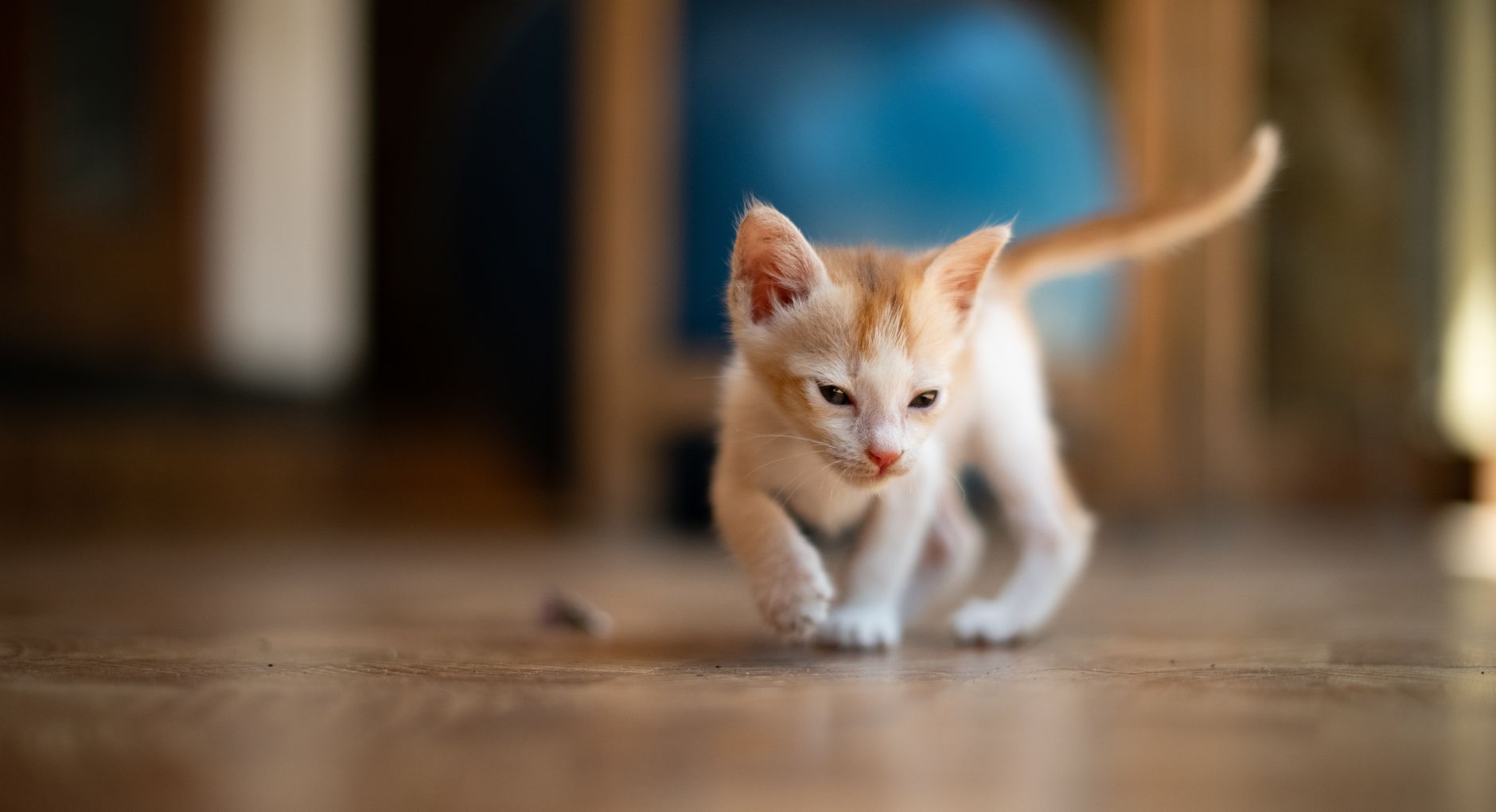
Your dog gets a diluted floor. Your cat gets a diluted floor, and then she licks all four paws clean.
Short answer: A diluted, fully dry Fabuloso floor is low-risk for a healthy cat. Real hazards: undiluted concentrate, damp scented residue she grooms off her paws, and heavy fragrance in a closed room. Cats clear phenols and many essential oils poorly. Prefer a fragrance-free plant-based Ecolosophy concentrate — small-batch, made with care — and keep cats off until dry.
TL;DR — Dilute, ventilate, keep cats off until fully dry. Fragrance-free beats scented for cat households. Call poison control or your vet if she contacts undiluted concentrate or shows drooling / mouth ulcers.
Key Takeaways
- Cats clear phenols and many essential oils poorly (UDP-glucuronosyltransferase deficiency)
- Grooming damp residue off paws is the exposure route most people miss
- Standard Fabuloso cleans; antibacterial Complete is a separate EPA-registered product (lactic acid)
- Prefer fragrance-free concentrate — small-batch, made with care — and wait for full dry
She waits until the mop has passed. Then she steps out — one paw, then another — across the damp, lavender-smelling floor, sits down in the middle of it, and starts washing her feet.
That’s the moment. Not the mopping. The grooming.
Let me explain it the way I’d explain it to a friend with a cat on her counter, not the way a brand would.
What is the short answer?
- Dried, diluted, fragrance-free floor: low risk.
- Damp floor she walks on and grooms: this is the exposure everyone misses.
- Undiluted concentrate: a real hazard. Lock it up.
- “Antibacterial” Fabuloso Complete: an EPA-registered antimicrobial whose accepted label lists L(+)-lactic acid 2.00% as the active ingredient — not a quat. Many other antibacterial cleaners do use benzalkonium chloride, which is the ingredient with the most feline case data behind it; check the label of whatever you actually own.
- Heavy fragrance in a closed room: an irritant, and a reason to open a window.
If you want to stop reading and just fix it: mop with a fragrance-free cleaner, let the floor dry all the way before she’s allowed back, and never leave concentrate where a curious animal can reach it. Our Unscented Oasis concentrate is the one I hand people with cats — and I’ll tell you below why I do not hand them our scented one. If you’d rather start with the bottles included, the Unscented Oasis kit has the concentrate plus three refillable sprayers.
Why are cats not small dogs?
This is the part almost every “pet-safe cleaner” article skips, and it’s the only part that actually matters.
Most mammals clear a whole family of chemicals — phenols and phenolic compounds — through a liver process called glucuronidation. An enzyme, UDP-glucuronosyltransferase, attaches a sugar acid to the compound so the body can flush it out.
Cats are deficient in that enzyme.
The Merck Veterinary Manual is direct about the consequence: cats are especially sensitive to essential oils precisely because they cannot glucuronidate these compounds efficiently, and those oils are readily absorbed through the gut, the skin, the lungs and the mucous membranes. There is no “she only got it on her fur” loophole. Fur leads to mouth.
So when a dog and a cat walk across the same floor, they are not having the same experience. The dog has a working disposal pathway and doesn’t groom much. The cat has a partial pathway and grooms obsessively.
That’s the whole distinction, and it changes every recommendation downstream.
What is the grooming exposure loop?
Think about how a cleaning product is supposed to work. You dilute it, you spread it, it lifts soil, you let it dry, and the surface is clean.
Now add a cat.
She crosses the floor while it’s still damp. The residue transfers to her paw pads and the fur between her toes. She settles somewhere and does what cats do roughly a dozen times a day — she licks each paw clean, thoroughly, deliberately.
Whatever was on the floor is now in her mouth.
This is why “it’s fine once it’s dry” is genuinely good advice rather than a brush-off. Drying time is the entire safety margin. A floor that has fully dried has far less transferable residue than one that’s still tacky. The failure mode isn’t the chemical being unusually dangerous — it’s the cat getting a dose the product design never accounted for.
Micro-lesson: with cats, the safety question is never just “what’s in it.” It’s “what’s still on the floor when she walks on it, and where does that go next.”
What’s actually in Fabuloso
Standard Fabuloso is a water-based multi-purpose cleaner: surfactants that lift soil, a preservative system to keep the water from growing bacteria, colorant, and a heavy dose of fragrance.
Two of those deserve attention in a cat household.
Fragrance. On the label it is one word. Under U.S. rules, that one word does a lot of work: the FDA notes that fragrance ingredients are the ones most likely to be granted trade-secret status, which is why they can be disclosed collectively rather than individually. So “fragrance” is not an ingredient. It’s a category you aren’t shown. For an animal that clears aromatic compounds poorly, being unable to read the list is itself the problem.
The preservative system. In February 2023 the CPSC announced a recall of roughly 4.9 million U.S. bottles of Fabuloso over possible Pseudomonas contamination. CPSC lists no reported injuries, and the recall was limited to specific lot codes — a defined manufacturing window, not proof that all Fabuloso is contaminated. CPSC’s notice states the hazard as possible Pseudomonas contamination and lists no reported injuries; we are not going to assert a cause beyond what the agency published. The general point still stands: every water-based scented cleaner depends on a preservative system to stay stable. That’s the bind the format is in.
Is antibacterial Fabuloso a different product?
Here’s the distinction that sends people in circles, and it’s worth getting exactly right.
Standard Fabuloso does not disinfect. It cleans. It carries no EPA registration number because it makes no antimicrobial claim.
Fabuloso Complete antibacterial products are separately EPA-registered. You can read the accepted label for the Sparkling Citrus version, EPA Reg. No. 4582-74, on the EPA’s own site. The active ingredient that earns that registration is L(+)-lactic acid at 2.00% — not a quaternary ammonium compound. We want to be exact about that, because the quat concern below is real for the category and simply is not the story with this particular product.
The point that does hold: “antibacterial” reads as safer to a shopper and means contains a registered pesticide to a chemist. If you buy an antibacterial cleaner for a cat household, read the “Active Ingredient” line — if it names benzalkonium chloride or another quat, the feline case data below applies to it.
What does the feline case data say?
I want to give you real numbers rather than vague worry, because vague worry makes people either panic or shrug.
This section is about benzalkonium chloride as an ingredient class, not about Fabuloso — as above, the EPA-registered Fabuloso Complete label names lactic acid, not a quat. It matters because plenty of other “antibacterial” cleaners you might reach for instead are quat-based.
Nicola Bates and Nicola Edwards reviewed 245 cases of benzalkonium chloride exposure in cats reported to the UK’s Veterinary Poisons Information Service. It remains the largest published feline series on this ingredient. What they found:
- Most common signs: hypersalivation — drooling — in 53.9% of cats; tongue ulceration in 40.4%; raised body temperature in 40.4%; mouth ulceration in 22.9%.
- Timing: mean onset 6.4 hours, with a range from five minutes to 48 hours.
- Where it came from: household antibacterial cleaners were the largest single source at 43.6%, followed by household disinfectants at 22.3% and patio cleaners at 17.5%.
- Outcome: 1.2% of the 245 cats died or were euthanised. The overwhelming majority recovered with washing and supportive care.
Read those two ends together. The outcome is reassuring — this is usually treatable, and the great majority of cats were fine. The timing is the part to actually act on. A mean onset of 6.4 hours means a cat can walk across a floor in the evening, seem completely normal, and be drooling and refusing food the next morning. If you are watching for an immediate reaction as your safety check, you are watching the wrong window.
A 2024 case report in Acta Veterinaria Scandinavica documents the severe end of that spectrum: a four-month-old kitten stepped in a spilled undiluted 5% benzalkonium chloride mould remover and ingested it while grooming, needing ten days in hospital before making a full recovery. That is a concentrated-product spill, not a mopped floor, and worth knowing exists — while remembering the 245-case series is the better guide to what’s typical.
Your dog gets a diluted floor. Your cat gets a diluted floor, and then she licks all four paws clean.
What about Ecolosophy’s own scented cleaner?
I’d rather lose a sale than be inconsistent, so let me say this plainly.
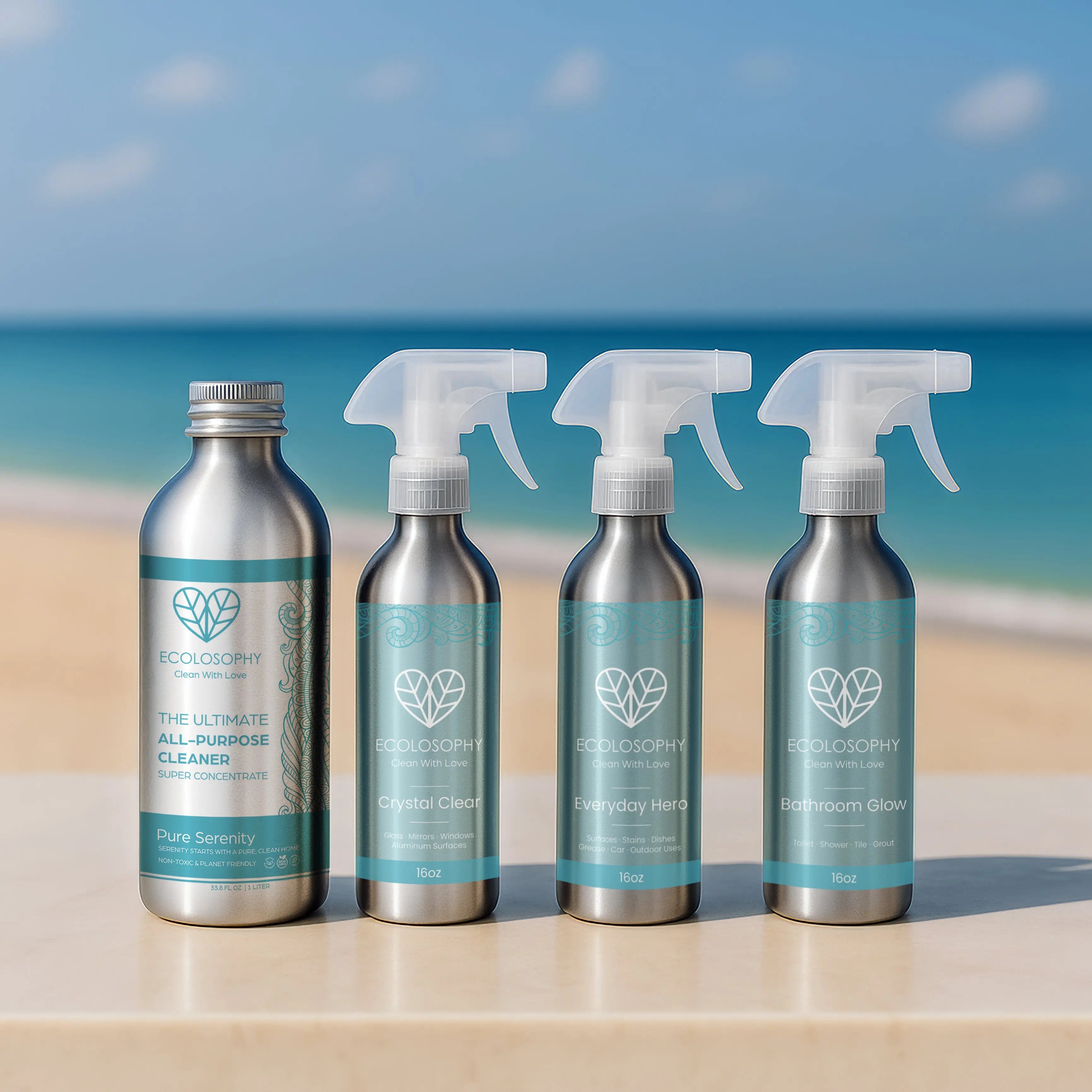
Everything above about phenols and essential oils applies to essential oils in any product, including ours. Our Pure Serenity concentrate is scented with eucalyptus and rosemary essential oils. It’s a genuinely good cleaner and plenty of people love it — in a household with dogs and no cats, it’s a fine choice.
In a cat household, it is not the one I’d pick, and I’m not going to pretend otherwise.
The version I’d hand you is Unscented Oasis — the same plant-based concentrate with no added fragrance and no essential oils at all. That’s the point of making a fragrance-free line: so the answer to “what about my cat” doesn’t require a caveat.
If a brand tells you every one of their products is perfect for every animal in your house, they are selling, not advising.
What should a cat-household mopping routine look like?
None of this requires a special product category. It requires a slightly different order of operations.
- Choose fragrance-free. Not “lightly scented,” not “natural fragrance.” No added fragrance and no essential oils.
- Dilute correctly. A concentrate exists to be diluted. More product does not clean better — it leaves more residue for her to groom off.
- Shut her out of the room while it’s wet. This is the single highest-value step and it costs nothing.
- Let it dry completely. All the way. Not “mostly dry.” Drying time is the safety margin.
- Rinse with plain water on hard floors if you’ve used anything scented, or if she’s a heavy groomer.
- Store concentrate behind a latch. Cats open cabinets. This is not theoretical.
- Ventilate. The American Lung Association is clear that cleaning-product VOCs and fragrances can irritate airways. A room that still smells strongly of cleaner an hour later is telling you about your air, not your cleanliness. Open a window.
When should you call someone?
Call your veterinarian or the ASPCA Animal Poison Control Center — don’t wait and watch — if your cat:
- swallowed, or walked through, undiluted concentrate
- is drooling, foaming, or pawing at her mouth
- has visible ulcers or redness on the tongue or gums
- is vomiting, unsteady, or refusing food
- has product on her coat (wash it off with plain water and mild soap first, so she cannot groom it)
Remember the 6.4-hour average onset. “She seemed fine right after” is not the reassurance it feels like.
What is the honest bottom line?
Fabuloso is not a poison sitting in your cupboard, and I’m not going to tell you it is. Used diluted, on a floor that dries fully, in a ventilated room, it is not likely to hurt a healthy cat.
But cats live at floor level and eat everything they touch. They also happen to be missing the enzyme that would let them shrug off exactly the kind of chemistry that makes a scented cleaner smell like a scented cleaner. That combination means the margin for error is thinner for them than for the dog asleep on the couch — and much thinner than the label implies.
You don’t need to be afraid of your floor. You need a cleaner you can read the whole label of, and the discipline to let it dry.
Where to start
If you have cats, start fragrance-free. Unscented Oasis concentrate is $49.95, makes 100+ spray bottles at under $0.49 each, is fully plant-based, and lists every ingredient — no “fragrance” doing quiet work on the label, no essential oils for her liver to deal with. If you’d like the refillable sprayers included, take the Unscented Oasis kit.
And if your household is dogs-only, Pure Serenity with its eucalyptus and rosemary is a lovely thing to mop with. Just not around cats. We’d rather tell you that than sell you the wrong bottle.
Then keep reading: is Fabuloso safe for babies and pets? covers what changes for a crawling baby, where the answers come easier, is Fabuloso toxic? is the full ingredient breakdown, and the cat-safe floor cleaner guide gets into surfaces, dilution and routine. If you use scented cleaners anywhere in the house, essential oils in floor cleaners and pets is the next one to read.
Sources cited
- Merck Veterinary Manual — Toxicoses From Essential Oils in Animals — Cats are particularly sensitive to essential oils because they are deficient in glucuronyl transferase; essential oils are readily absorbed via the GI tract, skin, lungs and mucous membranes
- Bates N, Edwards N — Benzalkonium chloride exposure in cats: a retrospective analysis of 245 cases reported to the Veterinary Poisons Information Service (VPIS) — In 245 feline benzalkonium chloride exposures the commonest signs were hypersalivation (53.9%), tongue ulceration (40.4%), hyperthermia (40.4%) and oral ulceration (22.9%); mean onset 6.4 hours, range 5 minutes to 48 hours; household antibacterial cleaners were 43.6% of source products; 1.2% died or were euthanised
- Acta Veterinaria Scandinavica — A case of severe benzalkonium chloride intoxication in a cat (2024) — 4-month-old kitten stepped in a spilled 5% benzalkonium chloride mould remover and ingested it while grooming; severe oral ulceration and chemical burns, 10 days hospitalised, full recovery at three weeks
- U.S. EPA — Fabuloso Complete Antibacterial Multi-Purpose Cleaner, Sparkling Citrus (EPA Reg. No. 4582-74) accepted label — Accepted label dated 6 Oct 2022 lists ACTIVE INGREDIENT: L(+)-lactic acid 2.00%, inert ingredients 98.00%; the antibacterial Fabuloso Complete product is separately EPA-registered as an antimicrobial, while standard Fabuloso multi-purpose cleaner carries no EPA registration number
- ASPCA Animal Poison Control Center — Household Hazards — Household cleaners are a recognised pet poisoning hazard; ingestion of concentrated product warrants immediate poison control contact
- U.S. CPSC — Colgate-Palmolive Recalls Fabuloso Multi-Purpose Cleaners (February 2023) — CPSC recall 23-115, 8 Feb 2023: about 4.9 million U.S. units (plus ~56,000 in Canada) recalled because product could contain Pseudomonas species; injuries reported: none
- U.S. FDA — "Trade Secret" Ingredients (cosmetics labeling) — Fragrance ingredients may be listed simply as 'fragrance' because they are the ingredients most likely to be granted trade secret status
- American Lung Association — Cleaning Supplies and Household Chemicals — Cleaning products release VOCs and fragrance compounds that can irritate airways