
What's Actually in All-Purpose Cleaner?
Flip your spray bottle around. Most of what's inside isn't on the label — and the words that are printed are designed to tell you as little as possible. Here's the honest breakdown of every ingredient class hiding in a conventional all-purpose cleaner, what each one actually does, and which ones deserve a second look before you spray them near your kid.
Short answer: Most all-purpose cleaners are water plus surfactants, with optional solvents, fragrance, dyes, and preservatives. The mystery is usually the fragrance blend and any solvent you cannot name. Prefer a plant-based, fragrance-free Ecolosophy concentrate with full disclosure — small-batch, made with care.
The big picture: an all-purpose cleaner is mostly water
Here's the first thing nobody tells you. Pick up a typical ready-to-use all-purpose spray and the largest single ingredient — by a wide margin — is water. Often 90% or more. You are paying full price, and shipping a heavy plastic bottle across the country, for a product that is mostly the thing already coming out of your tap.
Everything that actually does something is packed into the remaining sliver: the surfactants, solvents, fragrance, preservatives, and dyes. That's it. Five classes of ingredients riding inside a bottle of water. Once you understand those five, you can read almost any cleaning label in the world — and you can see why the concentrate format we'll talk about at the end changes the math entirely.
The micro-lesson worth holding onto: when a formula is mostly water, it becomes a perfect home for bacteria and mold. That single fact is the reason conventional cleaners need aggressive preservatives in the first place. Less water means less of that problem.
Surfactants: the ingredient that actually cleans
If an all-purpose cleaner has a hero ingredient, it's the surfactant. The word is short for "surface-active agent," and these molecules are the reason cleaning works at all. Each surfactant molecule has a water-loving end and an oil-loving end. The oil-loving end grabs grease and grime; the water-loving end lets the whole mess rinse away with water. That's the whole trick — surfactants let water do something water can't do on its own: lift oil.
You'll see surfactants on labels under names like:
- Sodium lauryl sulfate (SLS) and sodium laureth sulfate (SLES) — common, effective, and known skin and eye irritants for some people, especially at higher concentrations.
- Alkyl polyglucosides (decyl glucoside, lauryl glucoside, coco glucoside) — gentler, plant-derived sugar-based surfactants, generally considered mild.
- Nonylphenol ethoxylates (NPEs) — older, effective surfactants that have drawn environmental and endocrine-disruption scrutiny and are restricted in parts of Europe; worth avoiding.
- Quaternary ammonium compounds ("quats") — a special class of cationic surfactant that doubles as a disinfectant, and carries its own separate concerns (more below).
The honest truth: not all surfactants are villains. The plant-derived, sugar-based ones are some of the safest cleaning agents we have. The concern isn't "surfactants" as a category — it's which surfactant, at what concentration, and whether the brand will even tell you. A cleaner can list "surfactants" generically and never name the actual molecule. That ambiguity is the problem.
Solvents: dissolving the grime surfactants can't lift
Solvents are the second workhorse. Where surfactants lift greasy dirt, solvents dissolve things — dried-on residue, marker, sticky films, soap scum. The most common solvents in all-purpose cleaners are glycol ethers and simple alcohols.
- 2-Butoxyethanol (also listed as butyl cellosolve or ethylene glycol monobutyl ether) — a very common, very effective glycol-ether solvent. It's also a known irritant that can be absorbed through skin and has been linked to blood and reproductive effects at high exposures. It frequently appears in "heavy-duty" and glass-and-multi-surface cleaners.
- Glycol ethers more broadly — a family of solvents, some of which (the "E-series") have raised reproductive-toxicity concerns and face restrictions.
- Ethanol and isopropyl alcohol — fast-evaporating solvents used for streak-free finishes; generally lower-concern but flammable and drying.
- d-Limonene — a citrus-derived solvent (literally orange-peel extract). Effective and plant-based, though it can be a skin sensitizer for some and oxidizes over time.
The micro-lesson: "solvent" isn't automatically scary — alcohol and citrus extract are solvents too. But glycol ethers like 2-butoxyethanol are exactly the kind of ingredient that can be present in meaningful amounts, do real work, and still get buried under a vague "cleaning agents" line on the label.
Fragrance: one word, up to 100+ hidden chemicals
This is the class where transparency completely breaks down. "Fragrance" (or "parfum") is a single word on a label that can legally stand in for a blend of dozens — sometimes more than a hundred — individual chemicals. In the United States, no law requires a cleaning-product maker to disclose the individual components inside "fragrance." The blend is protected as a trade secret.
So a bottle can say "fragrance" and tell you essentially nothing: not the synthetic musks, not the solvents used as carriers, and not the phthalates frequently added to make a scent last longer. Phthalates are a particular concern here because several act as endocrine disruptors — chemicals that can interfere with the body's hormones at low doses — and they routinely hide under "fragrance" without ever appearing by name on the label.
Fragrance is also one of the most common triggers of allergic and irritant reactions in consumer products, and airborne fragrance from aerosolized sprays is a recognized asthma trigger. The deeper problem isn't that the chemicals are listed and alarming — it's that they're legally allowed to be hidden. You can read every word on the bottle and still have no idea what you just sprayed near your child's face.
One more trap: "unscented" and "fragrance-free" are not the same. "Fragrance-free" means no fragrance materials were added. "Unscented" can mean a masking fragrance was added to cover up the smell of other ingredients — so an "unscented" product can still contain fragrance chemicals.
Preservatives: keeping a water-based formula from spoiling
Remember that an all-purpose cleaner is mostly water — and water is a buffet for bacteria and mold. To keep the product from spoiling on the shelf, conventional formulas rely on preservatives. The trouble is that some of the most effective preservatives are also among the most sensitizing ingredients in the whole bottle.
- Isothiazolinones — methylisothiazolinone (MIT) and methylchloroisothiazolinone (MCI) are potent preservatives and well-documented skin sensitizers. MIT was named "Contact Allergen of the Year" in 2013 by the American Contact Dermatitis Society after a sharp rise in allergic reactions, and the EU restricted it in leave-on cosmetics in response.
- Formaldehyde releasers — ingredients like DMDM hydantoin and quaternium-15 slowly release formaldehyde, a known human carcinogen by inhalation, to keep the product preserved over time.
- Parabens — preservatives with weak estrogenic activity that have drawn endocrine-disruption scrutiny.
Gentler systems do exist — multifunctional ingredients like caprylhydroxamic acid and caprylyl glycol are lower-sensitization alternatives. But the most elegant fix is structural: use less water. A concentrate is mostly active cleaning agents rather than water, so it offers far less of the microbial environment that demands aggressive preservation in the first place — and you dilute it fresh at home when you're ready to use it.
Dyes: pure cosmetics that clean nothing
This is the easiest class to understand, because it does absolutely nothing to clean your home. That blue, green, or amber tint? It's there so the product looks like it works — so "clean" has a color. Dyes contribute zero cleaning power. They are 100% cosmetic.
And they aren't free of concern. Synthetic colorants (listed as "FD&C" or "D&C" dyes, or by names like "Acid Blue" and "CI" numbers) can be skin and eye irritants, some are derived from petroleum, and a handful have faced scrutiny over contaminant impurities. The kicker: you're accepting that risk — however small — in exchange for a prettier liquid you're about to wipe onto your counter and rinse away.
The micro-lesson: if an ingredient adds risk and adds nothing useful, its presence tells you something about the brand's priorities. A genuinely transparent cleaner has no reason to add color. Ours doesn't.
Quats: the disinfectant surfactant with its own baggage
Some all-purpose cleaners — especially the "antibacterial," "disinfecting," or "kills 99.9% of germs" kind — contain quaternary ammonium compounds, or "quats": benzalkonium chloride (BAC), didecyldimethylammonium chloride (DDAC), and alkyl dimethyl benzyl ammonium chloride (ADBAC). They're cationic surfactants that kill microbes by disrupting cell membranes, and they cling to surfaces, which is exactly why they linger.
The peer-reviewed record on quats is concerning, especially with chronic exposure: they're documented respiratory sensitizers linked to work-related asthma, recognized skin irritants and allergens, and animal studies (Melin et al.) have reported reduced fertility and developmental effects in mice exposed to common quat mixtures. They sit in a regulatory blind spot too — many were "grandfathered in" under the 1976 Toxic Substances Control Act and are registered by the EPA as antimicrobial pesticides (confirming they kill germs) rather than health-tested for the chronic, low-dose exposure of spraying them in your kitchen every day.
The honest takeaway: most of what families do daily is cleaning, not disinfecting. A good plant-based surfactant removes dirt, grime & residue without quats. True disinfection has its place — during illness, on raw-meat surfaces — but it doesn't need to be your default for wiping a high chair. See how to disinfect naturally for exactly where that line falls, and whether a quat-heavy spray like Lysol disinfectant is the right tool for a given job.
Want the room-by-room version of this?
The free 7-Day Home Detox walks you through one room a day — what to toss, what to keep, what actually matters.
Every ingredient class, side by side
| Ingredient class | What it does | Common label names | Concern level |
|---|---|---|---|
| Surfactants | Lift dirt and grease so water can rinse them away — the actual cleaning | SLS, SLES, alkyl polyglucosides, decyl/lauryl glucoside, NPEs | Varies — plant-sugar types are mild; NPEs and harsh sulfates raise concern |
| Solvents | Dissolve dried-on grime, films, and residue | 2-butoxyethanol, glycol ethers, ethanol, d-limonene | Varies — alcohol/citrus are lower; 2-butoxyethanol and some glycol ethers raise concern |
| Fragrance | Adds scent (and masks chemical smells) | "Fragrance," "parfum" | High — undisclosed blend, common allergen/asthma trigger, can hide phthalates |
| Preservatives | Stop microbes from growing in the water-based formula | MIT, MCI, DMDM hydantoin, quaternium-15, parabens | High for isothiazolinones & formaldehyde releasers; lower for caprylyl glycol |
| Dyes | Color only — no cleaning function at all | FD&C / D&C colors, CI numbers, "Acid Blue" | Moderate — pure cosmetic risk with zero benefit |
| Quats (optional) | Disinfect by killing microbes (in "antibacterial" cleaners) | Benzalkonium chloride, ADBAC, DDAC | Concerning with chronic exposure — asthma, dermatitis, under-regulated |
Read that table once and you can decode almost any all-purpose cleaner. The pattern that matters: the two classes that actually clean (surfactants, solvents) can be made safe and plant-derived — while the three that raise the most concern (fragrance, certain preservatives, dyes) are often the most hidden and, in the case of dyes, completely unnecessary.
How to read a label and spot the concerning classes
You don't need a chemistry degree. You need a short list of red flags and one green flag.
- Red flag — "Fragrance" or "Parfum" with nothing disclosed behind it. If you can't see what's in the scent, assume the worst.
- Red flag — MIT, MCI, methylisothiazolinone, DMDM hydantoin, quaternium-15. Sensitizing preservatives and formaldehyde releasers.
- Red flag — any colorant (FD&C, D&C, CI numbers). Risk with zero cleaning benefit.
- Red flag — 2-butoxyethanol or unnamed "glycol ethers." A solvent worth avoiding for daily use.
- Red flag — benzalkonium chloride / "quaternary ammonium" if you're buying it as an everyday cleaner rather than an occasional disinfectant.
- Green flag — a fully disclosed ingredient list that names every component, plant-based surfactants you can pronounce, no synthetic fragrance, and no dyes. Disclosure itself is the strongest signal of a brand worth trusting.
The single most useful habit: trust what a brand is willing to show you, not the adjective on the front of the bottle. "Natural," "non-toxic," and "green" have no legal definition on a household cleaner. The disclosed back-of-bottle list is the only thing that can't lie to you.
Radical transparency: the Ecolosophy approach
Here's why this got personal for us. Our founder, Italo Campilii, has spent 23+ years living with an inflammatory bowel disease. This is his personal account, not a medical claim -- no cleaning product treats or resolves it, and he still manages it with his doctors. What did happen is that the ingredient labels on his own household products pushed him to start reading everything. So we built the cleaner we wished existed, and we built it around one rule: show people everything.
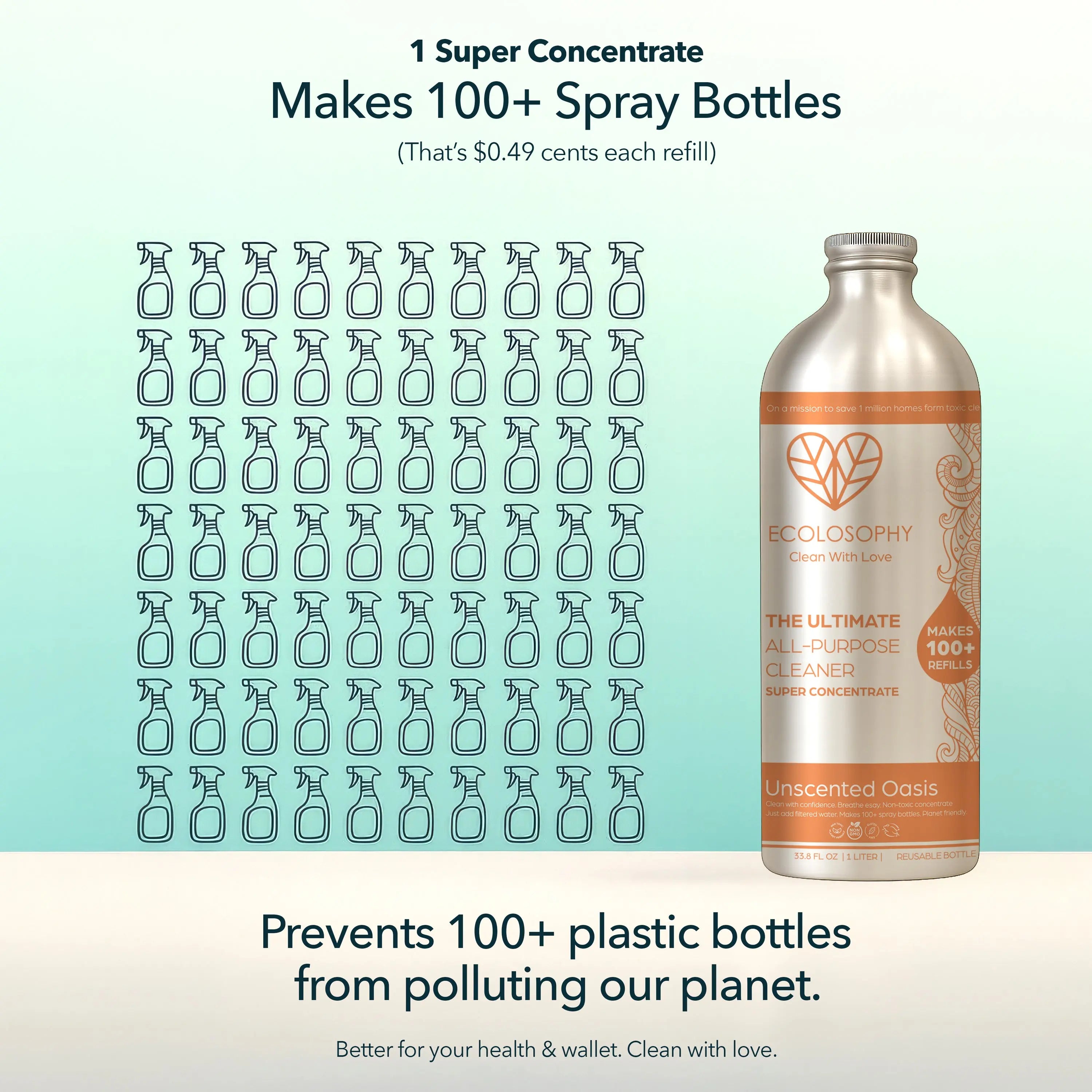
The Ecolosophy All-Purpose Cleaning Concentrate is plant-based, with no artificial scents and. No dyes. No formaldehyde releasers. No fragrance loophole. And because it's a concentrate — just add water — it sidesteps the whole "mostly water needs aggressive preservatives" problem at the root. One bottle makes 100+ ready-to-use spray bottles, replaces dozens of single-purpose products under your sink, and saves roughly 42.75 lbs of CO2 per bottle on our own lifecycle estimate. It's family-safe, pet-safe, and made in small batches with care.
We're not an EPA-registered disinfectant, and we won't pretend to be one — we clean and remove dirt, grime & residue. That honesty is the whole point. When the safest choice is a fully disclosed plant-based formula and you've got a baby on the floor, it's a low-regret decision.
Frequently asked questions
What is the main ingredient in all-purpose cleaner?
Water — usually 90% or more of a ready-to-use spray. Everything that actually cleans (surfactants and solvents) plus the additives (fragrance, preservatives, dyes) is packed into the remaining fraction. That's a big reason concentrates make sense: you stop paying to ship a heavy bottle of water and add your own at home.
Which ingredient in all-purpose cleaner is the most concerning?
It's a tie between synthetic "fragrance" and sensitizing preservatives. Fragrance is concerning because it's a single undisclosed word that can legally hide dozens of chemicals, including phthalates. Preservatives like methylisothiazolinone (a former "Contact Allergen of the Year") and formaldehyde releasers are concerning because they're among the most sensitizing ingredients in the bottle. Dyes are also pure risk with zero benefit.
Do all-purpose cleaners actually need preservatives?
Conventional water-based ones do, because water grows microbes. The smarter fix is to use less water. A concentrate is mostly active cleaning agents, so it needs far less preservation, and you dilute it fresh when you use it. That's a structural advantage, not a marketing claim.
Are the dyes in cleaners dangerous?
Dyes contribute nothing to cleaning — they're purely cosmetic — and some synthetic colorants can be skin or eye irritants or carry contaminant concerns. The risk is generally modest, but you're accepting it for zero benefit. A transparent cleaner has no reason to add color, which is why Ecolosophy doesn't.
Is a "natural" or "non-toxic" label enough to trust?
No. Those words have no legal definition on a household cleaner, so they aren't proof of anything. Trust the disclosed ingredient list and what the brand intentionally leaves out — plant-based, fully disclosed, no synthetic fragrance, no dyes, no harsh preservatives — not the front-label adjective.
How is the Ecolosophy concentrate different from a conventional all-purpose cleaner?
It's plant-based, fully disclosed, with no artificial scents, and no dyes — and it's a concentrate, so just add water and one bottle makes 100+ spray bottles. It's family-safe and pet-safe, saves roughly 42.75 lbs of CO2 per bottle, and is made in small batches with care. You can read everything that's in it before you buy.
📕 Free download · 28 pages
Not ready to switch yet? Get the free playbook.
28 pages, every non-toxic swap, room by room. One email, no spam.
We'll email it from [email protected]. Reply anytime — a real person answers.
Sent. Check your inbox.
The download link is heading to your email. If you don't see it in 2 minutes, look in Promotions or hit resend.
Or grab it right now: Download the 28-page PDF →
Couldn't deliver — try again? Retry
← Back to the full Non-Toxic Cleaning Guide
Keep Reading
Unscented Oasis Kit
$69 · 4.97★ · 72 reviews