

What Does "Non-Toxic" Actually Mean?
You bought the bottle with the leaf on it. The one that said "non-toxic." You felt good — safe, even. Here's the part nobody tells you: in the United States, no agency owns that word for cleaning products. A brand can print "non-toxic" on almost anything. So let's stop trusting the word and learn to read the truth underneath it — on any label, ours included.
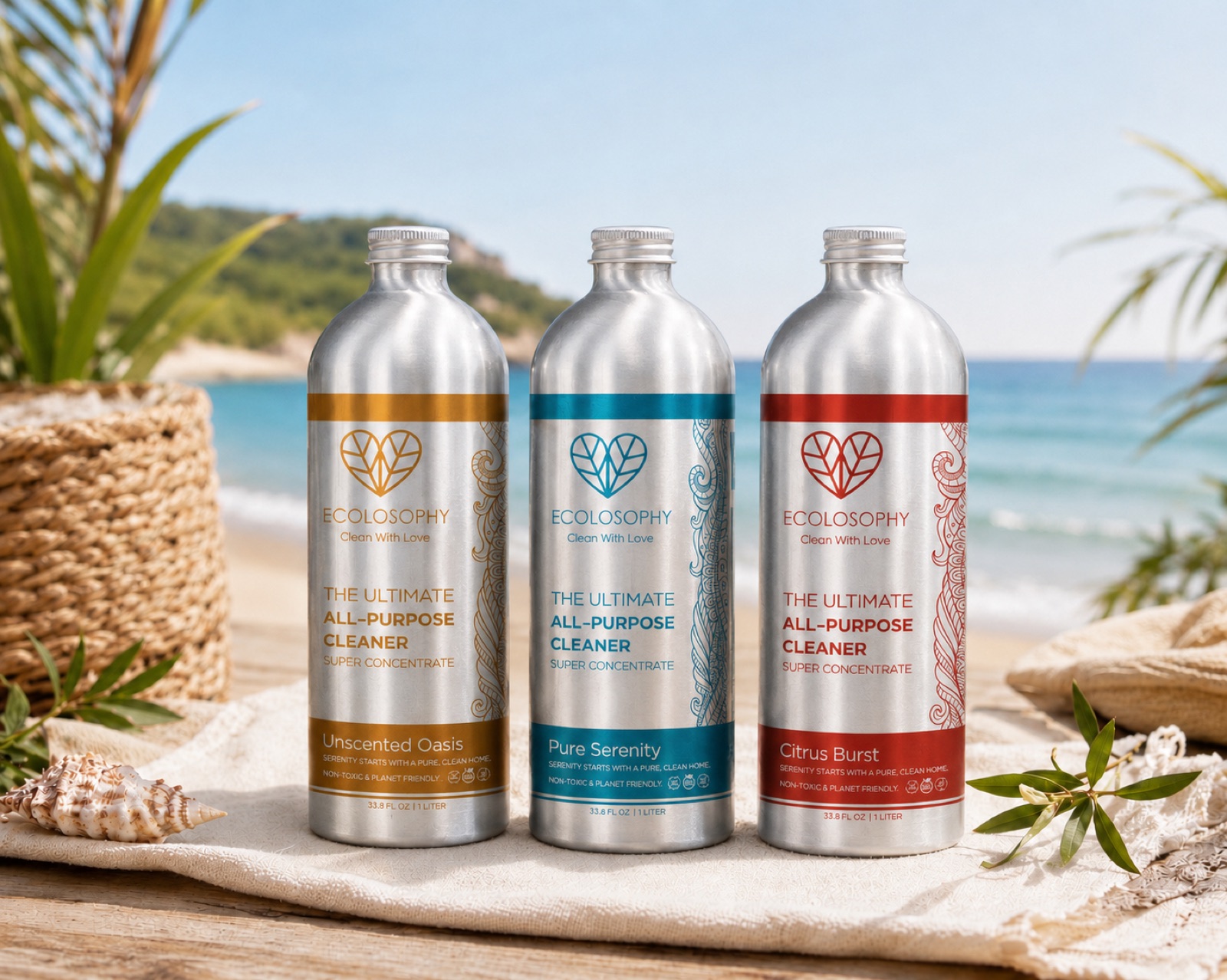
Short answer: "Non-toxic" on a cleaner is not a single legal guarantee — dose, misuse, and undisclosed fragrance still matter. Read the full ingredient list and safety data sheet, not the front badge. Prefer a plant-based, fragrance-free Ecolosophy concentrate you can fully name — small-batch, made with care.
The myth: "non-toxic" is a regulated, meaningful word
Here's the truth most brands won't say out loud: in the U.S., "non-toxic" on a household cleaner is a marketing claim, not a regulated standard. There is no federal definition of "non-toxic" for cleaning products the way there is for, say, "organic" food (which the USDA controls) or "Energy Star" appliances. No agency requires a brand to prove anything before printing it.
The Federal Trade Commission's Green Guides do warn companies not to make deceptive environmental marketing claims, and the FTC can act after the fact if a claim is misleading. But that's enforcement against deception — it is not a pre-approval standard. Nobody checks the bottle before it hits the shelf. The same goes for cousin words you see everywhere: "natural," "green," "eco," "gentle," "plant-powered," "clean." Most of them mean exactly as much as the brand wants them to mean, which is often nothing.
So when you pick up a spray that says "non-toxic and safe for your family," you are reading a sentence a copywriter wrote — not a result a lab certified. That's not a conspiracy. It's just how the rules are written, or rather, not written.
The micro-lesson: a claim you can't verify is a feeling, not a fact. And your kid crawling on the kitchen floor deserves a fact.
Why the word is unregulated (the gap in plain English)
To understand why "non-toxic" is so slippery, you have to know how cleaning products are regulated in the first place — because the answer is "barely."
- No mandatory full ingredient list. Unlike food and cosmetics, household cleaners are not required by federal law to print a complete ingredient list on the package. Some states (notably California, under the Cleaning Product Right to Know Act of 2017, and New York) now require online ingredient disclosure — a real step forward — but a federal, on-pack, every-ingredient mandate does not exist.
- "Fragrance" is a legal black box. Even where disclosure rules apply, "fragrance" or "parfum" can legally stand in for a blend of dozens to 100+ individual chemicals, protected as a trade secret. A product can be 100% transparent about everything except the one word hiding the most.
- Old chemicals were grandfathered in. When the Toxic Substances Control Act passed in 1976, tens of thousands of chemicals already in commerce were presumed safe without new health testing. "It's been used for decades" is not the same as "it's been proven safe."
Put those together and you get the gap: a brand can legally hide ingredients, hide fragrance components, use grandfathered chemicals, and then describe the whole thing as "non-toxic." Nothing in that sentence is illegal. That's the problem.
What "toxic" even means — dose, exposure, and the part that gets ignored
Let's be fair to the other side, because honesty cuts both ways. "The dose makes the poison" is a real toxicology principle. Water is toxic in enormous quantities; table salt can kill you at a high enough dose. So technically, almost nothing is "non-toxic" in an absolute sense — and a brand can lean on that to say "everything's toxic at some dose, so the word is meaningless anyway."
But that argument quietly skips the two things that actually matter for a family:
- Chronic, repeated, real-world exposure. You don't spray your counter once. You spray it every day, for years, in a closed kitchen, often as an aerosol you then breathe. Safety testing built around acute, single-use, "as directed" exposure doesn't capture that.
- Some hazards are not simple dose-response. That is a real argument in toxicology, but it is contested and we could not source it to a primary agency statement we had read in full, so we are not going to state it as settled. The claim we can stand behind is narrower: "only a tiny percentage" tells you nothing on its own, because percentage is not exposure — how often, how it is applied, and whether it is left on the surface all matter more.
So "non-toxic" isn't meaningless because everything is toxic. It's meaningless because the word makes a promise about your daily, cumulative, whole-family exposure that no one tested and no one verified.
How to actually evaluate a cleaner's safety (the 4-question test)
Stop reading the front of the bottle. Start asking four questions — our full guide to reading a cleaning product label walks through every one of these in detail. Any cleaner — drugstore brand, boutique brand, or ours — either answers them or it doesn't.
- Does it disclose every ingredient, by name? Not "plant-based surfactants." The actual names. If you can't find a full list on the pack or the website, treat the gaps as unknowns, not as nothing.
- Does it disclose what's inside "fragrance" — or skip fragrance entirely? "Fragrance" with no breakdown is the single biggest red flag. The honest options are: name the specific essential oils, or be genuinely fragrance-free.
- Is there independent hazard data on those ingredients? Once you have real names, you can check them against independent sources (EWG's databases, PubChem, the ingredient's safety data sheet). A brand that discloses gives you the power to verify; a brand that hides takes it away.
- Are the safety claims specific and checkable, or vague and emotional? "Free of quats, ammonia, chlorine bleach, formaldehyde releasers, phthalates, and synthetic fragrance" is checkable. "Non-toxic, safe, natural" is a vibe.
The micro-lesson worth tattooing on the inside of the cabinet door: transparency is the safety feature. A brand that tells you everything is giving you the tools to disagree with it. A brand that hides is asking for your trust without earning it.
Want the room-by-room version of this?
The free 7-Day Home Detox walks you through one room a day — what to toss, what to keep, what actually matters.
The "never-ever" list: ingredients worth avoiding regardless of the marketing
Once you can read the real names, here's a practical short list of ingredient classes with documented concerns — the ones worth avoiding even if the front of the bottle insists it's "non-toxic."
- Synthetic "fragrance"/"parfum" — one word standing in for a blend. It is far less hidden than it used to be: under California SB 258, cleaning and air care makers must publish every fragrance ingredient at 0.01% or more online (since 2020) and list fragrance allergens above 0.01% on the label (since 2021). We have removed the "frequent asthma trigger" line because we could not source it at household exposures. The reason to avoid it is exposure you did not choose and do not need — not a proven illness.
- Quats (quaternary ammonium compounds) like benzalkonium chloride — the respiratory evidence is genuinely unsettled. A 2019 methodological review found individual challenge studies document quats-induced asthma but the highest-exposure occupational groups do not consistently show increased asthma incidence, concluding the science “does not allow a proper assessment” of the link (LaKind & Goodman, 2019).
- Isothiazolinone preservatives (methylisothiazolinone/MIT) — named Contact Allergen of the Year for 2013 by the American Contact Dermatitis Society (Castanedo-Tardana & Zug, Dermatitis, 2013). We have dropped the EU leave-on-cosmetics restriction detail, which we could not verify at a primary source.
- Formaldehyde releasers (e.g., DMDM hydantoin, quaternium-15) — formaldehyde itself is listed by IARC as having sufficient evidence in humans for nasopharyngeal cancer and for leukaemia (IARC Monographs, classifications by cancer site). That classification is about formaldehyde as an agent, largely from occupational and industrial exposure; it is not a finding about any consumer product, and we are not claiming one.
- Phthalates — eight are prohibited above 0.1% in children’s toys and child care articles under 16 CFR Part 1307. That is a real, checkable restriction. We have removed the parabens/endocrine-disruption line: we could not fetch a primary source that states it at the strength the sentence implied, and hormone claims are exactly what should not be made without one.
- Ammonia and chlorine bleach — ATSDR states that low-level chlorine exposure causes nose, throat and eye irritation, that higher levels can cause coughing and lung damage, and that bleach must never be mixed with other cleaners because combining it with ammonia-containing products releases dangerous chemicals (ATSDR ToxFAQs: Chlorine).
You don't need a chemistry degree. You need a list and the ability to read it — which only works if the brand actually prints the names.
"Non-toxic" vs. what actually matters — a side-by-side
This is how to translate the marketing language on a shelf into the question you should really be asking.
| What the label says | What it legally guarantees | What actually matters |
|---|---|---|
| "Non-toxic" | Nothing — no legal definition for cleaners | Is every ingredient disclosed and independently checkable? |
| "Natural" / "plant-based" | Nothing standardized; can describe one ingredient or all of them | Are all ingredients named, and are the non-plant ones safe too? |
| "Fragrance" / "scented" | One word on the bottle for a blend — but under California SB 258, cleaning and air care makers must publish every fragrance ingredient at 0.01%+ on their website | Are the specific oils named on the bottle, or do you have to go and look them up? |
| "Family-safe" / "baby-safe" | No required testing behind the phrase | Specific free-of list + full disclosure you can verify |
| "Hypoallergenic" / "gentle" | Not a regulated cleaning-product standard | Absence of documented contact allergens such as MIT (Contact Allergen of the Year 2013) |
| "EWG VERIFIED" / "MADE SAFE" | An actual third-party standard with disclosure requirements | This is a real signal — independent, with rules behind it |
Notice the pattern: the words that feel the most reassuring guarantee the least, and the boring-looking certification marks are the ones with rules behind them.
Certifications that mean something (and ones that don't)
Third-party certifications aren't perfect, but the good ones do something the word "non-toxic" never will: they apply an independent standard and, crucially, require disclosure.
- EWG VERIFIED: products must meet the Environmental Working Group's strictest criteria and fully disclose ingredients, including what's in "fragrance." The disclosure mandate is the whole point.
- MADE SAFE (Nontoxic Certified): a separate program that screens ingredients against a banned-substances list with a supply-chain lens. (It is not the same as EWG VERIFIED — don't conflate the two.)
- Leaping Bunny: certifies no animal testing. Important ethically, but it's a cruelty mark, not a toxicity mark — a product can be Leaping Bunny certified and still contain ingredients you'd want to avoid.
- "Dermatologist tested," "clinically proven," brand-invented seals: often meaningless without details on what was tested, by whom, and against what standard. Treat self-awarded badges as decoration until proven otherwise.
Honesty note: a certification is a helpful shortcut, not a substitute for reading the ingredients. The strongest position is a brand that's both certified and fully transparent — and a brand that's fully transparent even without a badge still beats one with a logo and a hidden formula.
Hold us to it: judging Ecolosophy by the same test
It would be hypocritical to teach you a test and then ask for an exception. So apply the four questions to us — and to any bottle you're currently trusting, like we did in our own Mrs. Meyer's breakdown:
- Full disclosure? Our concentrate is plant-based, and we publish what's in it. We'd rather you read the list and decide than trust a leaf icon.
- Fragrance handled honestly? No artificial scents and. Where there's scent, it comes from named real plant sources — not a "fragrance" black box. Want zero scent? Choose a fragrance-free option.
- Checkable claims? Here's the format: the Pure Serenity Kit, $49.95–$65, one bottle makes 100+ spray bottles (just add water), family-safe, pet-safe, and roughly 42.75 lbs of CO2 saved per bottle on our own lifecycle estimate. Specifics you can hold us to — not adjectives.
- What we don't claim: we are not an EPA-registered disinfectant. We clean and remove dirt, grime, and residue — we don't claim to be a registered germ-killer, and you should be skeptical of any plant-based brand that does.
Every product here is small-batch, made with care. The point isn't "trust Ecolosophy because we said non-toxic." The point is: we built a formula designed to survive the exact test we just handed you.
Why this got personal
"I lived with Crohn's disease for 23+ years, cycling through hospital stays that never seemed to end. What finally clicked wasn't a single diagnosis — it was noticing how much of what surrounded me at home I didn't fully understand. The bottles all said 'safe.' None of them said what was actually inside. So we built the cleaner I wished existed: plant-based, fully disclosed, no synthetic fragrance, small-batch and made with care. 'Non-toxic' isn't a word we use loosely — it's the standard my own body forced me to learn the hard way."
A 5-minute under-the-sink audit you can do tonight
Don't overhaul your house in a panic. Do this instead:
- Pull every bottle out and line them up on the counter. Seeing them all at once is half the lesson.
- Find the ingredient list. No full list on the pack or the brand's website? Mark it "unknown."
- Scan for the never-ever list: "fragrance/parfum" with no breakdown, quats, MIT/MCI, DMDM hydantoin, ammonia, bleach.
- Retire the worst offenders — anything hiding fragrance plus a sensitizer is an easy first goodbye, especially in homes with babies, asthma, eczema, or pregnancy.
- Replace, don't accumulate. One fully disclosed plant-based concentrate can stand in for the dozen single-use sprays you just lined up — and it makes 100+ bottles from one, just add water.
You're not chasing a perfect, fear-free house. You're making low-regret swaps using a standard you can actually verify.
Frequently asked questions
Is "non-toxic" a regulated term for cleaning products?
No. In the U.S., "non-toxic" has no legal definition for household cleaners — no required testing and no pre-market approval. The FTC's Green Guides can act against deceptive claims after the fact, but nobody verifies the word before the bottle ships. Treat "non-toxic" as marketing and judge the product by its disclosed ingredients instead.
If "non-toxic" means nothing, how do I actually tell if a cleaner is safe?
Use four questions: (1) Is every ingredient disclosed by name? (2) Is "fragrance" broken down or skipped entirely? (3) Can you check those ingredients against independent hazard data? (4) Are the safety claims specific and verifiable rather than vague? A brand that passes gives you the tools to verify; a brand that hides is asking for trust it hasn't earned.
Are "natural" and "plant-based" any more trustworthy than "non-toxic"?
Not on their own. Neither word is standardized for cleaners, and a product can be "plant-based" while still including undisclosed fragrance or a harsh preservative. What matters is whether all ingredients are named — plant-derived and not — and whether the non-plant components are safe too. The word is a starting point, not proof.
Do certifications like EWG VERIFIED or MADE SAFE actually mean anything?
Yes, far more than "non-toxic." They apply an independent standard and, importantly, require ingredient disclosure (EWG VERIFIED even requires disclosing what's inside "fragrance"). They're real signals. Self-invented brand badges and vague "dermatologist tested" lines are not, unless the details are spelled out.
Does Ecolosophy claim to be "non-toxic"?
We'd rather earn your trust than borrow an unregulated word. Our All-Purpose Cleaning Concentrate is plant-based with no artificial scents, fully disclosed, family- and pet-safe, and makes 100+ spray bottles from one ($49.95–$65 kit, just add water). We also tell you what we're not: we are not an EPA-registered disinfectant. Hold us to the same four-question test you'd use on anyone.
Is everything technically toxic at some dose, making the word pointless anyway?
"The dose makes the poison" is real, and it is a fair point against alarmism. Our objection to "non-toxic" is not a hidden health claim — it is that the phrase has no legal definition for cleaners, so it guarantees nothing and cannot be checked. Disclosure can be checked. That is the whole argument, and it does not require us to assert any health effect.
📕 Free download · 28 pages
Not ready to switch yet? Get the free playbook.
28 pages, every non-toxic swap, room by room. One email, no spam.
We'll email it from [email protected]. Reply anytime — a real person answers.
Sent. Check your inbox.
The download link is heading to your email. If you don't see it in 2 minutes, look in Promotions or hit resend.
Or grab it right now: Download the 28-page PDF →
Couldn't deliver — try again? Retry
Sources
Every health, safety or regulatory statement on this page traces to one of the following. Where a source does not support a stronger claim, we have not made one.
- California SB 258 — Cleaning Product Right to Know Act of 2017 (full statute text)
- 16 CFR Part 1307 — prohibition of children’s toys and child care articles containing specified phthalates
- LaKind & Goodman, “Methodological evaluation of human research on asthmagenicity and occupational cleaning: a case study of quaternary ammonium compounds,” Allergy Asthma Clin Immunol, 2019
- ATSDR (CDC) — ToxFAQs: Chlorine
- IARC Monographs — List of classifications by cancer site (Volumes 1–141)
- Castanedo-Tardana & Zug, “Methylisothiazolinone” (Contact Allergen of the Year 2013), Dermatitis, 2013
← Back to the full Non-Toxic Cleaning Guide
Keep Reading
Pure Serenity Kit
$69 · 4.97★ · 72 reviews