how to
What Non-Toxic Shower Tub and Tile Cleaner Works? Soap Scum, Acid, Grout
Soap scum and hard-water film are mineral problems, not germ problems — which is why a mild acid beats bleach fumes in a small, closed bathroom. Here's what works, what's safe on your tub, and where non-toxic genuinely falls short.

You are spraying a chlorine aerosol into a windowless, humid box the size of a closet — and then standing in it.
— Elizabeth Uria, PhD
Short answer: Soap scum and hard-water film are mineral deposits — a mild acid dissolves them; bleach does not. Use a mildly acidic plant-based cleaner with dwell time on acrylic, enamel, tile, and glass; never on marble or limestone. Prefer a plant-based Ecolosophy concentrate — small-batch, made with care. It cleans; it is not an EPA-registered disinfectant.
Kneel down next to your tub for a second. Look at the band of cloudy grey film along the waterline, the one that never fully comes off no matter how hard you scrub. Now look at the bottle you’ve been using on it.
Most people are using a chlorine or quaternary bathroom spray on that film. And most people have quietly noticed it doesn’t really work — the tub looks whiter for a day, then the dullness comes back. That isn’t a failure of effort. It’s a chemistry mismatch, and once you see it you can’t unsee it.
Here’s the short version: soap scum and hard-water film are mineral deposits, not germs. Bleach does not dissolve minerals. A mild acid does. That single fact is why a well-built non-toxic shower, tub, and tile cleaner outperforms the harsh stuff on the exact problem people buy the harsh stuff to solve.
The short answer
A non-toxic shower, tub, and tile cleaner works — on almost everything a bathroom actually throws at you — as long as it’s mildly acidic and you give it time to dwell. Soap scum and hard-water film are calcium and magnesium bonded with soap residue, and mineral deposits dissolve in acid, not in chlorine. Citric acid and lactic acid do that job well, without putting a chlorine aerosol into the smallest, most enclosed, least-ventilated room in your house.
Two honest limits, stated up front:
- A non-toxic cleaner does not disinfect. “Disinfectant” is a regulated word in the U.S. — a product has to be registered with the EPA as an antimicrobial pesticide to make germ-kill claims. Ecolosophy’s concentrate is not registered as one. It cleans thoroughly; it does not sanitize. Anyone telling you their plant-based spray kills 99.9% of germs without an EPA registration number on the label is telling you something they cannot back up.
- Acid and natural stone don’t mix. Marble, limestone, and travertine are calcium carbonate. Citric acid, lactic acid, and vinegar all etch them. This is true of “natural” acids exactly as much as industrial ones — nature does not make an exception for your countertop.
Everything else — acrylic and fiberglass tub surrounds, porcelain enamel, glazed ceramic and porcelain tile, glass doors, chrome fixtures, grout — is fair game.
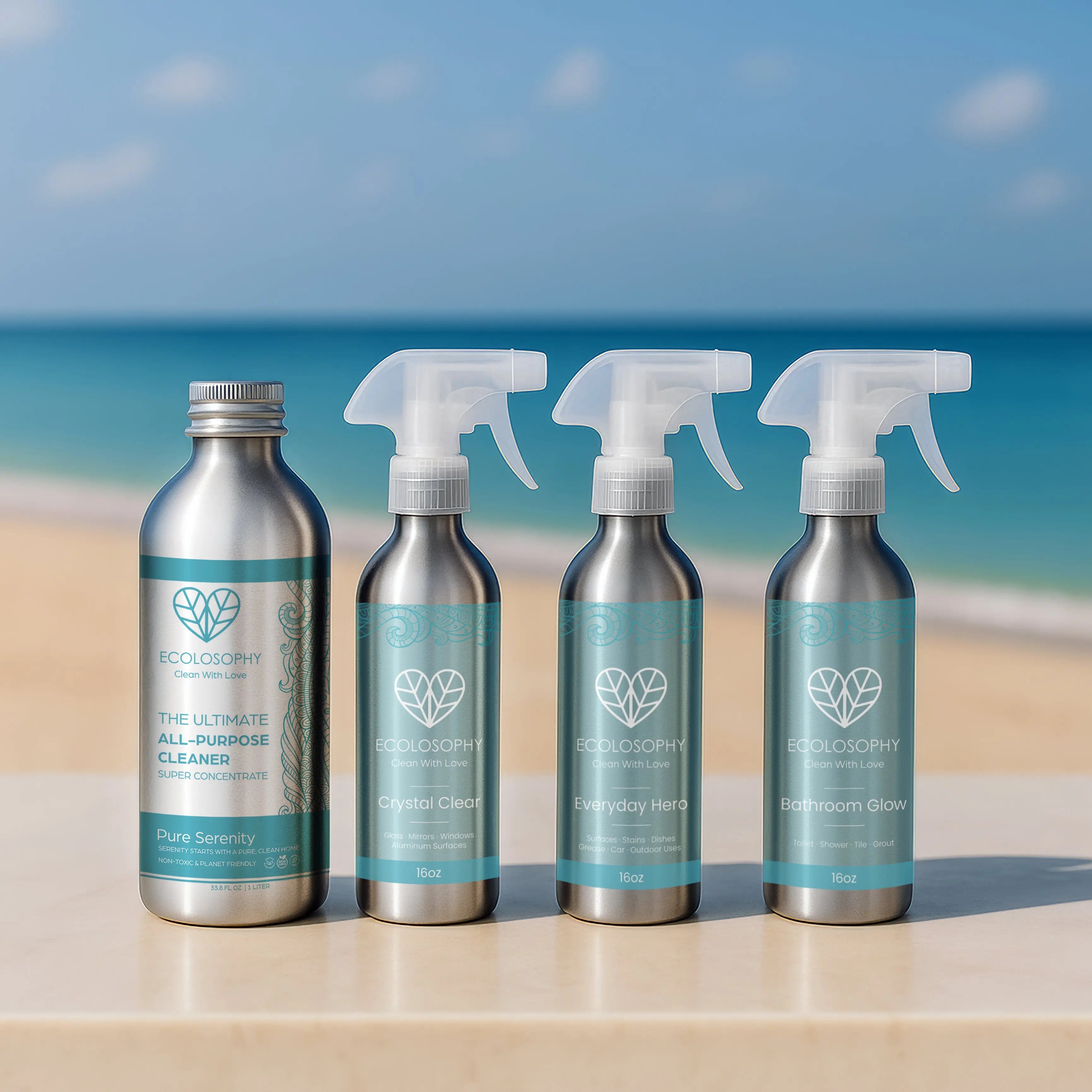
If you want the working setup rather than the whole explanation, it’s the Citrus Burst Super Concentrate Kit: one bottle, three refillable sprayers, and the bathroom dilution is 2 capfuls (14 mL) per 16 oz bottle. The rest of this piece is why.
Why your bathroom is the worst room to use fumes in
I spent years in a lab where the first rule of any volatile chemical was use it under the hood. Then I came home, walked into a five-by-eight windowless bathroom, and sprayed an aerosol at a wall two feet from my face.
Think about the room honestly. It is small. It is usually the least ventilated space in the house — often no window at all, sometimes just an exhaust fan nobody turns on. It is warm and humid, which increases how much of a volatile compound stays airborne. And you’re not spraying and leaving; you’re kneeling in the tub for ten minutes, breathing at the level of the spray.
The American Lung Association is direct about this: cleaning products release volatile organic compounds and fragrance chemicals that can irritate airways, and it lists chlorine bleach, air fresheners, and detergents among them. Its practical advice for the home is refreshingly unglamorous — warm water and soap will often do the trick.
And there is one warning in that guidance that deserves to be in bold on every bathroom cabinet door: never mix bleach, or any bleach-containing product, with any cleaner containing ammonia. That combination produces chloramine gas. It is not a “chemicals are scary” talking point — it is a real, documented household hazard, and the bathroom is where it happens most, because people reach for a chlorine tub spray and a glass cleaner in the same ten minutes without reading either label.
I’m not telling you this to frighten you. I’m telling you because it is the single most useful safety fact in this entire article, and most people learn it the hard way.
Soap scum is a mineral problem — this is the part nobody explains
Here’s the thing that reframes bathroom cleaning permanently.
Hard water means dissolved minerals. The U.S. Geological Survey defines water hardness as the amount of dissolved calcium and magnesium in water, and classifies 121–180 mg/L as calcium carbonate as “hard,” and anything above 180 mg/L as “very hard.” Large parts of the country sit in those bands.
When soap meets those minerals, the fatty acids in the soap bond with the calcium and magnesium and form an insoluble curd. That’s soap scum. It is not dirt sitting on the surface — it is a new, water-insoluble mineral compound that has physically bonded to your tub. Alongside it you get pure mineral scale where water evaporated and left calcium behind, which is the white crust on the shower head and the spotting on the glass door.
Now ask the obvious question: what does chlorine bleach do to a mineral deposit?
Bleach is an oxidizer. It attacks organic color — pigments, stains, biological material. That is genuinely useful for whitening a mildew stain. But calcium and magnesium compounds are not colored organic matter. Bleach makes the deposit look lighter and leaves the deposit exactly where it was. That’s why the film feels like it’s coming back within days: it never left.
Acid, on the other hand, does the one thing that actually matters. It reacts with the calcium and magnesium compounds and breaks them down into forms that rinse away. This is not a natural-living philosophy — it’s the same reason industrial descalers are acidic. The only real choice is which acid you want to breathe in a closed room for ten minutes.
The micro-lesson to take with you: if a bathroom stain is coloured — pink slime, black speckling, orange rings — it’s biological or organic. If it’s cloudy, chalky, white, or dull, it’s mineral. Colour problems need cleaning and drying. Mineral problems need acid and dwell time. Nearly every “this cleaner doesn’t work” complaint is somebody applying the wrong category of product to the problem in front of them.
What’s actually in a conventional tub-and-tile spray
Let me be fair here, because fairness is the whole point of this cluster. Mainstream bathroom cleaners are not poison, and the companies that make them are not villains. Used as directed, in a ventilated room, by a healthy adult, most of them are reasonably safe. Millions of people use them without incident.
But “reasonably safe when used as directed” is doing a lot of quiet work in that sentence, and in a bathroom, “as directed” is rarely what happens.
| Common ingredient class | What it’s actually for | The honest concern |
|---|---|---|
| Sodium hypochlorite (chlorine bleach) | Whitens organic stains; disinfects when EPA-registered | Respiratory irritant in enclosed spaces; catastrophic if mixed with ammonia; does nothing to mineral scale |
| Quaternary ammonium compounds (“quats”) | Registered disinfecting action | Legitimate germ-kill, but the label’s contact time (often 5–10 minutes wet) is almost never observed in practice |
| Undisclosed “fragrance” | Scent only | One label word can stand for many unnamed chemicals; the single largest inhaled exposure in the room |
| Solvents and surfactants | Cut body oil and product residue | Generally effective; the concern is inhalation in an unventilated space, not the chemistry itself |
| Abrasive powders | Physical scrubbing | Scratch acrylic and fiberglass permanently — and scum sticks faster to a scratched surface |
That fragrance row deserves a moment. Household cleaners are not required to publish a full ingredient list at all, and even in cosmetics — which have stricter labeling law — the FDA confirms that fragrance and flavor ingredients can be listed simply as “Fragrance” because they’re the components most likely to qualify as trade secrets. So the most heavily inhaled component of a bathroom spray is the one you have the least information about. I wrote about that in depth in the fragrance loophole, because it is the thing parents most consistently misunderstand.
Note the last row too. Abrasive powder is the most underrated way people ruin a tub. Every scratch is a new place for soap scum to anchor, which means next month’s cleaning is harder than this month’s. If your tub has gone permanently dull, the powder did that, not the water.
Do I still need bleach for mildew?
This is the question that keeps people tethered to chlorine, so let’s answer it with the primary source rather than opinion.
The EPA’s homeowner guidance on mold says to scrub mold off hard surfaces with detergent and water, and dry completely — that’s the instruction, verbatim. And in its longer guide, the EPA is more explicit still: “The use of a chemical or biocide that kills organisms such as mold (chlorine bleach, for example) is not recommended as a routine practice during mold cleanup.” It allows that professional judgment may indicate biocide use in specific situations — for example when immune-compromised individuals are present — but as routine household practice, it says no.
Sit with that. The federal environmental agency’s own household mold guidance is detergent, water, scrubbing, and drying.
The reason is the same reason bleach fails on scum, inverted. Bleach is very good at removing the colour of mildew and much less good at removing the mildew itself from a porous surface like grout — and it does nothing at all about the moisture that let it grow. So you get a white grout line for two weeks and black speckling again by week three, and you conclude you need something stronger. You don’t. You need the surface dry.
The things that actually stop bathroom mildew, ranked by how much they matter:
- Run the exhaust fan during the shower and for 20 minutes after. This is most of the battle. If you have no fan, crack the door and the window.
- Squeegee the glass and walls. Thirty seconds. It removes the water film that both mineral spotting and mildew depend on.
- Don’t leave a wet mat, loofah, or bottle sitting in the tub. Anything holding water is a colony site.
- Scrub with a real cleaner and a stiff nylon brush, and dry the surface after.
If you’ve done all four for a month and the mildew still returns in the same spot, you don’t have a cleaning problem — you have a leak, a ventilation failure, or moisture inside the wall. No spray fixes that, and reaching for a stronger spray just delays the diagnosis.
What to use instead — and exactly how
Here’s the setup I use in my own bathroom, and the reasoning behind each part.
The cleaner. A mildly acidic, plant-based concentrate. Ecolosophy’s formula is built on decyl glucoside and sodium lauryl glucose carboxylate (sugar-derived surfactants that lift body oil and product residue), plus citric acid and lactic acid — the two components doing the real work on scum and hard-water film — and sodium bicarbonate. Every ingredient is published on the site, which is the only claim about ingredient safety that means anything: you can read the list and disagree with me.
For the bathroom, the dilution is stronger than for everyday surfaces: 2 capfuls (14 mL) per 16 oz spray bottle, versus 1 capful for general use. The full breakdown is in the dilution guide. One 33.8 oz concentrate makes roughly 120 refill bottles across all uses — which is why a bathroom you clean weekly costs pennies rather than a bottle a month.
The method. This is where most people go wrong, and it has nothing to do with the product.
- Wet the surface with warm water first. Warm surfaces soften soap scum. Cold porcelain fights you.
- Spray and walk away for 5–10 minutes. Acid needs contact time to break down a mineral deposit. Spraying and immediately wiping is the number one reason people conclude a non-toxic cleaner “doesn’t work.” It didn’t get a chance to.
- Scrub with a stiff nylon brush — never an abrasive powder or steel wool. Use a grout brush for the tile lines. The mechanical action matters as much as the chemistry.
- Rinse thoroughly, then dry the surface. Drying is not optional. Wet is what starts the cycle again.
- For heavy buildup, repeat rather than escalate. Two 10-minute passes beat one aggressive chemical.
The realistic expectation. Years of accumulated scum will not disappear on the first pass. Nothing safe does that, and the products that claim to are usually strong acids you shouldn’t be inhaling in a closed room. Budget two or three sessions to reset a neglected tub, then weekly maintenance keeps it easy forever.
If you’re starting from scratch, the Citrus Burst Super Concentrate Kit ships with three labeled refill sprayers — one of them mixed specifically at the bathroom dilution — so you’re not measuring capfuls while kneeling in a tub. Cold-pressed orange peel oil is the scent, and it’s genuinely a degreaser rather than a perfume: the same terpenes that make orange peel cut grease in the kitchen work on body oil in the shower. If anyone in your home is fragrance-sensitive, take the Unscented Oasis kit instead — same chemistry, no scent at all.
Surface by surface: what’s safe on what
| Surface | Safe with a mildly acidic plant-based cleaner? | Notes |
|---|---|---|
| Acrylic / fiberglass tub surround | Yes | Never use abrasive powder — it scratches permanently and scum anchors in the scratches |
| Porcelain enamel tub | Yes | Durable; the enemy is abrasion, not mild acid |
| Glazed ceramic & porcelain tile | Yes | The glaze is chemically inert; safe with acid |
| Cement grout | Yes | Porous — needs dwell time and a stiff brush; discoloration deep in the pores is usually a moisture problem |
| Glass shower doors | Yes | Ideal use case — the spotting is pure mineral scale |
| Chrome / stainless fixtures | Yes | Rinse and dry to avoid new water spotting |
| Marble, limestone, travertine | No | Calcium carbonate — any acid, natural or not, etches and dulls it. Use a pH-neutral cleaner; see our stone and granite guide |
| Natural stone tile of unknown type | Test first | Try a hidden corner and wait 24 hours before committing |
I want to underline the stone rows, because “natural” gets treated as a synonym for “gentle” and it simply isn’t. Citric acid is natural. Lactic acid is natural. Vinegar is natural. All three will etch marble, and so will the acid in a lemon. The correct rule is not “natural is safe” — it’s “match the chemistry to the material.”
What “chemical free” really means (and why we won’t say it)
You’ll see “chemical free bathroom cleaner” everywhere, including in what people type into a search bar. I understand exactly what’s meant by it, and I still won’t put it on a bottle.
Nothing is chemical free. Water is a chemical. Citric acid is a chemical. The sugar-derived surfactants in our concentrate are chemicals, made in a factory, by chemists. Anyone who tells you otherwise is either confused or counting on you being confused.
What people actually mean — and it’s a completely reasonable thing to want — is free of the specific chemicals with documented health drawbacks in a home: chlorine bleach, ammonia, undisclosed synthetic fragrance, formaldehyde-releasing preservatives, quaternary disinfectants used casually. That’s a real and achievable standard, and it’s the one worth holding a brand to.
So here’s the standard I’d use instead of “chemical free,” and I’d apply it to us as strictly as to anyone:
- Is the full ingredient list published? Not “plant-derived” or “clean” — the actual list, every component named.
- Does it say “fragrance” anywhere? If yes, you don’t know what you’re breathing.
- Does it claim to disinfect? If yes, there must be an EPA registration number on the label. No number, no germ claims.
- Is it certified by anyone who isn’t the brand? The EPA’s Safer Choice program publishes a list of products whose ingredients meet its human-health and environmental criteria, which is a genuinely independent bar.
Ecolosophy passes the first three and I’ll tell you plainly that we do not hold Safer Choice certification. I’d rather say that than let you assume.
Kids, pets, and the bathroom specifically
The bathroom is where the household’s most concentrated products live, usually in a cabinet a toddler can open, at exactly toddler height. Whatever you decide about cleaners, that’s the change worth making today.
For pets: the practical risks are concentrated product, wet residue, and lingering scent — not a properly diluted, rinsed, dried surface. If your dog drinks from the tub (many do), rinse it thoroughly. If you have cats, note that they groom constantly and process some compounds differently than dogs do, so residue matters more for them. The ASPCA Animal Poison Control Center runs a 24-hour hotline at (888) 426-4435, and household cleaner ingestion is a legitimate reason to call it. Save the number now, before you need it.
For kids: ventilate while cleaning and for a while after, keep them out of the room until surfaces are dry, and store concentrate the way you’d store medication. That is the whole protocol. It isn’t complicated — it’s just rarely done.
More on the room-by-room version of this in how to clean your bathroom naturally and the full non-toxic bathroom cleaner buying guide, and if grout is your specific battle, the grout guide goes deeper than I can here.
The honest summary
Your bathroom does not need chlorine. It needs the right chemistry, a few minutes of patience, a stiff brush, and dry surfaces.
The industry sold “strong” as a synonym for “effective,” and in the one room where fumes concentrate most, that trade was worst. Meanwhile the actual problem — mineral film bonded to your tub — was never the kind of thing chlorine could fix in the first place.
One bottle. Two capfuls. Ten minutes of dwell time. A brush. That’s a clean shower, without spending your Saturday breathing something you’d have used a fume hood for at work.
If you want the setup ready to go, the Citrus Burst Super Concentrate Kit is the one I’d start with for bathrooms — cold-pressed orange, three labeled refill sprayers, roughly 120 bottles from one concentrate. If scent is a problem in your home, take Unscented Oasis. And if you’d rather try before committing to a full kit, the trial trio exists for exactly that.
Clean with love — and open the window.
Sources cited
- U.S. Geological Survey — Hardness of Water — Water hardness is the amount of dissolved calcium and magnesium in water; 121–180 mg/L as calcium carbonate is classified as hard and above 180 mg/L as very hard
- U.S. EPA — A Brief Guide to Mold, Moisture and Your Home — The use of a chemical or biocide that kills organisms such as mold (chlorine bleach, for example) is not recommended as a routine practice during mold cleanup
- U.S. EPA — Mold Cleanup in Your Home — Scrub mold off hard surfaces with detergent and water, and dry completely
- American Lung Association — Cleaning Supplies and Household Chemicals — Never mix bleach or any bleach-containing product with any cleaner containing ammonia; warm water and soap will often do the trick at home
- U.S. EPA — Safer Choice — EPA maintains a list of products meeting Safer Choice criteria for cleaning and other uses
- U.S. FDA — Fragrances in Cosmetics — Under U.S. regulations fragrance and flavor ingredients can be listed simply as 'Fragrance' because they are the components most likely to be trade secrets
- ASPCA Animal Poison Control Center — 24-hour animal poison control hotline, (888) 426-4435, for suspected household cleaner ingestion