how to
How Do You Clean a Bathroom Naturally? Toilet, Tub, Tile
Learn how to clean your bathroom naturally—toilet, tub, tile, and mirror—with one plant-based concentrate and no harsh chemical fumes.

Short answer: Deep-clean the toilet, tub, tile, sink, and mirror with one diluted plant-based concentrate, a microfiber cloth, and 5–10 minutes of dwell time. Skip bleach and ammonia—the surfactant and agitation lift soap scum without the fumes. Prefer a plant-based Ecolosophy concentrate — small-batch, made with care.
The bathroom is the most-toxic room you clean
Think about where you spray the strongest stuff in your home. It’s not the kitchen. It’s the bathroom—a tiny, humid, poorly ventilated box where you blast bleach into a toilet bowl and ammonia onto a mirror, then close the door and walk away. Then your kid comes in twenty minutes later to brush their teeth, breathing whatever’s left hanging in the air.
Here’s the truth most cleaning brands won’t put on the label: bleach and ammonia don’t clean better than a good plant-based surfactant. They disinfect, which is a different job, and they do it while irritating your lungs, eyes, and skin. The American Lung Association is direct about it—many common cleaning supplies release compounds that aggravate asthma and trigger respiratory symptoms, especially in enclosed spaces.
And the genuinely dangerous part: if you use a bleach product and an ammonia product in the same session, you can create chloramine gas. The CDC warns against mixing cleaners for exactly this reason. You don’t need either one to get a clean, fresh bathroom.
What you actually need
- One plant-based multi-surface concentrate
- Two or three microfiber cloths
- A toilet brush
- A spray bottle (an empty, clean one you refill)
- Optional: white vinegar for hard-water mineral buildup
That’s it. One concentrate replaces the toilet cleaner, the tub spray, the glass cleaner, and the all-purpose bottle under your sink.
The dilution recipe
Our concentrate is built to be mixed with water at the point of use. For a standard bathroom session, mix into a clean 16 oz spray bottle:
- All-purpose bathroom spray: 1 teaspoon concentrate to 16 oz water
- Heavy-duty (toilet, grimy grout, tub ring): 2 teaspoons concentrate to 16 oz water
- Glass and mirror: 1/2 teaspoon concentrate to 16 oz water
Always add the water first, then the concentrate, to avoid excess foam. Shake gently.
Step-by-step: clean your bathroom naturally
Step 1: Ventilate and clear surfaces
Open a window or run the fan. Move bath mats, trash cans, and counter clutter out so you can reach every surface. A few minutes here saves you from cleaning around obstacles later.
Step 2: Start with the toilet (let it work while you do other things)
Apply the heavy-duty dilution around the inside rim and let it run down into the bowl. Spray the outside—lid, seat, base, and the floor around the base, which is the dirtiest spot in most bathrooms. Now walk away and let it dwell 10 minutes. Dwell time is where the cleaning actually happens; the surfactant needs minutes, not seconds, to break down soil.
Step 3: Spray the tub and shower
Mist the heavy-duty dilution across the tub walls, fixtures, and any soap-scum buildup. Soap scum is a stubborn mix of soap residue, body oils, and hard-water minerals—it needs to soften before it’ll wipe away. Let it dwell 5–10 minutes too. For thick mineral scale, follow with a light pass of diluted white vinegar, which dissolves the mineral layer.
Step 4: Wipe down counters, sink, and fixtures
While the tub and toilet soak, spray the all-purpose dilution on the vanity, sink, faucet, and handles. Wipe with a clean microfiber cloth. Pay attention to faucet bases and the seam where the sink meets the counter—gunk hides there.
Step 5: Scrub and finish the toilet
Back to the toilet. Scrub the bowl with the brush, getting under the rim. Wipe the exterior top to bottom—lid, seat, tank, base—with a dedicated cloth (keep this one separate). Flush.
Step 6: Rinse and wipe the tub
Agitate any remaining soap scum with a damp microfiber cloth or non-scratch scrubber, then rinse thoroughly. The combination of dwell time plus light agitation removes the same soil that harsh chemicals would—because cleaning is surfactant action and friction, not toxicity.
Step 7: Do the mirror and glass last
Mist the glass dilution lightly—too much product is what causes streaks. Wipe in an S-pattern with a dry microfiber cloth, then buff with a second dry cloth. Skip paper towels; they leave lint.
Step 8: Floors
Spray the all-purpose dilution lightly across the floor and mop or wipe with microfiber. Hit the area behind and beside the toilet, which everyone skips.
Why dwell time beats “stronger” chemicals
People reach for harsher products because they spray, wipe immediately, see residue, and assume the product was too weak. It wasn’t—they didn’t give it time. A correctly diluted surfactant that sits for 5–10 minutes loosens grime so it lifts with almost no scrubbing. The EPA’s Safer Choice program recognizes that effective cleaning comes from well-formulated surfactants, not from the most aggressive chemistry on the shelf.
Tackling the trouble spots most people miss
A truly clean bathroom isn’t about the surfaces you can see at a glance—it’s the hidden grime that makes a room feel dirty even after you’ve wiped the obvious parts.
The shower door and tracks
Glass shower doors collect a foggy film of soap scum and hard-water minerals. Spray the heavy-duty dilution, let it dwell 10 minutes, wipe with microfiber, and squeegee dry. For mineral spots that won’t budge, follow with diluted white vinegar. The sliding-door tracks are a hidden swamp—spray the dilution in, let it sit, scrub with an old toothbrush, and rinse.
Faucet aerators and showerheads
Hard water clogs these with mineral scale and can harbor buildup. Unscrew the aerator if you can and soak it in diluted vinegar; for the showerhead, fill a bag with diluted vinegar, tie it over the head, and let it soak an hour, then run hot water through.
The exhaust fan cover
That dusty fan grille is recirculating particles into the air you breathe while you clean. Pop the cover off, wipe with the all-purpose dilution, and vacuum the dust before it falls.
Caulk and silicone seams
The seam where the tub meets the wall is where mildew loves to grow. Spray, dwell, and scrub with a toothbrush. If mildew has stained the caulk itself, a paste of baking soda and a little hydrogen peroxide left on for 15 minutes helps lift it without chlorine fumes in your face.
Hitting these few spots is the difference between a bathroom that looks clean and one that actually is—and it costs you maybe ten extra minutes.
A note on disinfecting vs. cleaning
Cleaning removes soil and most germs through physical action. Disinfecting kills remaining pathogens. For everyday family bathrooms, thorough cleaning is what you need most days. If someone’s sick and you want to disinfect, use a registered disinfectant only where needed, ventilate well, and never combine it with another cleaner.
Make the switch
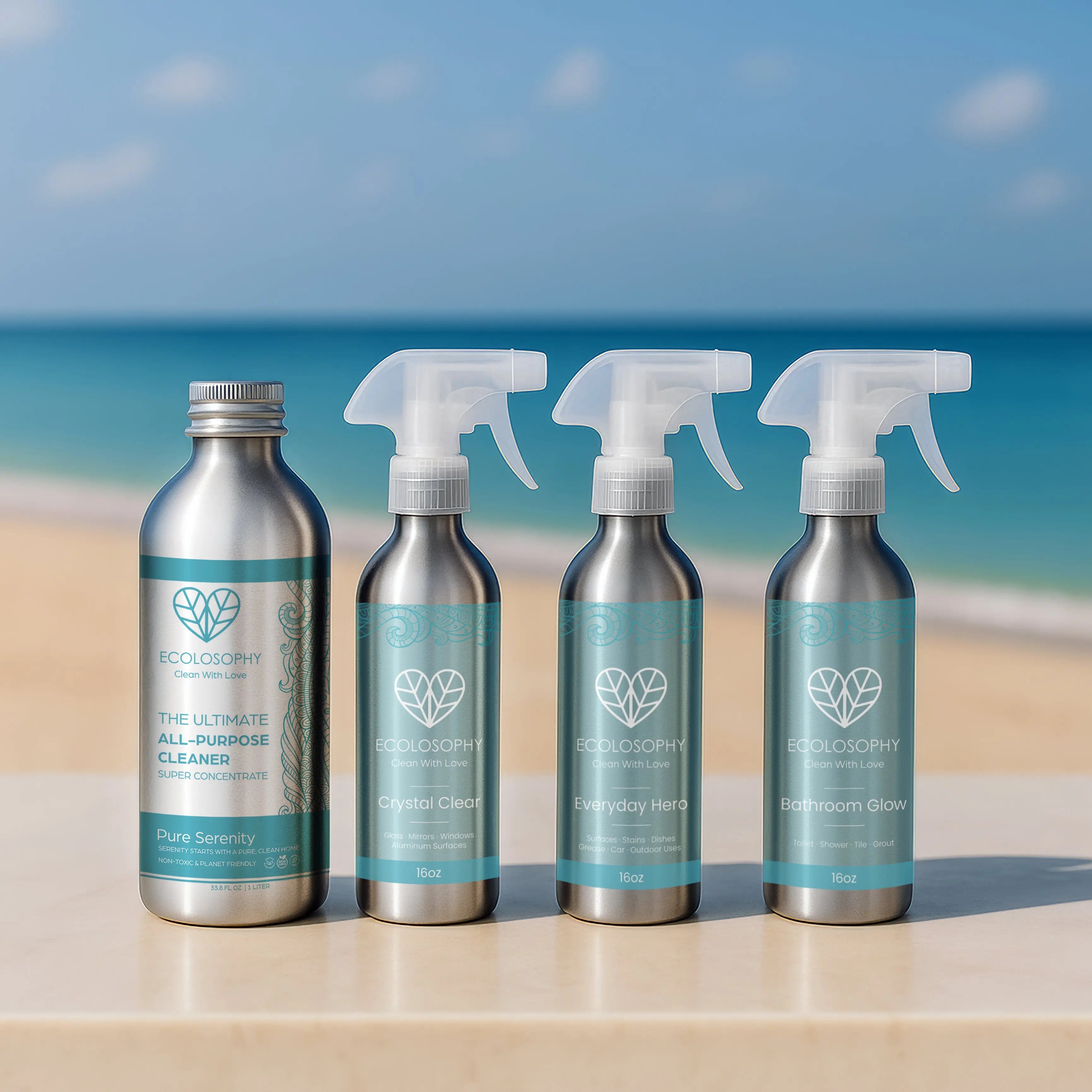
If your bathroom cabinet is a graveyard of single-purpose bottles—one for the toilet, one for glass, one for tile, all with warning labels—you can replace the whole lineup with one Pure Serenity concentrate and a refillable bottle — or browse all three scents, including a fragrance-free option. Curious how one bottle does so much? Read why we sell concentrate. Want to overhaul more than the bathroom? Our 7-day non-toxic switch plan walks you room by room, and you can tackle the worst tile with our natural grout guide.
Your bathroom should be the place you breathe easiest, not the place you hold your breath. Clean it like the people you love are going to live in it—because they are.