ingredient investigation
Is Fragrance in Cleaning Products Bad? Trade Secrets, Irritation, Disclosure
Is fragrance in cleaning products bad? “Fragrance” can hide an undisclosed blend — a transparency gap that matters for asthma, allergies, and kids.

Calling a product 'lightly scented' while hiding 47 undisclosed chemicals underneath it isn't a loophole. It's the design of the system.
— Italo Campilii — Founder, Ecolosophy
Short answer: “Fragrance” or “parfum” can stand in for an undisclosed blend — a transparency problem for asthma, allergies, and kids. Not every scented bottle is dangerous; you often cannot verify what you are breathing. Prefer a plant-based, fragrance-free Ecolosophy concentrate — small-batch, made with care.
One word. That’s all it takes to legally hide over three thousand chemicals from you.
It’s printed on almost every cleaning product under your sink. On the dish soap. On the floor cleaner. On the all-purpose spray you use every day on surfaces your kids touch.
The word is “fragrance.”
How This Is Legally Possible
The International Fragrance Association (IFRA) publishes a Transparency List of the ingredients used across the fragrance industry. It runs to thousands of distinct materials.
Any combination of those materials can appear on your ingredient label as a single word: fragrance.
This isn’t a glitch in the system. It was written this way deliberately — we call it the fragrance loophole, because that’s exactly what it is. Fragrance formulas are considered trade secrets — proprietary blends that manufacturers argued required protection from competitors. The Fair Packaging and Labeling Act, which governs ingredient disclosure, granted an exemption. That exemption became the cover under which thousands of undisclosed chemicals now legally enter your home.
For cosmetics and personal care products, the FDA has some authority — limited, but something. For household cleaning products? The FDA has essentially none. They’re governed by the EPA under the Toxic Substances Control Act and the CPSC under the Consumer Product Safety Act — neither of which requires fragrance component disclosure.
What’s Hiding Under That Word
The most studied group hiding under “fragrance” is phthalates.
Phthalates are plasticizer chemicals used as fragrance carriers — they help scents bind to surfaces and last longer. The EPA classifies several phthalates as endocrine disruptors, meaning they interfere with hormone signaling in the body. Specifically, phthalates like DEHP and DBP have been associated with developmental effects in male reproductive systems, early puberty in girls, and metabolic disruption.
They never appear on ingredient labels for cleaning products. They don’t have to.
Then there are synthetic musks — fragrance chemicals that don’t break down easily, accumulate in fat tissue, and have been found in human blood and breast milk. Galaxolide and Tonalide have appeared in studies measuring human bioaccumulation. Both are still legal and unlabeled in US household cleaners.
Volatile organic compounds (VOCs) released from fragranced cleaning products are a separate category. A 2018 study published in Air Quality, Atmosphere & Health found that fragranced products release more than 100 VOCs per product — including some classified as hazardous under federal law. These off-gas into indoor air during and after use, contributing to indoor pollution levels that routinely exceed outdoor air in American homes.
The EU vs. The US
The gap between European and American fragrance regulation is significant.
The EU’s Cosmetics Regulation — which applies to personal care products, not household cleaners — requires named fragrance allergens to be declared in the ingredient list once they exceed set concentrations. The EU has also launched a broader review to restrict additional fragrance chemicals linked to endocrine disruption.
In the US, none of those 26 banned EU substances are required to be disclosed in cleaning products. Several are legally present in products marketed to families with infants.
This isn’t an abstract regulatory comparison. It’s the reason you can walk into a Target in Berlin and see a meaningfully different ingredient landscape than you see in Chicago — in products with the same global brand name.
Does California’s SB 258 Actually Protect Me?
It’s the strongest fragrance-disclosure law in the country, but it only works if you know to look it up. In 2017, California passed SB 258, the Cleaning Product Right to Know Act, which took effect in January 2020. It requires manufacturers of cleaning products sold in California to list all intentionally added ingredients — including individual fragrance chemicals — on a publicly accessible website, and to disclose any ingredients that appear on authoritative hazard lists like California’s Prop 65. It’s genuinely significant: it’s the first US law to pierce the fragrance trade-secret shield for cleaning products, and several brands have updated their online disclosures because of it. But the law has real limits — “online disclosure” means you have to already know the law exists and navigate to a brand’s disclosure page before you buy, and most people scan a label for a few seconds and move on. It’s a floor, not a ceiling, and it doesn’t require anything on the physical label itself.
Unscented Doesn’t Mean What You Think
This one surprises most people.
“Unscented” and “fragrance-free” are not synonyms. Unscented means the product has no detectable odor — but it may contain masking fragrances, which are chemicals added to neutralize or cover the natural smell of other ingredients. Those masking fragrances are still chemical compounds with the same disclosure exemption.
“Fragrance-free” means no fragrance ingredients were added — period. It’s the only designation that actually means what people think “unscented” means.
If you have asthma, allergies, a child with eczema, or anyone in your household with chemical sensitivities, the label to look for is fragrance-free — not unscented, not naturally scented, not lightly fragranced. If you want a shortcut through all of this, we rounded up the actual non-toxic options worth buying in 2024.
Why We Use No Artificial Scents
When I was building Ecolosophy’s formula, this was a first-principles question: why would we add fragrance at all?
The honest answer is that scent is marketing. People associate clean with a smell — usually the artificial lemon or lavender that cleaning product brands have conditioned us to expect. That conditioning is deliberate. The smell has nothing to do with cleaning efficacy. It’s theater.
Our products are either unscented or scented with pure essential oils — fully disclosed, never hidden under the word “fragrance.” You can read every ingredient in our concentrate and know exactly what you’re working with.
That’s not a premium feature. That’s just the baseline of what honest cleaning looks like.
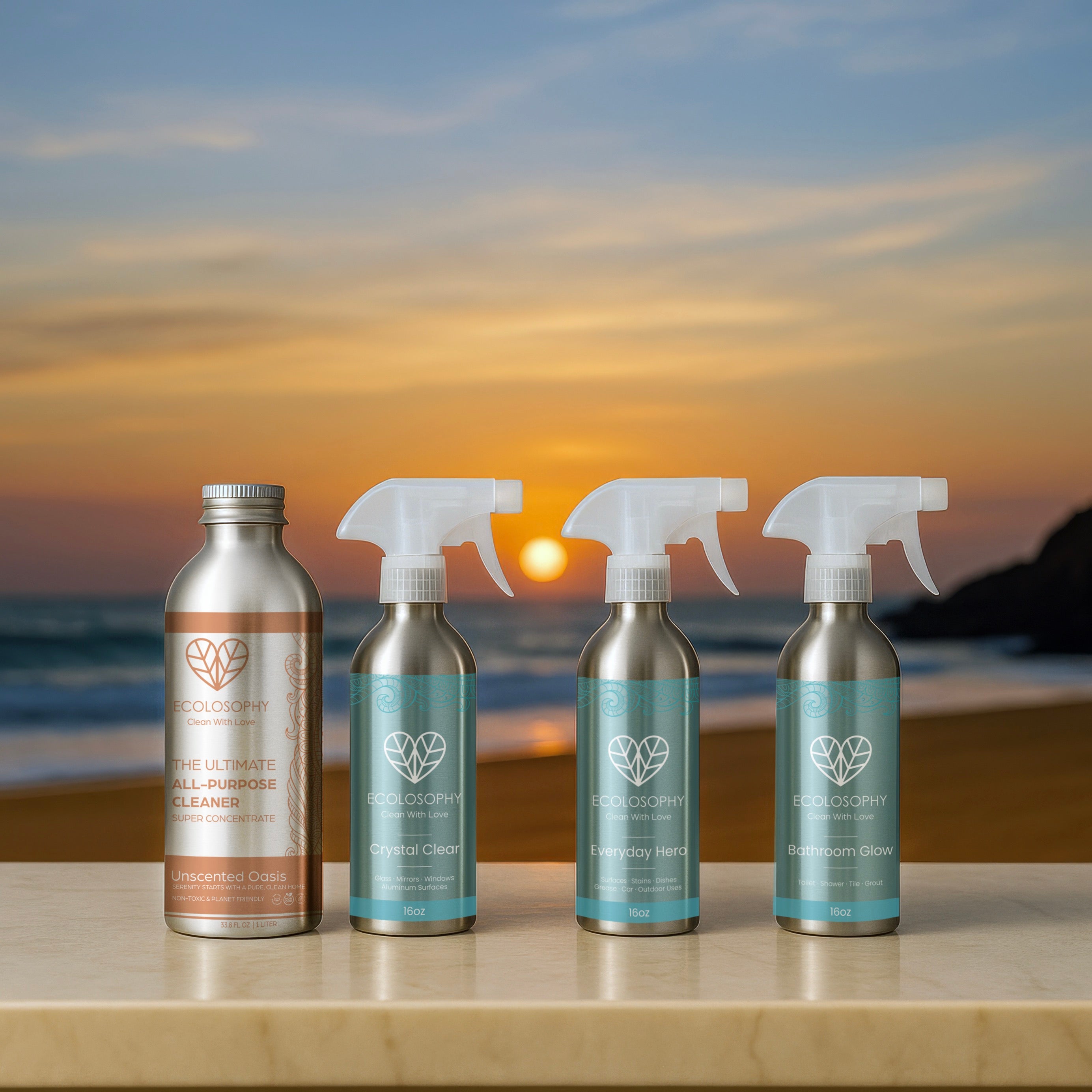
Curious what’s actually in our concentrate? The Unscented Oasis concentrate is fragrance-free in the true sense — no scent, no masking chemicals, nothing hidden under the word “fragrance.” Prefer a real, fully-disclosed essential-oil scent instead? The Pure Serenity concentrate lists every drop.
Next: What Is 1,4-Dioxane? — the other unlabeled chemical hiding in your dish soap. We keep digging into what’s actually in your home over on The Detox Journal.
#cleanwithlove #ecolosophy #nontoxichome #detoxyourlife #plantbasedliving
Sources cited
- IFRA — Transparency List of Fragrance Materials — IFRA Transparency List of fragrance materials used across the industry
- EPA — Phthalates Action Plan — EPA classification of phthalates as endocrine disruptors
- EU Cosmetics Regulation — Annex III (Restricted Substances) — EU list of 26 banned fragrance allergens and 82 requiring label disclosure
- Environmental Working Group — Guide to Healthy Cleaning — EWG analysis of fragrance chemicals in household cleaning products
- California Legislative Information — SB 258 Cleaning Product Right to Know Act — California SB 258 mandates online disclosure of fragrance ingredients in cleaning products, effective 2020