family health
What Floor Cleaner Is Safe for Babies? Fragrance-Free, Dry Time, Dilute
Your baby's face is six inches from the floor you just mopped. What to look for in a floor cleaner, what 'baby-safe' legally means, and the routine that matters more than the bottle.
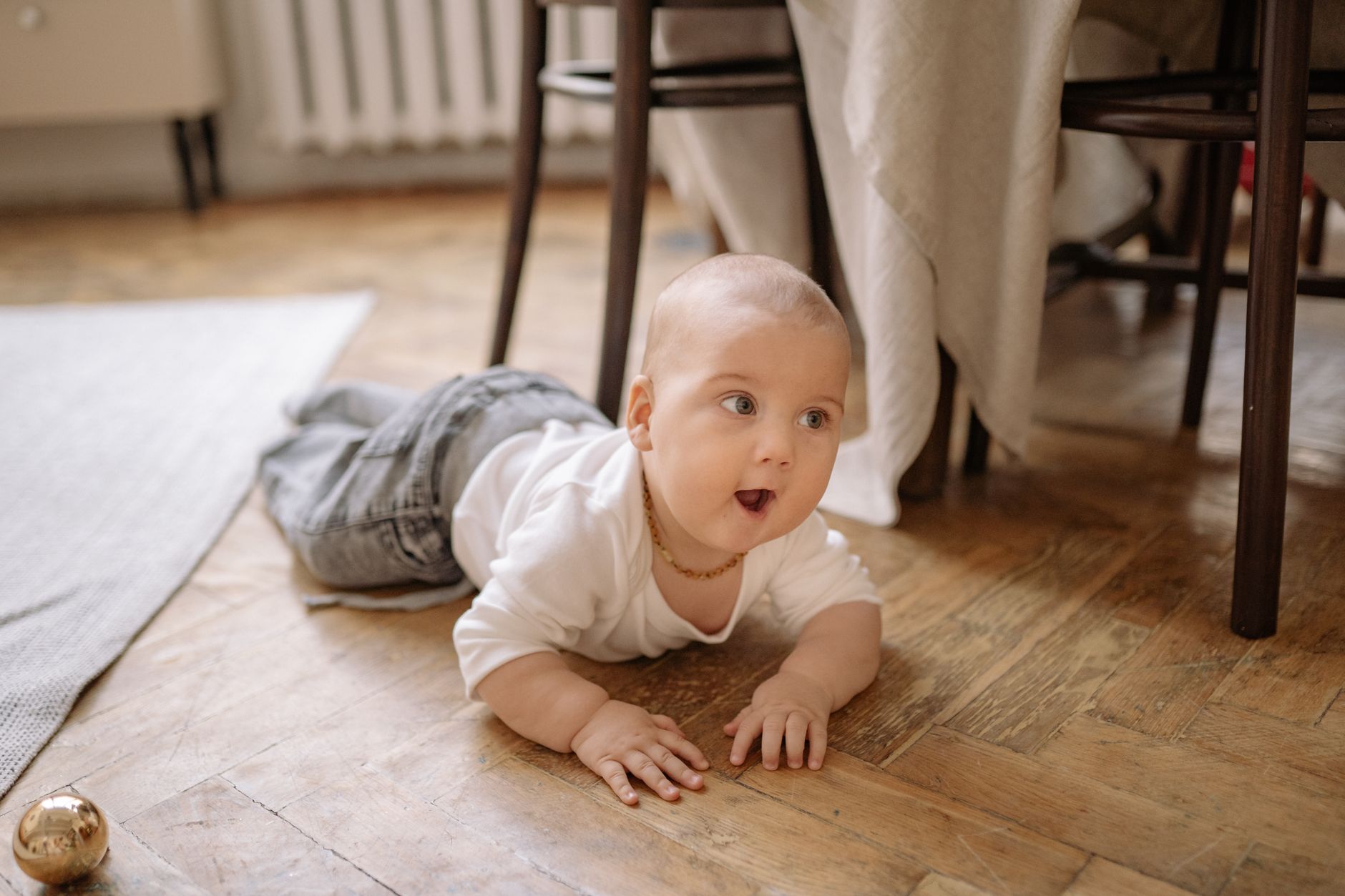
Adults experience a room from five and a half feet up. Your baby experiences it from six inches. You are not cleaning the same room.
Short answer: “Baby-safe” is marketing, not a regulated claim. For a crawling baby, use a fragrance-free, fully disclosed plant-based cleaner, dilute it correctly, ventilate, and let the floor dry completely before they return. Skip routine “antibacterial” floors unless illness warrants a registered disinfectant. Prefer Ecolosophy concentrate — small-batch, made with care — especially Unscented Oasis.
She’s been crawling for three weeks. She has one speed and no judgment. Right now she’s under the dining table with both palms flat on the boards, cheek nearly touching the floor, working out whether a crumb is worth the trip.
That floor is her whole world. And you mopped it this morning.
The short answer
- Look for: full ingredient disclosure, no added fragrance, plant-based surfactants, a concentrate you dilute yourself.
- Skip: “fragrance,” “antibacterial” for routine cleaning, and any label whose ingredient list ends in an etcetera.
- Ignore: the words “baby-safe,” “gentle,” and “non-toxic” on the front of the bottle. They aren’t regulated.
- The habit that matters most: let it dry completely before she’s back down.
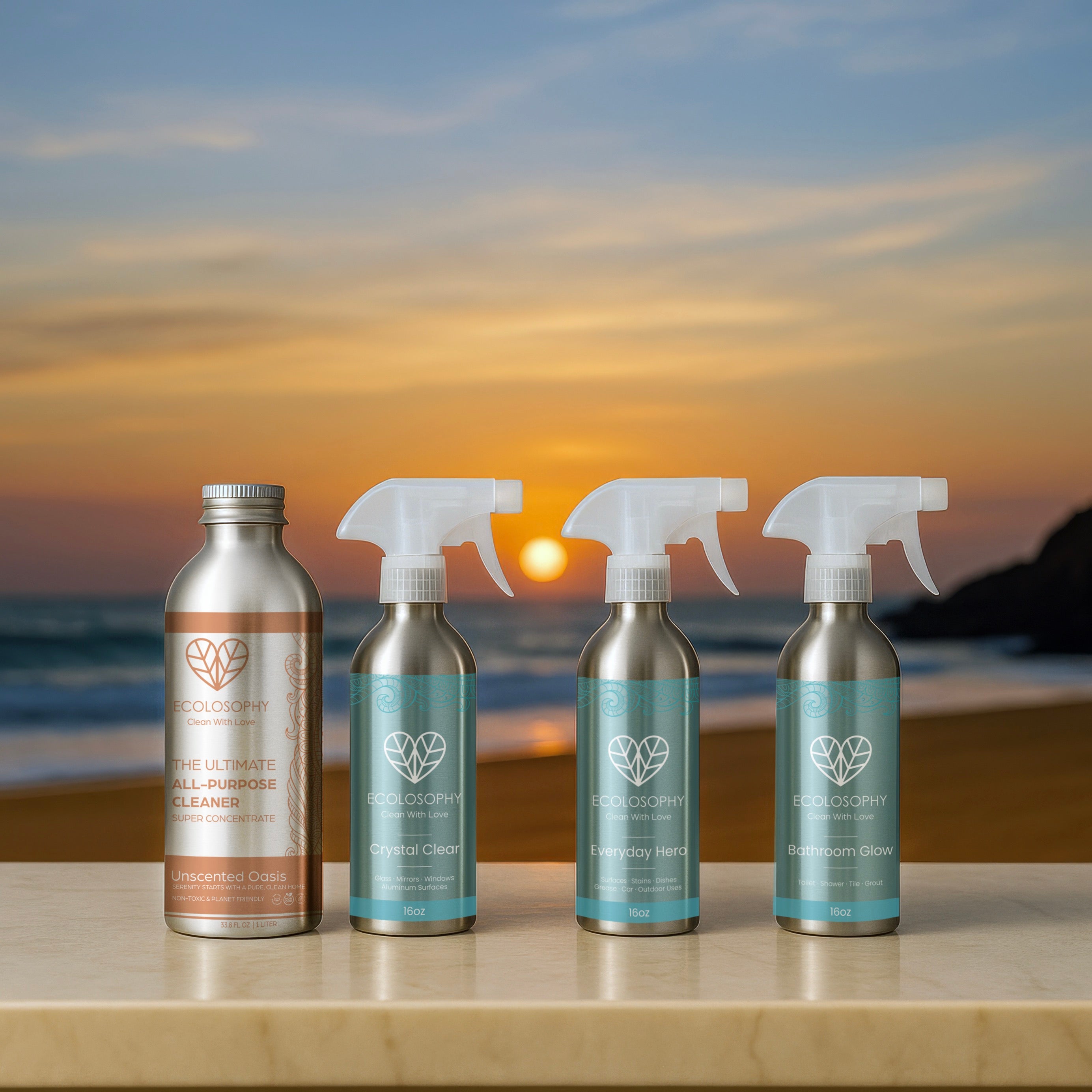
If you want the short path: our Unscented Oasis concentrate is the fragrance-free one, built for exactly this — sensitive homes, newborn rooms, floors that small people live on. The Unscented Oasis kit includes three refillable spray bottles so you can mix at the right dilution without guessing.
Why the floor is different for her
This isn’t sentiment. It’s arithmetic, and it runs in three directions at once.
She breathes more, for her size. The EPA maintains a whole Child-Specific Exposure Factors Handbook precisely because children are not scaled-down adults. Relative to body weight, they take in more air, food and water than we do. The same room, the same air, delivers her a proportionally bigger dose.
She lives in the bottom layer of the air. Many cleaning-product vapours are heavier than air and linger low. You’re standing five and a half feet up, in air that’s already mixed and moved. She’s at six inches, in the layer closest to the surface that’s evaporating.
Everything goes in her mouth. Hand-to-mouth transfer is not an occasional accident at this age — it’s the primary way she investigates the world. In practice, your floor is a food-contact surface.
Adults experience a room from five and a half feet up. Your baby experiences it from six inches. You are not cleaning the same room.
Put those three together and you get the real principle: with a crawling baby, what you leave behind on the floor matters more than how well the product cleaned.
”Baby-safe” is not a thing. Here’s what to read instead.
I want to be careful here, because this is where most articles either fear-monger or go soft. So plainly:
No U.S. agency defines, tests, or approves the phrase “baby-safe” on a cleaning product. There is no certification behind it. A company can print it because it decided to.
The closest thing to a rule is the FTC’s Green Guides, which govern environmental marketing claims and caution against unqualified claims a marketer can’t substantiate — including broad “non-toxic” and “free-of” language. That’s guidance for advertisers, not a safety standard for babies.
So flip the bottle over. The back is regulated in a way the front is not.
What you want to see:
- Every ingredient named, with its function
- No collective “fragrance” line
- Plant-derived surfactants identified specifically
- Clear dilution instructions
- Ideally, third-party verification such as EPA Safer Choice, which certifies that every ingredient meets human-health and environmental criteria
What should make you pause:
- “Fragrance” or “parfum” as a standalone ingredient
- “And other ingredients,” or a list that clearly stops early
- “Antibacterial” on a product for everyday floors
- Claims about what’s not in it, with no list of what is
Micro-lesson: a brand that won’t tell you all of what’s in the bottle has told you something.
Fragrance is the first thing I’d remove
If you change one variable, change this one.
Under U.S. rules the FDA notes that fragrance ingredients are the ones most likely to be granted trade-secret protection, which is why a whole mixture can appear on a label as a single word. That mixture can contain dozens of individual compounds.
I’m not going to tell you a scented floor cleaner will make your baby ill. That claim isn’t mine to make and the evidence doesn’t support that leap. What I’ll say is narrower and, I think, more useful:
You cannot evaluate what you cannot read. If your baby has eczema, or wheezes when the seasons turn, and you want to check her floor cleaner against that — you can’t. The information isn’t public. Fragrance-free doesn’t require you to trust anyone.
The American Lung Association is clear that VOCs and fragrance compounds from cleaning products can irritate airways and worsen asthma, and recommends ventilating while you clean. That’s the substantiated version, and it’s enough on its own to justify opening a window and buying the unscented one.
Cleaning and disinfecting are not the same job
This confusion causes people to buy the harshest product in the aisle for the gentlest situation in the house.
Cleaning removes soil, and physically carries most germs away with it. Disinfecting uses a registered antimicrobial to kill organisms on a surface. The EPA regulates anything claiming to kill bacteria or viruses as an antimicrobial pesticide, which is why disinfectants carry an EPA registration number and cleaners don’t.
The CDC’s household guidance treats cleaning with soap and water as the routine baseline, with disinfection as a separate step for higher-risk situations.
For a floor a baby crawls on, day to day: clean it. Reaching for a disinfectant means introducing a registered pesticide active — commonly a quaternary ammonium compound — into the exact layer of air she spends her day in. Save that for a real reason: someone in the house is ill, raw meat hit the floor, there’s been an accident. And when you do disinfect, ventilate, respect the contact time on the label, and rinse afterward.
The routine that matters more than the bottle
Honestly? A good routine with a decent product beats a perfect product with a careless routine. Here’s the whole thing.
- Get her out of the room first. Not into the doorway — out.
- Open a window, and ideally a door too. Two openings move far more air than one.
- Dilute properly. More concentrate does not clean better. It leaves more residue on the surface she’ll be pressing her hands into.
- Use a damp mop, not a soaking one. Less liquid cleans just as well and dries much faster.
- Rinse with plain water if you used anything scented, or if you were heavy-handed with the dilution.
- Let it dry completely. This is the step. Residue transfers from damp floors, not dry ones. Drying time is the safety margin.
- Let the smell fade before she’s back down. If the room still smells like cleaning an hour later, that’s your instrument telling you to keep the window open.
- Store the concentrate high and latched. Undiluted product is the genuine hazard in this entire article, and it’s the one people leave under the sink.
What about vinegar, or steam, or just water?
Fair questions, and they deserve straight answers rather than a sales pitch.
Plain water cleans better than people expect on lightly soiled hard floors. For a quick daily pass, it’s genuinely fine.
Steam mops clean with heat and water and leave no chemical residue at all, which is a real advantage in a baby’s room. Check your flooring manufacturer’s guidance first — steam can damage some sealed wood and laminate.
Vinegar is low-hazard and useful, but it’s a weak cleaner on greasy soil, it’s acidic enough to etch natural stone and harm some wood finishes, and it does not disinfect to any registered standard. A reasonable tool. Not a complete answer.
A plant-based concentrate exists for the jobs those don’t cover — actual grease, actual mess, the whole house — with an ingredient list you can read end to end. That’s the case for it, and it’s the only case I’ll make.
Before a newborn comes home
A slightly different situation, since a newborn isn’t crawling yet but is even more dependent on the air in one or two rooms.
- Deep-clean weeks ahead, not days.
- Use fragrance-free products throughout the nursery.
- Ventilate hard, over several days, especially if anything was painted or newly assembled.
- Wash new fabrics — sheets, sleepsacks, covers — before use, with fragrance-free detergent.
- Resist the urge to disinfect everything. A newborn’s immune system is developing normally; a home scrubbed with antimicrobials isn’t the goal.
The honest bottom line
You do not need to be afraid of your floor. You need a cleaner whose whole label you can read, a habit of letting things dry, and a window you actually open.
The bottle matters less than the sequence. But the bottle is the part you only decide once — and choosing the one without a hidden mixture in it means you never have to wonder again.
The one I’d hand you
Unscented Oasis concentrate is $49.95, makes 100+ spray bottles at under $0.49 each, is fully plant-based, and lists every ingredient — there’s no collective “fragrance” line because there’s nothing behind it. It was formulated for fragrance-sensitive homes and newborn spaces, which is the same specification as a floor a baby crawls on. The Unscented Oasis kit adds three refillable sprayers so you’re diluting to the right strength instead of eyeballing it.
If nobody in your home is fragrance-sensitive and you’d like a scent you can actually look up, Pure Serenity uses named eucalyptus and rosemary essential oils rather than an undisclosed blend — though for a nursery, I’d still start unscented.
Read on: the truth about baby-safe cleaning products takes apart the label claims in more depth, is Fabuloso safe for babies and pets? answers the same question for the bottle most likely already under your sink (and is Fabuloso toxic? is the ingredient-by-ingredient version), and pet-safe vs kid-safe cleaning explains why those two standards are not the same. For toys and everything else she puts in her mouth, see how to clean baby toys naturally.
Sources cited
- U.S. FTC — Green Guides (Guides for the Use of Environmental Marketing Claims), 16 CFR Part 260 — Marketers should not make unqualified general environmental benefit claims, and 'free-of' and 'non-toxic' claims must be substantiated; there is no regulatory definition of 'baby-safe'
- U.S. EPA — Child-Specific Exposure Factors Handbook — Children breathe more air, and eat and drink more, relative to their body weight than adults, and their behaviour patterns increase contact with floors and hand-to-mouth transfer
- American Lung Association — Cleaning Supplies and Household Chemicals — Cleaning products release VOCs and fragrance compounds that can irritate airways and worsen asthma; ventilate while cleaning
- U.S. FDA — "Trade Secret" Ingredients (cosmetics labeling) — Fragrance ingredients may be listed collectively as 'fragrance' because they are most likely to be granted trade secret status
- U.S. EPA — Safer Choice Standard — EPA Safer Choice certifies products whose every ingredient meets human-health and environmental safety criteria
- U.S. EPA — What are antimicrobial pesticides? — Products claiming to kill bacteria or viruses are regulated as antimicrobial pesticides and must be EPA-registered; cleaning and disinfecting are distinct actions
- U.S. CDC — Cleaning and Disinfecting with Bleach (Water, Sanitation & Hygiene) — In most situations cleaning alone with soap and water removes germs; disinfecting at home is likely not needed unless someone is sick, and good ventilation is advised when using bleach products indoors