ingredient investigation
What Does “Fragrance” Mean on a Cleaner Label?
What “fragrance” means on a cleaner label, fragrance-free vs unscented, and how to read the bottle before it reaches the high chair.
“Fragrance” on a cleaner label can describe a scent mixture without naming every component. Fragrance-free and unscented are not interchangeable, so read the product label and the ingredients page. If you prefer no scent at all, Unscented Oasis has no fragrance or essential oils. Ecolosophy removes dirt, grease and grime; it is not a disinfectant.
You are standing at the under-sink cabinet with a bottle in one hand and a crawler somewhere behind you. The label says “fragrance.” It sounds simple. It is not a full ingredient list.
This is a label-reading guide for tired moms and dads who want the high chair and the floor routine to match what the bottle actually says — not a marketing vibe.
Why one label word can cover a scent mixture
On many household cleaners, “fragrance” (or “parfum”) is a short word that can stand in for a blend of scent materials. The label may not list each piece of that blend by name. That does not automatically make a product “bad” or “good.” It means the word is a category, not a full recipe card.
If you care what ends up near a high chair tray or a floor a baby mouths, the honest move is boring: read the full label, check any linked ingredient page, and decide from the actual wording — not from how strongly the bottle smells when you open the cap.
Fragrance-free, unscented, scented, and named oils
These words get mixed up in the aisle:
- Scented usually means the formula includes added scent materials (sometimes listed simply as fragrance).
- Fragrance-free generally means no fragrance materials were added for scent. It does not rewrite every other ingredient on the label.
- Unscented can mean low noticeable scent, or that a masking agent was used so the product does not smell like the base formula. It is not a perfect synonym for fragrance-free. Read the specific bottle.
- Named oils (for example, an essential oil blend called out on an ingredient list) are more specific than the single word “fragrance,” but they still need the full label context.
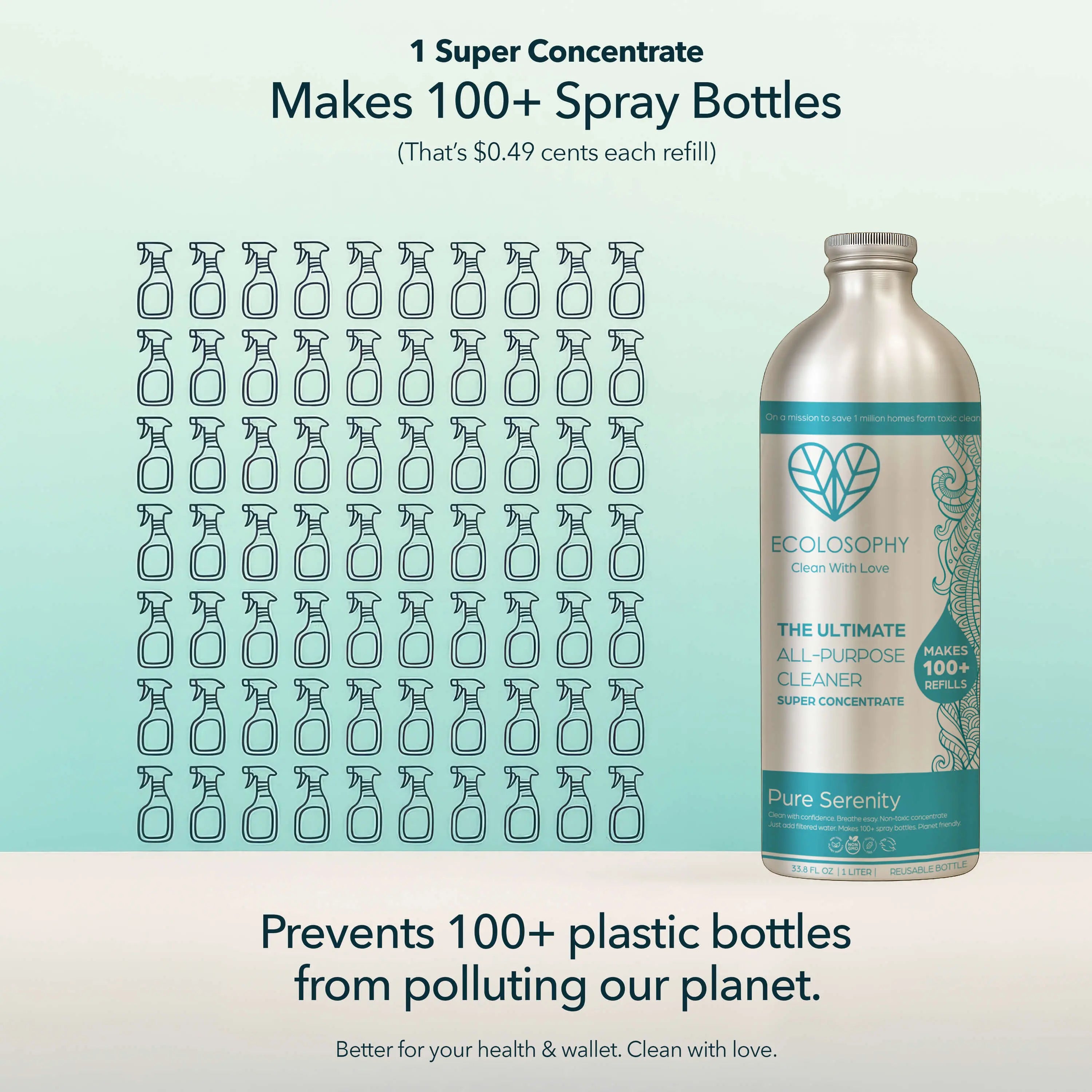
Ecolosophy’s scented concentrates name their essential oils on the ingredients page (orange for Citrus Burst; eucalyptus and rosemary for Pure Serenity). Unscented Oasis has none. That is a scent and preference choice — not a health claim, and not a promise about how anyone’s body will react.
Reading the label before a spray reaches the high chair
Before the bottle leaves the cabinet:
- Find the product name and the use directions (dilution, surfaces, rinse/dry notes).
- Scan the ingredient list or INCI-style disclosure.
- Notice whether scent is listed as “fragrance,” as named oils, or as none added.
- Check storage and keep-out-of-reach language.
- Match the job: everyday soil on a tray or floor is a cleaner job unless you separately need an EPA-registered disinfectant and follow that product’s label.
Ecolosophy ingredients (Unscented Oasis, 8): water, sodium methyl 2-sulfolaurate and disodium 2-sulfolaurate, lauryl alcohol ethoxylate (POE-7), lauryl/myristyl amidopropylamine oxide, glycerin, citric acid, baking soda, polysorbate 20. Citrus Burst adds orange oil; Pure Serenity adds eucalyptus and rosemary oils. Citric acid here is a pH helper — not an EPA disinfectant active.
Scent left behind versus residue left behind
A room can smell “clean” and still have a film. A surface can rinse clear and smell quiet. Scent is sensory. Residue is what is left on the surface after the wipe — over-pour, hard water, skipped rinse, or a formula that does not match the mess.
If the high chair tray feels tacky after you “cleaned,” treat that as a dose and method problem first: measure dilution, use friction, rinse food-contact surfaces when the label says to, and let the tray dry. Do not treat a stronger smell as proof the job is done.
Unscented Oasis if you prefer no scent
When the job is a floor a crawler uses as a highway (and sometimes as a snack), many parents prefer less added scent. Unscented Oasis has no fragrance or essential oils: preference and label clarity, not a medical story. Rinse surfaces kids mouth.
Use the live dilution directions. More concentrate is not “more clean.” Let floors dry fully before crawl time — “fully dry and non-tacky,” not a made-up minute count.
What a cleaner can do and where an EPA disinfectant begins
Ecolosophy is a cleaning concentrate for everyday soil and residue. It is not an EPA-registered disinfectant. If a surface or situation needs disinfection per a labeled, registered product, that is a different tool with different directions. Mixing categories on the same wipe-down is how people get confused labels and overconfident claims.
We do laundry and dishes differently than some “one bottle for everything” systems. Stay in the jobs the label supports.
Next step
Read the full ingredients list, then use the 7-day detox as a label-and-routine reset for the under-sink cabinet. The Unscented Oasis Kit is $69. Free US shipping over $40. See the shipping page.