ingredient investigation
What Does Fragrance Hide on a Label? Ingredients, Loophole, Disclosure
One word — fragrance — lets companies skip listing what's actually in a product. Here's the law that allows it, the disclosure loophole that's finally closing, and how to shop around it.
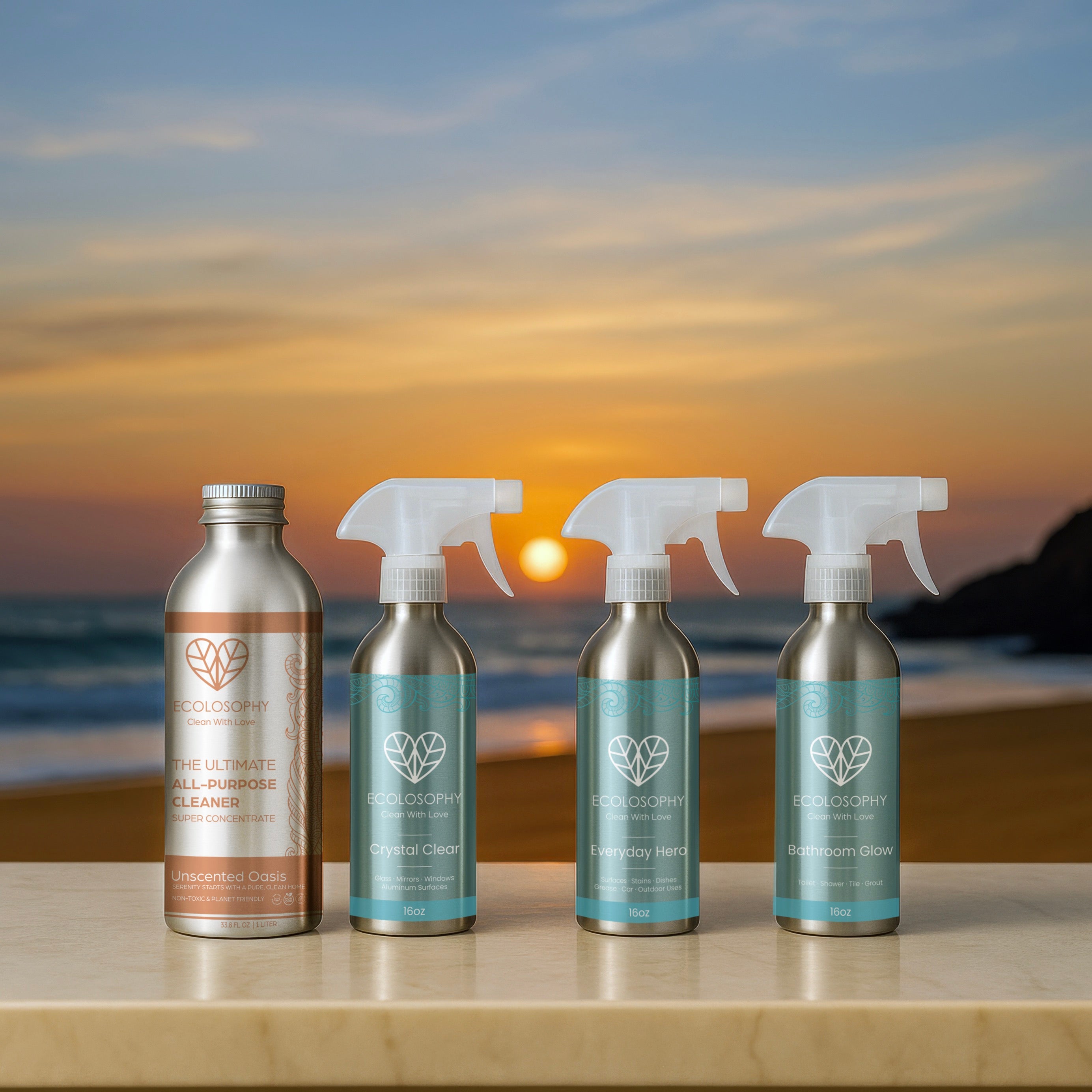
Short answer: In the US, “fragrance” on a label can legally hide dozens of unlisted chemicals under a 1973 trade-secret exemption — not a safety finding. California SB 258 and SB 312 force some disclosure, but only for products sold there. Prefer fragrance-free, or check a real SDS. Plant-based Ecolosophy concentrate — small-batch, made with care — starts fragrance-free.
You pick up the bottle, flip it over, and read the ingredient list like you’ve been trained to. Water. Surfactant. A few things you can pronounce. Then, near the bottom: fragrance. One word. You assume it means something like “a blend of nice-smelling plant oils” and move on.
It doesn’t have to mean that. Legally, that one word can stand in for a mixture of dozens of individual chemicals — and the company doesn’t have to tell you which ones, or how many.
The story behind the word
Elizabeth, our formulator, tells this one from her own kitchen: she was reading a “natural” all-purpose spray’s label to her daughter, sounding out each ingredient the way you’d read a nutrition label, when she hit “fragrance” and realized she had no honest answer to “what’s that, Mommy?” Not because she didn’t know chemistry — because the label itself didn’t know. Or rather, it wasn’t required to say.
That’s the moment that turns a lot of ingredient-label readers into fragrance skeptics. Not a scare headline. Just the quiet realization that one word on a label you trust is doing a lot of hiding.
The truth: it’s a 50-year-old trade-secret exemption, not a safety finding
Here’s what’s actually going on, and it’s older than you’d think. The Fair Packaging and Labeling Act of 1973 exempted fragrance formulas from the general rule that products must list their ingredients. The reasoning wasn’t about health — it was about protecting a company’s specific scent formula from being copied by a competitor. Fragrance houses treat their exact blends the way Coca-Cola treats its syrup recipe: a trade secret, not a hazard classification.
That exemption is why “fragrance” (or “parfum” on imported products) can appear on a US label as a single line item even when the fragrance itself is a proprietary mixture of anywhere from a handful to dozens of individual chemical components. The FDA confirms directly that fragrance ingredients are not required to be individually listed under federal law. Nothing about this is illegal or hidden in fine print — it’s just a fifty-year-old rule most shoppers have never heard explained.
What “3,000+” actually refers to
The number that circulates — that fragrance can legally hide 3,000-plus chemicals — comes from the scale of the fragrance industry’s own ingredient palette, not from any single bottle. The IFRA Transparency List, maintained by the International Fragrance Association, publishes roughly 3,800 ingredients used across fragrance formulas industry-wide. It’s a real, public list — you can look it up right now.
But here’s the nuance worth sitting with: that list tells you what fragrance chemicals exist and are in circulation. It does not tell you what’s in the specific bottle on your counter. IFRA participation and disclosure to that list are voluntary, and a given product’s fragrance blend might draw from three of those 3,800 ingredients or thirty — you have no way to know from the label alone.
The law that’s finally forcing the door open — and where it stops
Two California laws are the reason this topic is even discussable in concrete numbers, and it matters that they’re both narrower than most people assume.
SB 258 — the Cleaning Product Right to Know Act of 2017 — is the one that applies to what we make. It requires manufacturers to check their formulas against 22 designated hazard and disclosure lists, and to disclose fragrance allergens (drawn from the EU’s own mandatory allergen list) once they’re present above 100 parts per million. Disclosure started online in 2020, with a scaled-back label requirement following in 2021.
SB 312 — the Cosmetic Fragrance and Flavor Ingredient Right to Know Act — does the parallel thing for cosmetics, requiring reporting of designated fragrance and flavor ingredients to a state database, effective 2022.
Notice what both laws share, and don’t share: they apply to products sold in California, they route disclosure through an online database rather than requiring a full ingredient list on the physical label, and both still permit certain ingredients to be withheld as confidential business information if a company can show real competitive harm from revealing them. There is still no federal law requiring a full fragrance breakdown on a US label, in any state, for any product category.
Micro-lesson: the label word to actually trust
If you take one thing from this: “fragrance-free” and “unscented” are not the same claim, and only one of them is reliable. “Unscented” can legally include a masking fragrance — an ingredient added specifically to cancel out the smell of the other ingredients, which means fragrance chemicals are still present even though you can’t smell them. “Fragrance-free” means no fragrance ingredient, masking or otherwise, was added at all. If avoiding synthetic fragrance is the actual goal — not just avoiding a smell — fragrance-free is the phrase to look for, and it’s worth checking a brand’s own site or safety data sheet rather than trusting the front-of-bottle claim alone.
This is the same instinct behind reading past marketing words generally — see our 60-second ingredient label guide for the rest of the label, and our breakdown of the 10 ingredients worth avoiding for what else tends to hide behind vague terms like “surfactant” or “preservative.”
What to actually do about it
You don’t need to memorize the IFRA list or California’s 22 designated databases to shop smart. Three habits cover almost all of it:
- Default to fragrance-free, not “unscented,” if scent sensitivity or a baby’s developing system is a factor in your home.
- Check if a brand publishes actual fragrance components, not just “essential oil blend” — a company willing to name its specific plant-derived fragrance sources (not just claim “natural”) is telling you more than the law requires.
- Look up designated cleaning products in California’s SB 258 database if you want to verify a specific product — it’s public, and it’s the closest thing to a real fragrance ingredient list that currently exists for household cleaners.
We formulate fragrance-free by default for exactly this reason — not because scent is bad, but because “trust the word on the bottle” shouldn’t be the only option a parent has.
Read next: how quaternary ammonium compounds hide behind “disinfectant,” and why 1,4-dioxane doesn’t have to be listed at all because it’s a contaminant, not an added ingredient. For the full journal, visit The Detox Journal, or see the concentrate we formulate fragrance-free from the start.
Sources cited
- California Department of Public Health — SB 258, Cleaning Product Right to Know Act — SB 258 requires online ingredient disclosure for designated cleaning products sold in California, phased in from 2020 (online) and 2021 (label)
- California Department of Public Health — SB 312, Cosmetic Fragrance and Flavor Ingredient Right to Know Act — SB 312 requires disclosure of designated reportable fragrance and flavor ingredients in cosmetics sold in California, effective 2022
- IFRA — About the Transparency List — The IFRA Transparency List publishes fragrance ingredients used across the industry; compliance and disclosure to it are voluntary
- EWG — Fragrance in cleaning and personal care products — Analysis of fragrance disclosure gaps and undisclosed fragrance components found in cleaning products
- U.S. FDA — Fragrance ingredients in cosmetics — FDA confirms fragrance ingredients are not required to be individually listed on cosmetic labels under federal law