research
Which Cleaning Ingredients Should You Avoid? Fragrance, Quats, Bleach
Which cleaning ingredients to avoid: fragrance, quats, bleach, and seven more — plus what to use instead.

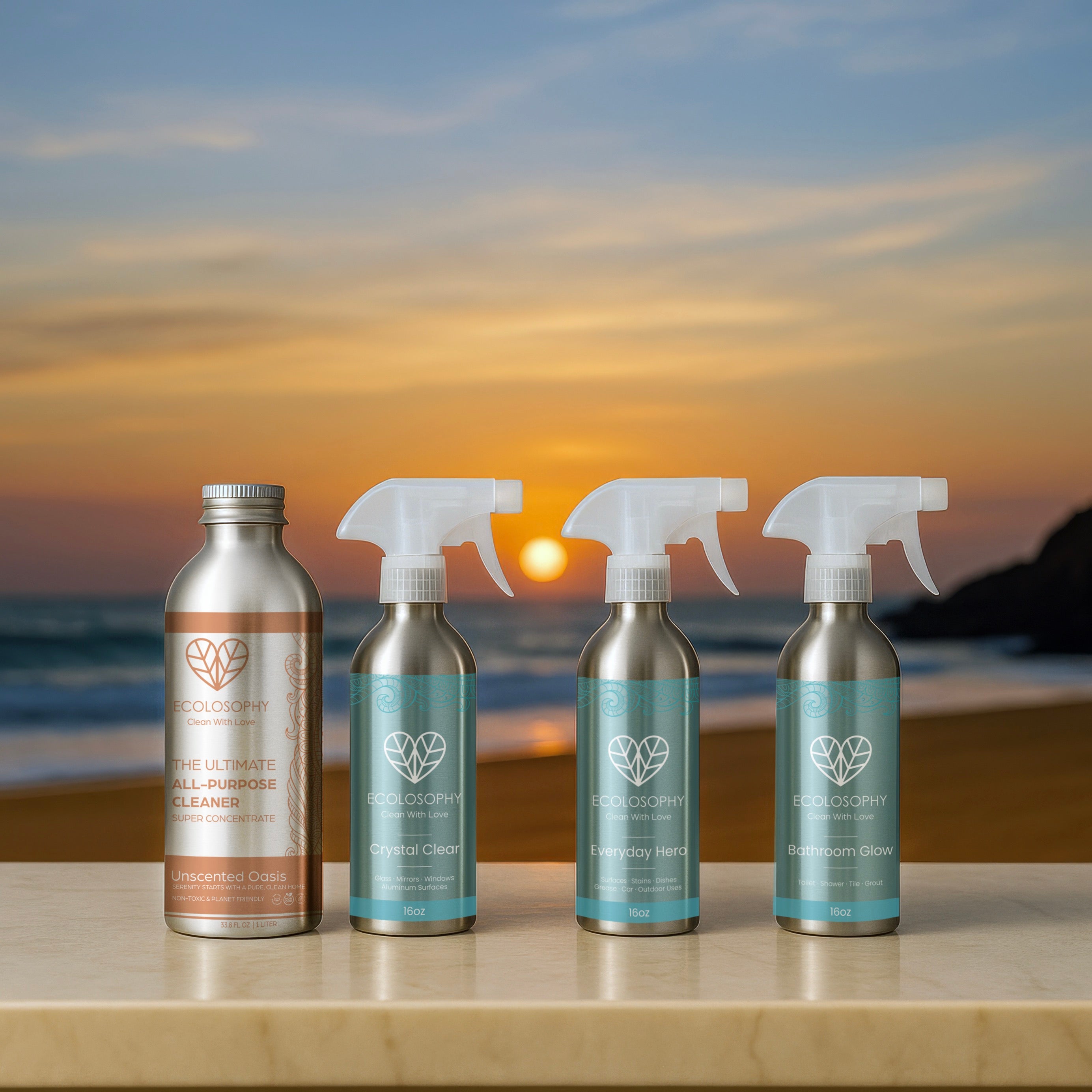
Short answer: Skip fragrance/parfum, triclosan, SLS/SLES, ammonia, bleach, quats, and other high-concern actives when you can — they drive most asthma, hormone, and residue worries in household cleaners. Read every label. Prefer a fragrance-free plant-based Ecolosophy concentrate — small-batch, made with care — built on disclosed plant-derived surfactants instead.
The average American home contains 62 different synthetic chemicals. Most of them don’t come from your food or your water. They come from your cleaning products.
This isn’t alarmism. It’s EPA-documented. And what’s worse: you’re exposed to them more intensely than you might think — because of how cleaning chemicals actually enter your body.
Here’s what nobody tells you at the grocery store.
Why Cleaning Product Ingredients Matter More Than Food Ingredients
We obsess over food labels. We check for high-fructose corn syrup. We flip the box over to read the ingredient list. But we pour cleaning chemicals directly onto the surfaces our children crawl on — and we never read the label.
The reason this matters even more than food: dermal absorption and inhalation bypass your digestive system’s filtration mechanisms entirely.
When you eat something, your liver gets first pass at it — metabolizing, neutralizing, clearing what it can. When you inhale a chemical or absorb it through your skin, it enters your bloodstream directly. No filter. No first pass. Straight into circulation.
A 2004 study published in Environmental Working Group research found that the average adult carries 91 industrial chemicals in their body — many from household cleaning product exposure. A separate study from the Silent Spring Institute found 66 endocrine-disrupting compounds in the air and dust of ordinary American homes. Cleaning products were the dominant source.
You’re not reading the label on your floor cleaner. You’re breathing it. Your baby is crawling through it.
That’s why this list matters.
The 10 Ingredients to Remove From Your Cleaning Cabinet
#1: Fragrance / Parfum
What it is: A blanket legal term that allows manufacturers to conceal the identity of any aromatic compound behind a single word. The FDA and EPA do not require fragrance ingredient disclosure — it’s protected as a trade secret.
Where it hides: Almost every conventional cleaning product: all-purpose sprays, floor cleaners, dish soap, laundry detergent, dryer sheets, bathroom cleaners, glass cleaners. If the label says it smells like lavender, ocean breeze, or “clean linen” — fragrance is in it.
Why it’s concerning: The International Fragrance Association (IFRA) lists over 3,000 chemicals that can legally be used as fragrance ingredients. Many of these are phthalates, synthetic musks, and volatile organic compounds (VOCs) linked to hormone disruption, asthma, and neurological effects. A 2018 study in Air Quality, Atmosphere & Health found that fragranced products used indoors emit as many VOCs as car exhaust. We’ve gone deeper on what’s actually hiding behind the word “fragrance” and on the legal loophole that lets manufacturers skip disclosure entirely.
How to identify it on a label: Look for “fragrance,” “parfum,” “scented,” “aroma,” or “masking fragrance.” Any of these is a red flag. The only safe fragrance disclosure is a full ingredient list — brand by brand, compound by compound.
What to use instead: Fragrance-free cleaning concentrates that rely on the cleaning chemistry of the surfactants — not aromatic masking.
#2: Triclosan
What it is: An antibacterial and antifungal agent added to cleaning products, soaps, and personal care items to kill bacteria on contact.
Where it hides: Antibacterial dish soaps, hand soaps marketed as “antibacterial,” some multipurpose cleaning sprays, and — until recently — some toothpastes.
Why it’s concerning: The FDA partially banned triclosan from consumer hand soaps in 2016, finding it was “not generally recognized as safe and effective.” Animal studies have shown it disrupts thyroid hormone signaling and androgen (testosterone) function — both critical for development in children. The concern isn’t only direct harm — triclosan is one of the top contributors to antibiotic resistance, as bacteria exposed to low concentrations develop resistance mechanisms that carry over to clinical antibiotics.
How to identify it on a label: Listed directly as “triclosan” or sometimes as “Microban.” The easiest shortcut: avoid any product that says “antibacterial” unless you have a clinical reason to need it.
What to use instead: Plain plant-based surfactants clean surfaces mechanically — they lift, suspend, and rinse away bacteria without leaving behind resistance-promoting residues.
#3: Sodium Lauryl Sulfate (SLS) and Sodium Laureth Sulfate (SLES)
What it is: Anionic surfactants that create foam and lather. SLS and its ethoxylated cousin SLES are among the most common surfactants in consumer cleaning products.
Where it hides: Dish soap, hand soap, bathroom cleaners, laundry detergent, and many “natural” cleaning products that still use synthetic surfactant bases.
Why it’s concerning: SLS is a known skin irritant — particularly at concentrations over 2%, which is common in undiluted cleaning products. Repeated dermal exposure is linked to disruption of the skin barrier, which increases sensitivity to other chemical penetrants (we’ve broken down the SLS research in detail here). SLES carries an additional risk: the ethoxylation process used to create it from SLS can leave behind 1,4-dioxane — a probable human carcinogen — as a byproduct that doesn’t appear on the label.
How to identify it on a label: “Sodium lauryl sulfate,” “SLS,” “sodium laureth sulfate,” “SLES,” “sodium dodecyl sulfate.” These will appear in the ingredients list if disclosed. Many brands do not disclose surfactant identity beyond generic terms.
What to use instead: Coco glucoside and decyl glucoside are plant-derived surfactants (from coconut and corn) that clean effectively without the skin barrier disruption or 1,4-dioxane contamination risk.
#4: Ammonia
What it is: A nitrogen-hydrogen compound (NH₃) used as a cleaning and degreasing agent. At household concentrations, it’s a colorless gas dissolved in water.
Where it hides: Glass cleaners (including most name-brand window cleaners), multi-surface sprays, and some oven cleaners. It’s the chemical behind the sharp, eye-watering smell in many cleaners.
Why it’s concerning: Ammonia is a respiratory irritant at concentrations as low as 25 ppm — easily reached during normal indoor cleaning use. People with asthma are particularly vulnerable; even brief exposure can trigger attacks. More dangerous: when ammonia-based cleaners are mixed with bleach (a combination many households accidentally create), they produce chloramine gas — a toxic compound used as a chemical warfare agent in World War I. The CDC lists ammonia/bleach mixing as a leading cause of household chemical exposure incidents.
How to identify it on a label: “Ammonium hydroxide,” “ammonia solution,” or simply “ammonia.” Presence is usually signaled by a sharp, chemical smell even before you open the bottle.
What to use instead: White vinegar and water handle most glass and surface cleaning tasks without respiratory risk. Or a plant-based concentrate diluted to the appropriate ratio for glass.
#5: Bleach / Sodium Hypochlorite
What it is: Sodium hypochlorite is the active ingredient in chlorine bleach — a powerful oxidizing agent that kills bacteria, viruses, and mold by denaturing their proteins.
Where it hides: Disinfecting sprays, bathroom cleaners, mold removers, toilet bowl cleaners, laundry whiteners, and many multipurpose kitchen cleaners.
Why it’s concerning: Sodium hypochlorite reacts with organic matter (including the food residue, body oils, and organic compounds in a typical home) to form chlorinated byproducts — including chloroform, a Group 2B possible carcinogen per the International Agency for Research on Cancer (IARC). A 2015 study in Indoor Air found that bleach cleaning in enclosed spaces generates airborne chloroform at levels comparable to occupational exposure limits. Bleach also off-gases chlorine gas on contact with acids (including vinegar, lemon juice, and some toilet bowl cleaners) — a combination that causes thousands of household poisonings annually.
How to identify it on a label: “Sodium hypochlorite,” “bleach,” or products labeled “disinfecting” or “germicidal” often contain it. Check the active ingredient panel, not just the brand name.
What to use instead: Hydrogen peroxide (3%) is an effective disinfectant that breaks down into water and oxygen — no chlorinated byproducts, no reactive fume risk. Plant-based concentrates with appropriate pH handle routine surface cleaning without disinfecting chemistry for most household tasks.
#6: Quaternary Ammonium Compounds (“Quats”)
What it is: A class of antimicrobial compounds — including benzalkonium chloride (BAC), benzethonium chloride, and dimethyl ammonium chloride — used as disinfectants and preservatives in cleaning products.
Where it hides: “Disinfecting” wipes and sprays, fabric softeners, dryer sheets (as static control agents), hard surface disinfectants, and many products that became ubiquitous during the pandemic.
Why it’s concerning: Multiple animal studies have found reproductive effects from chronic quat exposure. A 2016 study published in Reproductive Toxicology found that mice exposed to quats at real-world concentrations experienced significant reductions in fertility across two generations. Quats are also a leading cause of occupational asthma among cleaning workers — we cover the full picture on quats here. Like triclosan, they contribute to antimicrobial resistance — bacteria exposed to sublethal quat concentrations develop cross-resistance to clinical antibiotics.
How to identify it on a label: “Benzalkonium chloride,” “alkyl dimethyl ammonium chloride,” “didecyl dimethyl ammonium chloride,” or any compound ending in “ammonium chloride.” Products labeled “kills 99.9% of bacteria” almost always contain quats.
What to use instead: For genuine disinfection needs (illness in the home, immune-compromised family members), hydrogen peroxide or properly diluted isopropyl alcohol are effective without the resistance and reproductive concerns. For routine cleaning, quats aren’t necessary.
#7: 2-Butoxyethanol
What it is: A solvent used to increase the cleaning power of all-purpose and glass cleaners. It gives some products their characteristic “chemical” smell distinct from ammonia.
Where it hides: Glass cleaners, multi-surface sprays, oven cleaners, and some floor cleaners. It’s particularly common in professional-grade cleaning products that have crossed into consumer retail.
Why it’s concerning: 2-Butoxyethanol is classified as a possible carcinogen by the National Toxicology Program and as a Group 2 hazardous substance under OSHA standards. It absorbs readily through intact skin — meaning you don’t have to inhale it for it to enter your bloodstream. Animal studies show liver and kidney toxicity at repeated exposures. The EPA limits its use in commercial settings but consumer cleaning products have no analogous restriction.
How to identify it on a label: “2-Butoxyethanol,” “ethylene glycol monobutyl ether,” or “EGBE.” Many products containing it don’t disclose ingredients fully — if a glass or all-purpose cleaner has a sweet, ether-like chemical smell and no ingredient list, this is likely present.
What to use instead: Plant-based solvents derived from citrus (d-limonene) or corn (propanediol) provide degreasing and cutting power without the dermal absorption profile of glycol ethers.
#8: Phthalates
What it is: A class of plasticizer chemicals used to make synthetic fragrance compounds last longer on surfaces and in the air. Phthalates are not cleaning ingredients — they’re fragrance carriers.
Where it hides: Any cleaning product with synthetic fragrance contains phthalates — including “fresh scent” all-purpose sprays, “clean linen” laundry products, “ocean breeze” bathroom cleaners, and most dryer sheets.
Why it’s concerning: Phthalates are endocrine disruptors hiding under your sink — they interfere with the body’s hormone signaling by mimicking or blocking estrogen and testosterone. The National Institute of Environmental Health Sciences (NIEHS) links phthalate exposure to developmental issues in boys, early puberty in girls, and reduced sperm count in adult men. Because they’re concealed inside the “fragrance” exemption, they’re almost never listed on cleaning product labels. The EWG’s Skin Deep database has documented phthalates in hundreds of cleaning and personal care products whose labels list only “fragrance.”
How to identify it on a label: You can’t — they hide behind “fragrance” or “parfum.” The only way to avoid them is to choose products that are certified fragrance-free by a third-party standard (not just “unscented,” which can still contain masking fragrances).
What to use instead: Cleaning products that list every ingredient individually, with no “fragrance” catch-all. If a brand won’t tell you what’s in their product, treat that as an answer.
#9: Chlorine-Based Compounds
What it is: Beyond bleach (sodium hypochlorite), this category includes chlorine-releasing agents used in toilet bowl cleaners, dishwasher pods, mold sprays, and pool maintenance products — compounds like sodium dichloroisocyanurate (NaDCC) and trichloroisocyanuric acid (TCCA).
Where it hides: Dishwasher detergents, toilet bowl cleaners, “mold and mildew” sprays, automatic bowl cleaners (the blue-green tablets in the tank), and some tile and grout cleaners.
Why it’s concerning: Chlorine-releasing compounds off-gas chlorine gas and hypochlorous acid during use. In enclosed spaces — a bathroom with the door closed, a kitchen with poor ventilation — concentrations can reach levels that irritate mucous membranes, trigger asthma, and cause chemical burns to eyes and respiratory tissue. Long-term indoor exposure has been associated with increased asthma incidence in children. Like bleach, these compounds react dangerously with acids.
How to identify it on a label: “Sodium dichloroisocyanurate,” “trichloroisocyanuric acid,” “chlorine bleach,” or the presence of a chlorine smell during use. Most toilet bowl and mold products will have warning labels specifically about fume generation.
What to use instead: Baking soda and citric acid for toilet bowls. Hydrogen peroxide spray for mold (leave on for 10 minutes before wiping). Neither generates toxic fumes.
#10: Optical Brighteners (in Laundry)
What it is: Fluorescent whitening agents (FWAs) added to laundry detergents that absorb UV light and re-emit it as visible blue light — making whites look whiter than they actually are. Common compounds include stilbene derivatives and triazines.
Where it hides: The vast majority of conventional laundry detergents, including many marketed as “gentle” or “sensitive skin.” They’re also in some dishwasher detergents.
Why it’s concerning: Optical brighteners are not rinsed out in the wash cycle — that’s by design; they have to stay on the fabric to keep it “bright.” This means prolonged skin contact throughout the day, particularly against skin that sweats. Several stilbene-based brighteners are classified as skin sensitizers that can cause photosensitive reactions (rashes triggered by sun exposure). More importantly, optical brighteners do not biodegrade readily. They accumulate in waterways, are acutely toxic to aquatic organisms, and persist in the environment — which is why the EU regulates several of them more strictly than the US does.
How to identify it on a label: “Optical brighteners,” “fluorescent whitening agents,” “FWA,” or compounds like “distyrylbiphenyl disulfonate” or “4,4’-bis-(2-sulfostyryl)biphenyl.” Many detergents don’t disclose them at all — another reason full ingredient transparency matters.
What to use instead: Laundry concentrates that clean through surfactant chemistry and enzyme action. Whites stay clean because the dirt is removed — not because a fluorescent dye is masking what’s underneath.
How to Choose Safer Cleaning Products
The label on the front of the bottle tells you almost nothing useful. The ingredient list tells you everything.
Here’s what to look for:
Green flags:
- Full ingredient disclosure, by name — not “surfactant blend” or “cleaning agents”
- Plant-derived surfactants you can identify: coco glucoside, decyl glucoside, sodium coco-sulfate
- No “fragrance” or “parfum” — only full disclosure or genuinely unscented
- Third-party certifications: EWG Verified, EPA Safer Choice, MADE SAFE
- Short ingredient list — the fewer compounds, the fewer unknowns
Red flags:
- “Fragrance,” “parfum,” or any scented claim without ingredient disclosure
- “Antibacterial” without specifying the antibacterial compound
- “Fresh,” “clean,” “lemon scent” without any fragrance ingredient list
- Active ingredient panel listing sodium hypochlorite, benzalkonium chloride, or ammonia
- No ingredient list at all (still legal for cleaning products in the US)
The EWG’s Guide to Healthy Cleaning (ewg.org/guides/cleaners) rates over 2,500 cleaning products — it’s the most comprehensive public database for ingredient verification. If you want to keep pulling this thread ingredient by ingredient, that’s exactly what The Detox Journal is for.
Ecolosophy Contains None of These
Ecolosophy’s All-Purpose Cleaning Concentrate was formulated with one standard: if we can’t fully disclose it, we don’t put it in.
Our full ingredient list:
- Water
- Coco Glucoside (derived from coconut)
- Sodium Gluconate (derived from corn fermentation)
- Citric Acid (derived from fermentation)
- Sodium Citrate (pH buffer, from citric acid)
No fragrance. No synthetic surfactants. No preservatives we can’t name. No 1,4-dioxane risk. No phthalates. No quats. No chlorine.
One bottle makes 100+ spray bottles. It costs $0.49 per refill. It works on granite, hardwood, glass, stainless steel, and every surface in between.
See the full ingredient list and shop the Pure Serenity concentrate, or compare the whole lineup on the concentrates collection — every one lists all five ingredients, by name.
Frequently Asked Questions
Are all-natural or organic cleaning products guaranteed to be safe?
No. “Natural” and “organic” are not regulated terms on cleaning product labels — any company can use them without meeting a standard. Some genuinely plant-derived products still contain synthetic preservatives, undisclosed fragrances, or harmful pH adjusters. The only guarantee is a full ingredient list from a brand that discloses everything.
Is it safe to mix different cleaning products?
No — and this is a serious household hazard. Bleach mixed with ammonia creates chloramine gas. Bleach mixed with vinegar or other acids creates chlorine gas. Hydrogen peroxide mixed with vinegar creates peracetic acid at concentrations that can irritate mucous membranes. Never mix cleaning products unless you’ve confirmed their ingredient compatibility.
How can cleaning products affect children differently than adults?
Children have faster respiratory rates (they inhale more air per body weight), thinner skin with higher permeability, and developing endocrine and nervous systems that are more sensitive to disruption at lower exposure levels. The same concentration of a VOC or hormone disruptor that causes no acute effect in an adult can have significant developmental impact in a child with repeated exposure.
Do cleaning product ingredients need to be disclosed by law?
In the US, no — not fully. The Fair Packaging and Labeling Act requires disclosure of some aerosol ingredients, and California’s Cleaning Product Right to Know Act (effective 2020) requires online disclosure for products sold in CA. But federal law does not require full ingredient disclosure for most household cleaning products. This is why third-party transparency (EWG Verified, MADE SAFE) matters.
What’s the difference between “unscented” and “fragrance-free”?
“Unscented” means the product has no detectable smell — but it may still contain masking fragrances that cancel out the odor of raw ingredients. “Fragrance-free” means no fragrance compounds were added at all. For people with chemical sensitivities or for families wanting to avoid phthalates and synthetic musks, fragrance-free is the only safe designation.
Sources
- U.S. Environmental Protection Agency. Safer Choice Standard. epa.gov/saferchoice
- Environmental Working Group. EWG’s Guide to Healthy Cleaning. ewg.org/guides/cleaners
- National Institute of Environmental Health Sciences. Endocrine Disruptors. niehs.nih.gov/health/topics/agents/endocrine
- Steinemann, A. (2018). “Volatile emissions from common consumer products.” Air Quality, Atmosphere & Health, 11(7), 861–866.
- Hrubá, E. et al. (2022). “Household Chemical Use and Asthma Incidence.” Environmental Health Perspectives, 130(1).
- Crebelli, R. et al. (2016). “Use of sodium dichloroisocyanurate as a disinfectant: risk assessment.” Regulatory Toxicology and Pharmacology, 80.
- Melin, V.E. et al. (2016). “Exposure to common quaternary ammonium disinfectants decreases fertility in mice.” Reproductive Toxicology, 50.
- U.S. Food and Drug Administration. Safety and Effectiveness of Consumer Antiseptics. fda.gov (2016 final rule on triclosan).
- International Fragrance Association (IFRA). IFRA Transparency List. ifrafragrance.org
- Silent Spring Institute. Household Exposure Study. silentspring.org