ingredient investigation
What Does EWG Verified Mean for Cleaners? Yuka, Ratings, Disclosure
What EWG Verified actually requires, where Yuka and Think Dirty fall short, and why full ingredient disclosure beats a single score.

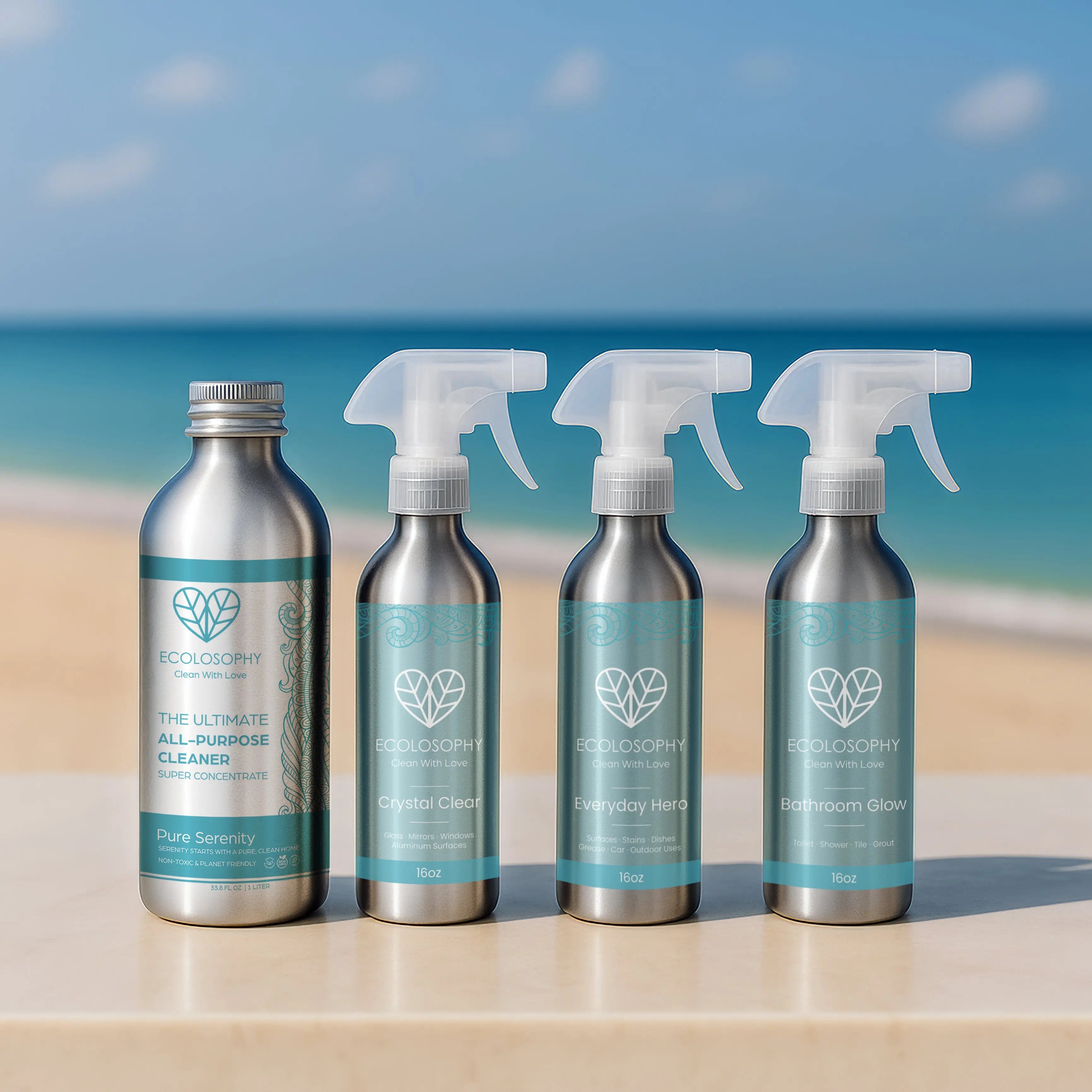
Short answer: EWG Verified is a strict paid mark with a free-of list and full fragrance disclosure — useful, not the only proof a cleaner is honest. Yuka and Think Dirty only grade disclosed ingredients and often ignore concentration. Full disclosure is the real test. Prefer a transparent plant-based Ecolosophy concentrate — small-batch, made with care.
You scan the bottle, open Yuka, point your phone at the barcode, and wait for a number. If it’s green, it goes in the cart. We get it — that’s how a lot of us shop now. But here’s the honest version: a rating is a starting point, not a verdict. EWG Verified is a real, strict mark. Yuka and Think Dirty are useful. And the thing that actually protects your family is knowing every single ingredient in the bottle.
That last sentence is the whole guide. Everything below is how to act on it without getting fooled by a green checkmark.
Which cleaning product rating actually protects your family?
A high Yuka or EWG score is a starting point, not a verdict. EWG Verified is a rigorous mark with a strict free-of list and full fragrance disclosure, while Yuka and Think Dirty can disagree, ignore concentration, and miss what’s not on the label. Full ingredient disclosure is what actually protects your family.
What “EWG Verified” really means
EWG Verified is not the same as “this product appears in EWG’s database” or “this brand says it’s clean.” It’s a certification with published, specific requirements. To carry the mark, a cleaning product has to clear a real bar (EWG Verified program criteria):
- It can’t contain anything on EWG’s “unacceptable” list. These are ingredients EWG has flagged for health or environmental concerns. No exceptions, no “but it’s only a little.”
- It has to fully disclose every ingredient — including fragrance. This is the part most people miss. A product can’t carry the mark and then hide a dozen undisclosed chemicals behind the single word “fragrance.” If there’s a scent, the components get disclosed. (More on why that word is a trap in the fragrance loophole.)
- It has to meet standards beyond the ingredient list. That includes limits on VOCs (volatile organic compounds that affect your indoor air quality), restrictions on ingredients of concern, and honest, legible labeling.
So when you see the EWG Verified mark on a cleaner, it’s earned and it means something. Same goes for the broader EWG Guide to Healthy Cleaning, which grades thousands of products A to F based on hazard and disclosure.
Here’s the part nobody at these companies likes to say out loud: EWG Verified is a paid certification program. Brands apply and pay to be reviewed. That doesn’t make the standard weak — the criteria are genuinely tough. But it does mean a fantastic, fully transparent product might simply never have applied. The seal is a great shortcut. Its absence is not a guilty verdict. Don’t let a missing mark talk you out of a product that discloses everything and holds up when you read it.
How Yuka & Think Dirty score cleaners — and where they fall short
Yuka and Think Dirty changed the game. They put a hazard database in your pocket and made ingredient research something you can do in the cleaning aisle in ten seconds. We love them for that. We use them. But you have to understand what they can and can’t do.
They grade the ingredients a brand chooses to disclose. A rating app reads the listed ingredients, matches them to a hazard database, and produces a score (Yuka). That’s powerful — and it’s also the ceiling. The app can only judge what’s on the label. If a brand lists “fragrance” with no breakdown, the app is grading a black box. It physically cannot see what you can’t see.
They usually don’t account for concentration. This is the big one. The same ingredient at a trace, rinse-off level is a different story than that ingredient as a primary component you spray and leave on a surface your toddler licks. Most apps treat an ingredient’s hazard score the same regardless of how much is in the bottle or how the product is used. Dose and exposure matter, and a single hazard flag doesn’t carry that nuance.
They disagree with each other. Scan the same product into Yuka, Think Dirty, and EWG’s database and you can get three different impressions. Each uses its own data, its own scoring math, and its own way of weighting fragrance and “ingredients of concern.” That’s not a bug you should be angry about — it’s proof that no single number is the answer. When the apps disagree, the tiebreaker should always be the same: how much did the brand actually tell you?
None of this means delete the apps. It means use them like a smoke detector — they tell you where to look, not what the final answer is.
How to read a rating without getting fooled
A score is a question, not a conclusion. Here’s how to interrogate it in a few seconds:
- Check what’s driving the score. Tap into the rated ingredients. Is the app penalizing a fragrance black box, or a specific named ingredient? “Knocked down for undisclosed fragrance” is a very different situation than “knocked down for a known irritant listed by name.”
- Ask about concentration and use. Is this a leave-on surface spray or a rinse-off product? Is the flagged ingredient a main component or a trace stabilizer? The label and the brand’s disclosure should help you tell.
- Cross-check, don’t worship. If a score surprises you, look the ingredient up yourself or compare apps. One green checkmark from one app is not a force field.
- Weight disclosure heaviest. A product that scores a hair lower but discloses 100% of its ingredients is often a safer bet than a “perfect” score sitting on top of a hidden fragrance blend. You can trust what you can see.
If you want the deeper version of this, we walk through it step by step in reading an ingredient label in 60 seconds.
What to look for by category
Not all cleaners carry the same risk, because not all of them are used the same way. Here’s how to think category by category.
All-purpose cleaner. You spray this on counters, tables, and high chairs and often don’t rinse it. Leave-on, high-contact. This is where full disclosure and fragrance transparency matter most. Look for named surfactants, no undisclosed “fragrance,” and ingredients you can actually pronounce or look up.
Bathroom and tub cleaner. Often the most aggressive formulas — degreasers, acids, and antimicrobials. Watch for harsh disinfectant chemistry and, again, hidden fragrance. A strong “clean smell” is frequently the tell that something synthetic is masking the work.
Glass cleaner. Usually simpler formulas, but this is a classic home for solvents and that signature blue dye plus heavy synthetic fragrance. Simpler is genuinely better here — fewer ingredients, all disclosed.
Dish soap. High skin contact, used many times a day, and the category where the plant-based vs. synthetic surfactant distinction matters most. Look at what’s doing the cleaning, not just the marketing on the front.
Across every category, the same two red flags repeat: the word “fragrance” with no breakdown, and a front label making big “clean” claims that the back label can’t back up. That gap is exactly what we mean by greenwashing — and it’s everywhere.
Why ingredient disclosure beats a single score
Here’s the truth most brands won’t put on their homepage: a rating is only as honest as the ingredient list it’s reading.
Every tool you trust — Yuka, Think Dirty, the EWG Guide, your own research — depends entirely on the brand disclosing what’s in the bottle. The score is downstream of disclosure. So a brand that hides ingredients behind “fragrance” or vague catch-alls like “cleaning agents” isn’t just keeping a secret from you — it’s making it impossible for any app to grade the product accurately. A high score on an incomplete label is a high score on missing information.
That’s why we keep coming back to one principle: disclosure first, score second. A brand that publishes 100% of its ingredients, breaks down its scent, and tells you what each thing does is handing you — and the apps — everything needed to make a real judgment. A brand that won’t is asking you to trust a number built on a blank. (For the hidden ingredients that disclosure tends to expose, see the hidden toxins in cleaning products.)
Programs like EPA Safer Choice and EWG Verified are valuable precisely because they force disclosure as a condition. The lesson generalizes even when a product doesn’t carry a seal: demand the same transparency the certifications demand.
Where Ecolosophy stands on transparency
We’re going to be straight with you, because that’s the whole point.
We don’t believe the answer is to chase every badge or imply a certification we haven’t earned. What we believe in — and what we build the brand around — is radical, full ingredient disclosure. We publish what’s in everything. No “fragrance” black box. No “proprietary blend” hand-wave. If it’s in the bottle, you get to know about it and what it’s there to do.
Concretely, that means our All-Purpose Cleaning Concentrate is built on plant-based surfactants we name, it comes in a fragrance-free option so there’s no scent mystery to begin with, and it’s a concentrate — fewer ingredients doing more work, instead of a long list padded with fillers. We’d rather earn your trust by showing you the whole list than by flashing a single green number and hoping you don’t ask.
We’re not telling you to skip Yuka or ignore EWG. Use them. Scan us. We want you to. We just want you to do it the right way: read the full list, judge the disclosure, and decide for yourself. That’s what clean actually looks like — not a checkmark you took on faith, but a label you understood. If you’ve ever wondered whether transparent, plant-based cleaners actually clean as well as the harsh stuff, we answer that honestly in do non-toxic cleaners work.
Your 60-second label-check routine
Do this on any cleaner — ours included — before it goes in the cart:
- Flip it over and count. Are the ingredients actually listed? A real list with named ingredients beats a front label full of adjectives.
- Hunt for the word “fragrance.” If it’s there with no breakdown, that’s a black box. Drop the score by a grade in your head until you know what’s inside it.
- Scan one or two unknowns. Use Yuka or Think Dirty on the ingredients you don’t recognize — and remember the score is a flag, not a verdict.
- Ask the concentration question. Leave-on or rinse-off? Main ingredient or trace? Match the concern to the actual use.
- Make disclosure the tiebreaker. Between two products, pick the one that told you more. Every time.
Sixty seconds. No certification required to do it — just the willingness to read. That’s the muscle worth building, because once you have it, no marketing claim and no green checkmark can fool you again.
#cleanwithlove #ecolosophy #nontoxichome #detoxyourlife #plantbasedliving
Sources cited
- EWG Verified for Cleaning Products — EWG Verified program criteria
- EWG's Guide to Healthy Cleaning — EWG Guide to Healthy Cleaning
- Yuka — How the rating is calculated — Yuka product-scanning app (methodology page cited previously returned 404; linking the app's own site instead)
- EPA Safer Choice Standard — EPA Safer Choice