ingredient investigation
Is Plant-Based Cleaner Always Safe? Surfactants, SLES, INCI Names
Plant-based does not mean safe. Two coconut-derived surfactants can have opposite profiles. Here is the label word that tells you which is which.
If a brand can't tell you which surfactant they use, they're hiding the answer — because the answer matters.
— Ecolosophy
Short answer: Plant-based does not mean any one thing chemically. Two surfactants can both start from coconut oil and end as different molecules — one by sulfonation, the other by ethoxylation, which can leave trace 1,4-dioxane. California lists 1,4-dioxane under Proposition 65. The full name on the label tells you which you bought.
Walk into any grocery aisle in 2026 and you’ll find the words “plant-based” stamped on shampoo, dish soap, all-purpose spray, laundry detergent, baby wipes, and toothpaste. The phrase is everywhere because it works — it earns the click, it earns the buy, and it lets brands sidestep the harder question of what’s actually in the bottle.
But “plant-based” is a marketing claim, not a chemistry guarantee. And the loophole is wider than most parents realize.
What Is a Surfactant, and Why Does the Source Not Matter?
A surfactant is the workhorse of any cleaner — the molecule that loosens grease and lifts dirt off a surface so water can carry it away. Every all-purpose spray, dish soap, and laundry detergent on the shelf relies on them.
Here is the part the marketing never tells you: the raw material a surfactant starts from says almost nothing about how safe the finished molecule is. A surfactant built from coconut oil and one built from petroleum can be chemically identical by the time they reach the bottle. And two surfactants built from the same coconut oil can be wildly different. The starting feedstock is the easiest thing to advertise and the least important thing to know.
The Source-Material Trick
Here’s how it works in the real world. A surfactant — the molecule that lets a cleaner cut grease and lift dirt — needs a fatty alcohol as its starting material. That fatty alcohol can come from petroleum (synthetic) or from coconut, palm, or castor oil (plant-derived).
Two formulators can start with the same coconut oil and end up with wildly different molecules:
- Path A — Sulfonation with methyl ester chemistry produces sodium methyl 2-sulfolaurate (MES). Ethylene oxide is not used, so 1,4-dioxane is not a byproduct of the process.
- Path B — Ethoxylation produces sodium lauryl ether sulfate (SLES). The reaction uses ethylene oxide, and traces of a contaminant called 1,4-dioxane carry through into the final ingredient.
Both molecules can legally be called “plant-based” because both started with a coconut. Only one is on California’s Prop 65 carcinogen list.
We previously published a statistic here — that 78% of products labeled “plant-based” contain at least one chemical of concern — attributed to EWG. We went back to check it and could not find that figure in EWG’s published material, so we have removed it rather than leave it standing. What we will say instead is narrower and verifiable: “plant-based” has no legal definition in U.S. cleaning products, so it constrains nothing about which surfactant, preservative, or fragrance is in the bottle.
Why Brands Can Get Away With This
The honest answer is that no one is checking. The FDA explicitly does not regulate the labeling of household cleaners — that authority falls to the EPA’s Toxic Substances Control Act, which governs the chemicals themselves but not the marketing language on the bottle.
So a brand can:
- Source the cheapest ethoxylated surfactant from a contract manufacturer
- Disclose only the surfactant category (“anionic surfactant from coconut”) instead of the specific INCI name
- Print “plant-based” on the front
- Sleep fine because they technically told the truth
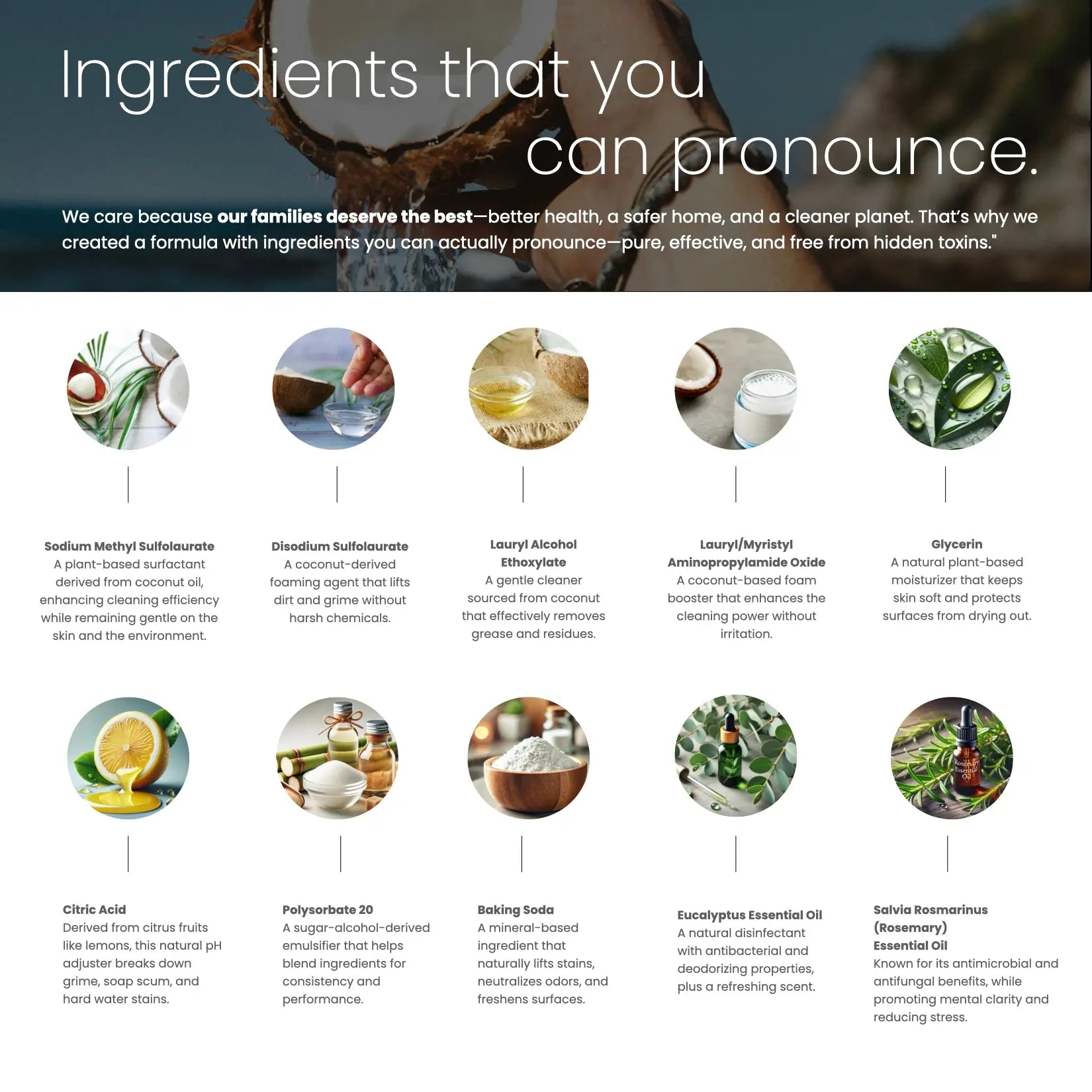
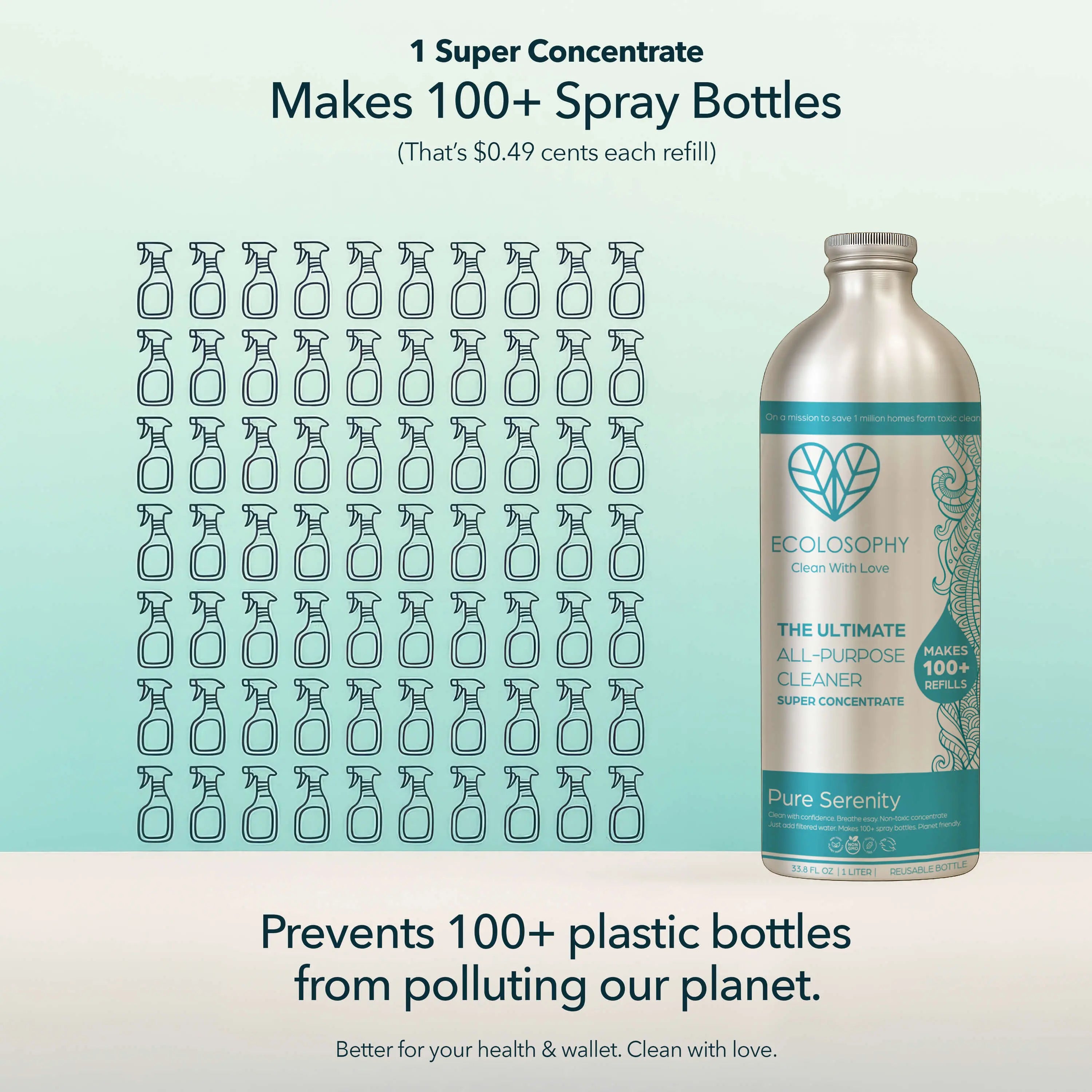
The brands that disclose the full ingredient list are the ones you can actually evaluate. Ecolosophy’s Pure Serenity concentrate publishes its full list of 10 ingredients. Several other brands publish theirs too; check any brand’s own site for a full ingredient page rather than taking a comparison article’s word for it.
The harder a brand makes it to find their ingredient list, the more concerning the list usually is.
How to Read a Cleaner Label in 60 Seconds
The next time you flip a bottle to check the ingredients, look for these signals:
| Signal | What it tells you |
|---|---|
| Full INCI names listed | Brand has nothing to hide |
| Only category names (“surfactant”, “anionic blend”) | Brand is hiding something |
| Contains “lauryl ether” or “laureth” | Ethoxylated — ask the brand whether residual 1,4-dioxane is stripped and to what limit |
| Contains “methyl ester sulfonate” or “MES” | Sulfonated, not ethoxylated — no 1,4-dioxane pathway |
| ”Fragrance” with no specific oils | Up to 4,000 unlisted chemicals possible |
| ”Eucalyptus oil 0.3%, rosemary oil 0.2%“ | Real disclosure |
| EPA Safer Choice seal | Independently verified safer chemistry |
Three quick examples
A label that says only “surfactants”: not enough information to verify, whatever it says on the front.
A label that names “sodium lauryl sulfate”: good, they’re telling you, even though SLS is on many non-toxic do-not-use lists due to skin irritation in concentrated form.
Ecolosophy Pure Serenity Concentrate: lists water, sodium methyl 2-sulfolaurate and disodium 2-sulfolaurate, lauryl alcohol ethoxylate (POE-7), lauryl/myristyl amidopropylamine oxide, glycerin, citric acid, baking soda, polysorbate 20, and eucalyptus and rosemary essential oils. Note that two of those are ethoxylated, so ask any brand, including us, about residual 1,4-dioxane. Whether you choose us or not, this is the disclosure standard to ask for.
Worth separating clearly: the surfactant is what actually removes soil from a surface. Fragrance is a different ingredient, added afterward, with a different job — smell, not cleaning. A formula can be fully effective and rinse with zero surfactant residue while still smelling like almost nothing once it dries. That absence isn’t a sign the surfactant failed; see our full breakdown of why a genuinely clean house smells like nothing at all for the science behind that specific confusion.
The Surfactants You’ll Actually See on a Label
You don’t need a chemistry degree to triage a label. You need to recognize a handful of names. Here is how the common ones sort out:
- Sodium methyl 2-sulfolaurate (MES) — coconut-derived and sulfonated rather than ethoxylated, so 1,4-dioxane is not a process byproduct.
- Decyl glucoside / lauryl glucoside (alkyl polyglucosides) — sugar-and-coconut surfactants, very gentle, widely considered safe for skin contact. Common in genuinely clean formulas.
- Sodium lauryl sulfate (SLS) — coconut-derivable but a known skin irritant in concentrated form. Brands that list it are at least being honest, but it lands on most non-toxic do-not-use lists.
- Sodium lauryl ether sulfate (SLES / sodium laureth sulfate) — the “eth” and “laureth” tell you it was ethoxylated, which is the route by which trace 1,4-dioxane can appear. Reputable manufacturers strip it; the question to ask is whether a given brand does and to what limit.
- Quaternary ammonium compounds (quats) — found in disinfecting sprays and wipes. EPA registers disinfectants as antimicrobial pesticides. Benzalkonium chloride has been documented as a cause of occupational asthma in healthcare staff handling disinfectant solutions (Purohit et al., Int Arch Occup Environ Health, 2000) — an occupational exposure setting, not a household one.
If you want a deeper breakdown of the worst offender on that list, we wrote a full explainer on 1,4-dioxane and another on why quats show up in so many disinfectants.
The Biodegradability Number Nobody Mentions
Surfactants get rinsed down your drain and into wastewater. The relevant standard is the OECD 301 series, which classifies a substance as “readily biodegradable” if at least 60 percent biodegrades within 28 days under conditions simulating municipal water treatment.
The numbers most brands won’t post:
We previously published specific day-by-day biodegradation percentages for MES, SLES, and quats here. We could not trace those figures to a published OECD test result, so they have been removed rather than left standing on an inference. Both methyl ester sulfonates and SLES are generally classified as readily biodegradable under OECD 301; the meaningful difference between them in this article is the manufacturing route and its byproducts, not their biodegradation rate.
Faster biodegradation generally means less persistence in wastewater. If a brand claims a specific rate, ask which OECD test method and which result — that is a question with a checkable answer.
What to Do Tomorrow Morning
You don’t need to throw out every cleaner under your sink today. Start with three steps:
- Pick the cleaner you use most (probably an all-purpose spray) and flip it over.
- Look for any of the red-flag ingredients in the table above. If you find “lauryl ether”, “laureth”, “methylisothiazolinone”, “fragrance” without a breakdown, or any “quat” — that’s your replacement candidate.
- Replace one bottle at a time. Don’t try to detox the whole sink in a day. Pick the next refill, and choose a brand that publishes its full INCI list.
If you want a head start on what to look for, our hidden toxins guide breaks down the most common offenders by category, our 60-second label-reading guide turns all of this into a quick aisle checklist. If you’d rather skip the detective work, every Ecolosophy concentrate prints its full ingredient list on the label, and our free Academy walks you through detoxing your home one bottle at a time.
The single most useful question to ask a cleaning brand: “Can you send me the full INCI list of every surfactant in this product?” The brands that answer in one email are the ones worth your money. The brands that need a week to “check with their formulator” are usually the ones hiding the ethoxylation.
Plant-based means almost nothing on its own. The chemistry behind the molecule is what matters — and that’s a label you have to learn to read for yourself.
Sources cited
- EWG — Guide to Healthy Cleaning — Third-party ratings database for household cleaning products and their ingredients
- California Proposition 65 — 1,4-Dioxane listing — 1,4-dioxane is listed under Proposition 65 as causing cancer, listed 01/01/1988 on the basis of the State's Qualified Experts, with a cancer safe-harbor level of 30 micrograms per day
- U.S. EPA — Safer Choice Program — EPA's voluntary program for cleaning products; ingredient disclosure for household cleaners is not federally mandated, which is why a voluntary program exists at all