ingredient investigation
Do Non-Toxic Cleaners Work? Surfactants, Plant-Based, Grease
Do non-toxic cleaners actually work? Yes — plant-based surfactants lift grease the same way conventional ones do. Here's the science.
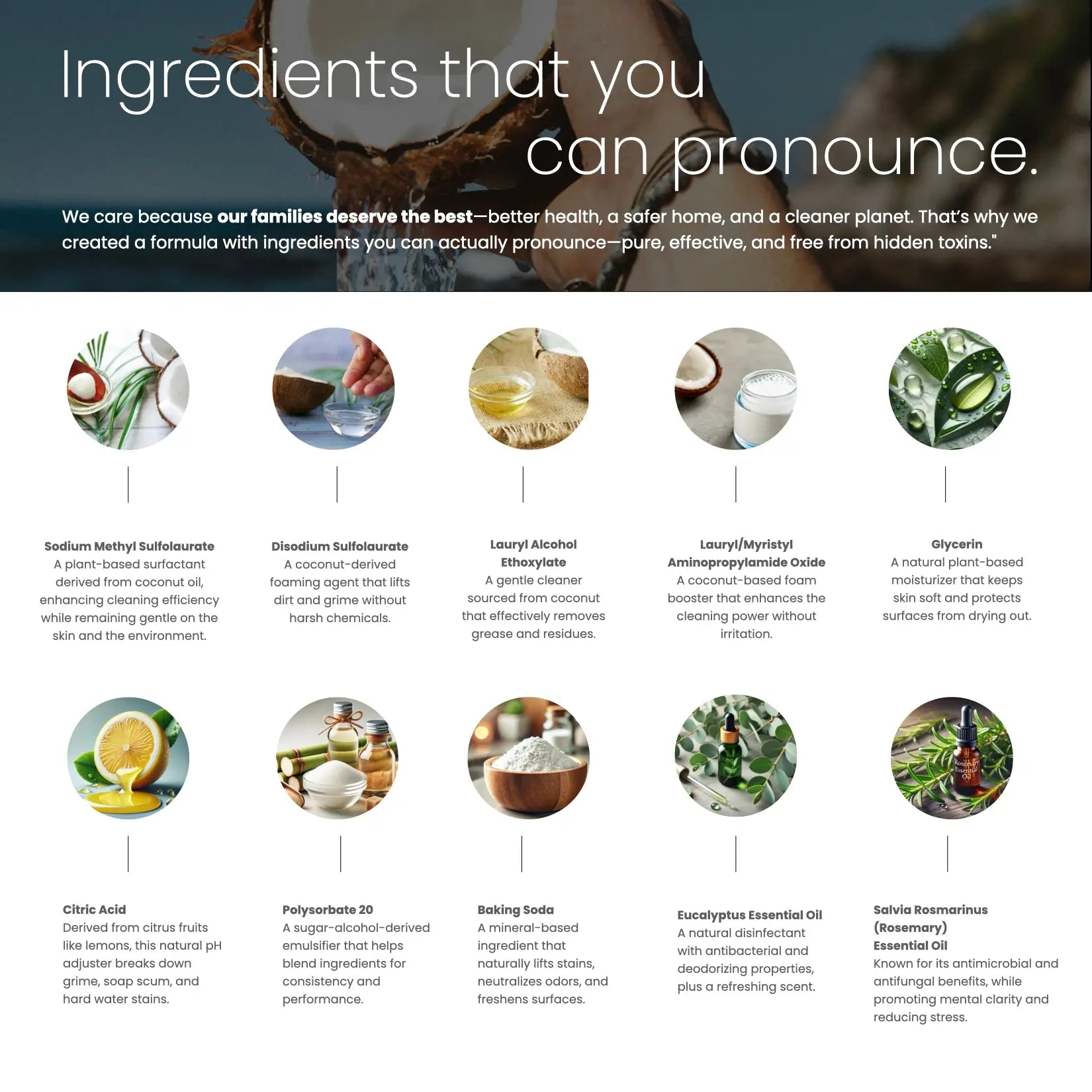
Plant-based surfactants didn't copy the cleaning model. They invented it. Soap is plant chemistry.
— Italo Campilii, co-founder, Ecolosophy
Short answer: Yes — non-toxic cleaners work. All cleaning runs on surfactants that lift grease into micelles, and plant-based surfactants match or beat synthetics like SLS on most household soils. If a “natural” cleaner failed you, it was usually watered down, not the chemistry. Consider an Ecolosophy concentrate — small-batch, made with care — for everyday messes.
That’s the short answer. Here’s why so many people doubt it.
The most common pushback against switching to plant-based cleaning isn’t “I don’t care about toxins” — it’s “do they actually work?”
Fair question. Most “natural” cleaners on store shelves are watered-down, weakly formulated, or rely on synthetic surfactants disguised by green marketing. If you’ve tried a few and decided plant-based doesn’t clean, you weren’t wrong. You were just buying the wrong products.
Real plant-based cleaners absolutely work. The science is straightforward. Let’s walk through it.
The Chemistry of Cleaning
All cleaning, at the molecular level, comes down to one mechanism: surfactants.
A surfactant is a molecule with a water-loving head and a grease-loving tail. When you spray a cleaner on a dirty surface, the surfactant’s tail attaches to grease and grime; its head pulls those soils into the water. The combination forms tiny spheres called micelles that lift dirt from surfaces and suspend it in water so it can be wiped or rinsed away.
This is exactly how soap works. It’s how dish detergent works. It’s how the bile in your digestive system breaks down dietary fat. It’s how plant-based concentrates clean your home.
The question isn’t “do plant-based surfactants work?” — they invented the model. The real question is “are plant-based surfactants as effective as synthetic ones?”
The answer, in published surfactant chemistry research: yes, with measurable advantages on most household soils.
Why Plant-Based Often Outperforms Synthetic
Synthetic surfactants — sodium lauryl sulfate (SLS), sodium laureth sulfate (SLES), and quaternary ammonium compounds (quats) — were developed during the post-WWII industrial boom for one reason: they were cheap to produce at scale.
Cheap, not better.
Plant-based surfactants like decyl glucoside (from coconut and corn), coco glucoside, and alkyl polyglucosides are:
- Gentler on surfaces. SLS strips finishes and degrades sealants over time. Plant glucosides don’t.
- Equally effective on most household soils. Peer-reviewed studies in detergent chemistry journals have shown plant glucosides match or exceed SLS on grease and protein soils.
- Better at low concentrations. Concentrate formulas like Ecolosophy dilute at 1 capful per 16 oz, so you control the strength.
- Biodegradable. Most plant surfactants break down in water within 28 days. Quats persist for months.
If you’ve used a “natural” cleaner that didn’t work, you were probably using one with weak surfactant concentrations or padded with water and “fragrance” doing the perceptual work.
What the Research Says About Conventional Cleaners
Here’s the part most cleaning brand marketing doesn’t mention.
The EPA reports that indoor air can carry concentrations of some pollutants two to five times higher than typical outdoor air, and household products—including cleaners—are a documented source of volatile organic compounds (VOCs) indoors (EPA, VOCs and Indoor Air Quality). The pollution you can’t see often comes from the products you spray, wipe, and mop with every day.
VOCs released by conventional cleaners have been studied in connection with:
- Respiratory irritation and asthma symptoms, with young children among the more vulnerable groups
- Sensitization from fragrance compounds, which can trigger allergic and asthmatic responses
- Eye, nose, and throat irritation during and after use in poorly ventilated rooms
One of the more careful studies on this comes from Canada’s CHILD Cohort, published in CMAJ in 2020: researchers scored how often 26 household cleaning products were used in the homes of 2,022 infants at 3-4 months of age, and found that more frequent use was associated with higher odds of recurrent wheeze (adjusted OR 1.35, 95% CI 1.11-1.64) and of an asthma diagnosis (adjusted OR 1.37, 95% CI 1.09-1.70) at age three — with no increase in the odds of atopy (Parks et al., CMAJ 2020).
To be precise about what that study does and doesn’t say: it shows an association, not proof that any single ingredient causes asthma. But it’s a large, well-designed birth cohort, and it points in a consistent direction—the products we aerosolize in our homes are not chemically neutral. For a fuller breakdown of what’s actually in conventional formulas, see our guide to hidden toxins in cleaning products, and for the hormone-signaling angle, the endocrine disruptors hiding under your sink.
The “convenience” of synthetic cleaners is paid for, in part, by your family’s lungs.
What “Effective” Actually Means
When we say Ecolosophy effectively cleans, here’s what we mean specifically:
- Removes dirt, grime, and residue — including the soils that harbor most household germs — through surfactant action
- Cuts kitchen grease as well as conventional all-purpose cleaners (orange peel oil contains d-limonene, a natural degreaser used in industrial cleaning for decades)
- Lifts soap scum from glass without ammonia
- Wipes hard-water residue from stainless steel without bleach
- Cleans high-touch surfaces — rinse any surface a child mouths
What we don’t claim: registered antimicrobial efficacy. That requires EPA registration, which we do not have. The concentrate removes dirt, grease and grime; it is not a disinfectant.
For routine cleaning, plant-based does the job. For pathogen-specific situations (raw meat, illness recovery), pair Ecolosophy with a separate EPA-registered product on those specific surfaces.
Plant-Based vs. Conventional: Head to Head
It helps to put the two side by side on the things that actually matter at the counter—not the marketing, the mechanics.
| What matters | Conventional cleaner | Plant-based concentrate |
|---|---|---|
| How it cleans | Surfactants (often SLS/SLES) lift soil into micelles | Surfactants (named on the label) lift soil into micelles—same mechanism |
| Grease cutting | Strong, often with added solvents | Strong; d-limonene from citrus peel is a proven degreaser |
| Biodegradability | Quats and some synthetics persist longer in water | Manufacturer wording: expected to be readily biodegradable |
| Fragrance | Often undisclosed “fragrance” blends | Disclosed scent or fully unscented |
| VOCs in your air | Frequently elevated, especially sprays | No synthetic fragrance load |
| Cost per use | Pay to ship 90%+ water in every bottle | Concentrate adds water at home—far less per clean |
The cleaning column on both sides reads the same because the cleaning is the same. The difference is everything around the surfactant: what’s added, what’s hidden, and what you breathe afterward. We dig into the shipping-water economics in why we sell concentrate.
Three Myths Worth Killing
“Plant-based can’t cut grease.” D-limonene, the compound in orange essential oil, has been used as an industrial degreaser for decades. Plant chemistry isn’t the weak option here.
“If it doesn’t have warning labels, it isn’t strong enough.” Warning labels flag hazard to you, not effectiveness on dirt. A formula can be powerful on soils and gentle on skin at the same time—those are different properties.
“Natural means it doesn’t disinfect, so it’s useless.” Routine surfactant cleaning physically removes the grime that harbors most household germs. Disinfecting is a separate, narrower job for specific moments. Conflating the two is how marketing scares you into harsher products than daily life needs.
For the deeper chemistry of why surfactant source changes safety without changing performance, read the surfactant distinction.
The Real Test
The cleanest version of “does it work?” is: try it for a week.
Spray it on the same messes you’ve been spraying for years. Pancake batter on the stovetop. Soap scum on the shower door. Sticky high-chair tray after spaghetti night. Toddler fingerprints on the glass.
If you notice you’re using less product per clean, less elbow grease per wipe, and your house no longer smells like an air-freshener aisle — that’s the answer.
Start with our 33.8oz concentrate — $49.99, makes up to 100 refills, 60-day money-back guarantee.
Clean With Love. — The Ecolosophy Team
Sources cited
- EPA — Safer Choice Standard and Safer Ingredients — EPA Safer Choice Standard, criteria for surfactants and cleaning product ingredients
- EPA — Indoor Air Quality and Volatile Organic Compounds — EPA, Volatile Organic Compounds' Impact on Indoor Air Quality
- CMAJ — Use of cleaning products and respiratory health in a Canadian birth cohort — Parks J, et al. CMAJ. 2020 Feb 18;192(7):E154-E161 (CHILD Cohort Study), PMID 32071106
- OECD 301 Ready Biodegradability Test Guideline — OECD Guideline for Testing of Chemicals, Test No. 301: Ready Biodegradability