research
Are Cleaning Products Making You Sick? VOCs, Asthma, Fragrance
Are cleaning products making you sick? VOCs, asthma links, and fragrance — what the indoor-air research says.

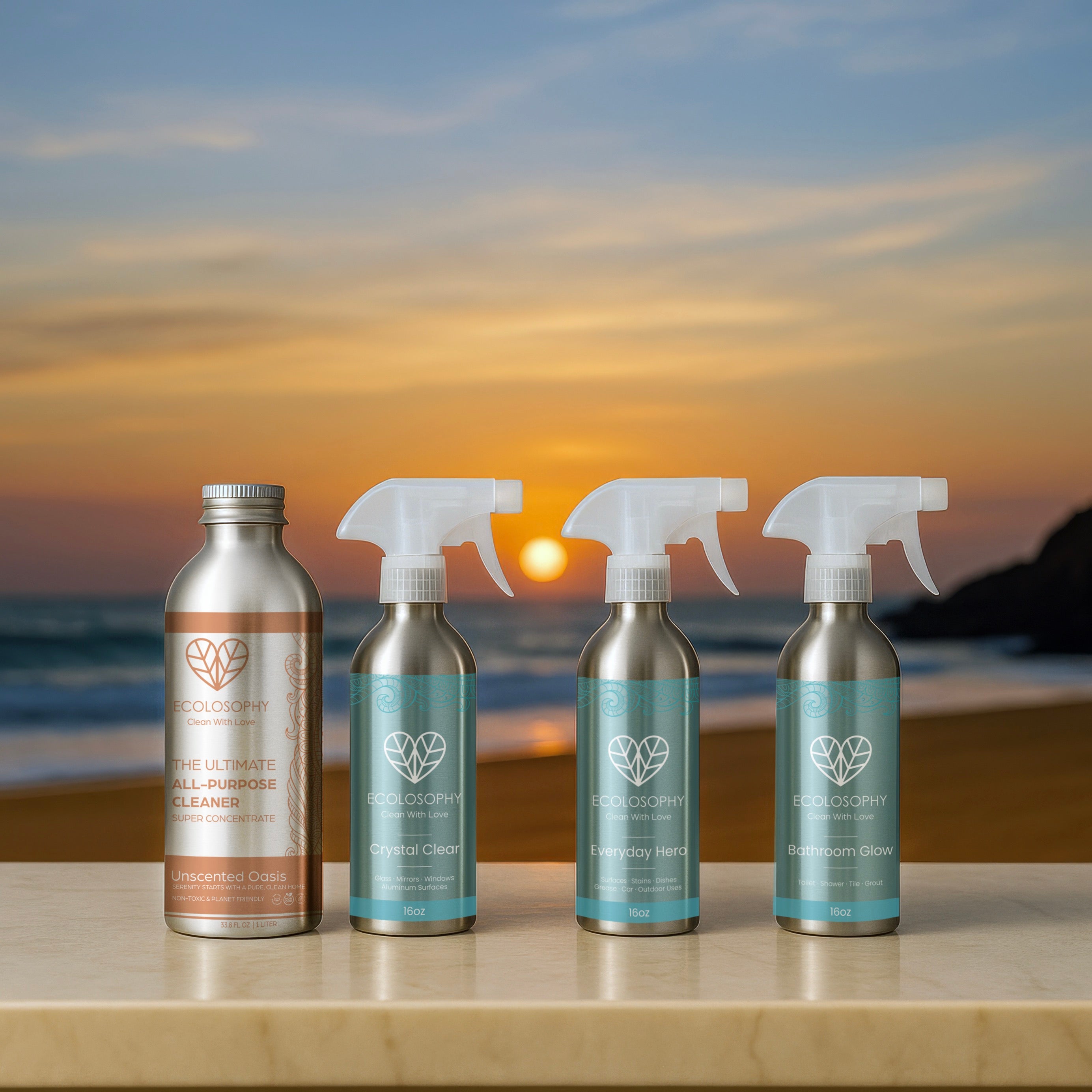
Short answer: Yes — cleaning products can worsen indoor air. EPA estimates indoor pollutant levels are often 2–5× outdoor air, and VOCs from sprays, fragrance, and quats are a major source. Asthma, hormone disruption, and skin sensitization show up in the research. Prefer a fragrance-free plant-based Ecolosophy concentrate — small-batch, made with care — and ventilate while you clean.
You close your windows in winter to stay warm. You close them in summer to run the air conditioning. You run the dishwasher, spray the counters, scrub the toilet, mop the floors — and then breathe everything in.
The Environmental Protection Agency has been studying indoor air quality for decades. Their finding: indoor air pollutant levels are often 2 to 5 times higher than outdoor air. In some cases, up to 100 times higher.
That’s not a typo. Your living room may be more polluted than the street outside.
And one of the most significant contributors to that pollution? The products you use to clean your home.
How Cleaning Products Pollute Indoor Air
To understand why cleaning products affect air quality, you need to understand volatile organic compounds — VOCs.
VOCs are chemicals that evaporate at room temperature. They turn from liquid to gas easily, which means they move from your cleaning products into the air you breathe. Some are harmless. Many are not.
Common cleaning products release VOCs including:
- Ethylene glycol — found in many all-purpose cleaners; linked to liver and kidney damage with repeated exposure
- Terpenes — naturally occurring in citrus and pine-based cleaners; react with ozone in indoor air to form formaldehyde and ultrafine particles
- Glycol ethers — solvents used in many spray cleaners; linked to blood disorders and developmental harm at high exposures
- Acetaldehyde — released by many products with synthetic fragrance; classified as a possible human carcinogen by the International Agency for Research on Cancer (IARC)
When you spray a conventional cleaner on your counter and the droplets settle, the liquid evaporates — and those VOCs move into your home’s air. In a well-sealed, poorly ventilated home (common in winter or with central air conditioning), those compounds accumulate — we go deeper on how this actually plays out room by room here.
The American Lung Association states directly: “cleaning supplies, air fresheners and other household products release compounds that can harm health.”
The Conditions Linked to Chemical Cleaning Exposure
This isn’t theoretical. There is a growing body of peer-reviewed research connecting regular use of conventional cleaning products with specific health outcomes.
Asthma and respiratory symptoms
A 2010 study published in Environmental Health Perspectives followed 3,503 women and found that cleaning spray use at home was associated with an increased risk of adult-onset asthma. The more types of sprays used and the higher the frequency, the stronger the association.
Occupational research has found the same pattern in cleaning workers — people who professionally clean buildings show significantly elevated rates of asthma compared to the general population.
The mechanism is direct: VOCs and aerosol particles from cleaning sprays reach the airways, trigger inflammation, and in sensitized individuals, trigger asthmatic responses (we’ve mapped the specific asthma triggers hiding in everyday cleaners here).
Hormone disruption
Synthetic fragrances are the most common vector for endocrine-disrupting chemicals in cleaning products. Phthalates — the chemical carriers used to make synthetic fragrance last longer — are among the most studied endocrine disruptors.
Phthalates interfere with the body’s hormonal signaling — they’re part of a broader class of endocrine disruptors sitting under your sink right now. Research has linked phthalate exposure to:
- Altered hormone levels in men and women
- Reduced sperm quality and count
- Early puberty in girls
- Developmental effects in children exposed in utero
The problem: fragrance ingredients are legally protected as trade secrets under FDA guidelines. A company can list “fragrance” as a single ingredient, hiding dozens or hundreds of individual chemicals behind that one word. Independent testing by the Environmental Working Group has found phthalates in products that contain no phthalates on their ingredient list — because they were embedded in the fragrance blend.
Skin sensitization
Conventional cleaning products frequently contain preservatives — methylisothiazolinone (MI), methylchloroisothiazolinone (MCI), and related compounds — that are among the most common causes of allergic contact dermatitis. The European Scientific Committee on Consumer Safety has repeatedly tightened restrictions on these preservatives due to their sensitization potential.
Once sensitized, a person reacts to even trace amounts of these compounds — not just in cleaning products, but in personal care products, paints, and other household items that use the same preservative systems.
The cumulative exposure problem
The challenge with cleaning product health effects is that they’re not acute. You don’t spray your counter and immediately fall ill. The effects accumulate over years of daily exposure. By the time a pattern is apparent — recurring respiratory infections, persistent skin reactions, unexplained hormonal irregularities — the connection to cleaning products is rarely considered.
”Natural” vs. “Non-Toxic”: Why the Difference Matters
This is where marketing language causes real harm.
The word “natural” has no legal definition in cleaning products. A company can call any product natural regardless of what’s in it. There is no required testing, no certification body, no enforcement.
“Green,” “plant-based,” “eco-friendly” — same situation. These are marketing terms, not safety standards.
“Non-toxic” is more meaningful, but still not legally defined. However, it can be a useful signal when combined with actual ingredient transparency.
Here’s how to actually evaluate a cleaning product’s safety:
1. Read the ingredient list. If the product doesn’t have a full ingredient list on the label or on the brand’s website, that’s a significant warning sign. Brands with nothing to hide publish everything.
2. Look up ingredients. The Environmental Working Group’s Skin Deep database and EWG Cleaners database rate individual ingredients by health concern level. Run the ingredient list through these databases.
3. Identify fragrance. If “fragrance” or “parfum” appears on the label and the brand does not disclose the full fragrance ingredients, you don’t know what’s in the product. Unscented is safer than “lightly scented” if the brand won’t disclose.
4. Watch for quats. Quaternary ammonium compounds — benzalkonium chloride, alkyl dimethyl benzyl ammonium chloride, and related compounds — appear in many disinfecting cleaners (here’s what quats actually are and where they hide). NIH-funded research has linked them to occupational asthma, and animal studies show reproductive harm at repeated exposures. Their presence doesn’t make a product immediately dangerous, but regular daily use in an enclosed home is worth reconsidering.
A Personal Note From Our Founder
I spent 23+ years with Crohn’s disease. Hospitalizations. Medication cycles. A body that kept fighting something I couldn’t identify — I’ve written more about that connection here.
When I started researching the connection between environmental toxins and gastrointestinal inflammation, I kept finding the same pattern: the gut barrier is exquisitely sensitive to chemical exposures. The immune system responds to things we inhale and ingest, even in small amounts, even from surfaces.
I’m not claiming that switching to plant-based cleaners cured my Crohn’s disease. What I can say is that removing the chemical burden from my home was part of a larger shift toward understanding what my body was being exposed to — and that shift changed everything about how I approached what I put in and on and around my body.
Ecolosophy exists because I needed something that didn’t exist. A cleaner with no synthetic fragrance, no petroleum-derived surfactants, no preservatives I couldn’t pronounce, and no marketing language that hides what’s actually there.
That’s still all we make.
What to Look For When You Transition
You don’t need to throw everything out today. Here’s a practical approach:
Start with what you spray in the air or on food-contact surfaces. Kitchen sprays and air fresheners are the highest-exposure products — they go directly into the air you and your family breathe. Replace these first.
Eliminate synthetic fragrance. Choose fragrance-free or products that disclose all fragrance components. This single change removes more undisclosed chemical exposure than almost any other switch.
Read before you buy. EWG’s database rates thousands of products. Spend five minutes before your next purchase and look up what you’re currently using. The ratings may surprise you.
Look for full ingredient disclosure. Brands that publish every ingredient, including their function, source, and EWG safety rating, have nothing to hide. That transparency is itself a quality signal.
Concentrate format reduces exposure. Pre-diluted spray cleaners require preservatives to remain stable in water for months on store shelves. A concentrate you dilute yourself at home doesn’t require the same preservative load — and generates significantly less plastic waste.
The Question Worth Asking
The next time you open a cleaning product, ask yourself one question: would I be comfortable if my child crawled across the floor I just cleaned, then put their hands in their mouth?
If the answer gives you pause, that’s worth paying attention to.
Clean isn’t a smell. Clean isn’t a chemical reaction you can feel in your sinuses. Clean is a surface that’s free of pathogens and residue — achieved with the gentlest effective chemistry available.
That’s all it needs to be. We keep unpacking questions like this one over on The Detox Journal, our running archive of what’s actually in your home, if you want to keep going.
Ready to transition? Start with the Pure Serenity concentrate — no synthetic fragrance, no quats, no mystery preservatives. Every ingredient listed, sourced, and explained. One bottle replaces 100+ spray bottles. If anyone at home has asthma or sensitivities, the Unscented Oasis concentrate has no scent at all, or browse every concentrate here.
Sources cited
- EPA — Introduction to Indoor Air Quality — EPA documentation that indoor air pollutant levels often exceed outdoor levels by 2–5 times
- American Lung Association — Cleaning Supplies and Household Chemicals — American Lung Association on VOC emissions and respiratory effects of cleaning products
- NIH — Quaternary Ammonium Compounds and Occupational Asthma — NIH-funded research linking quaternary ammonium compounds to occupational asthma
- Environmental Health Perspectives — Cleaning Products and Asthma Risk — EHP study on cleaning product use and asthma risk in women
- FDA — Fragrance in Cosmetics: Trade Secret Disclosure — FDA documentation of trade-secret protections for fragrance ingredient disclosure
- EWG — Cleaning Supplies and Your Health — EWG analysis of undisclosed ingredients in cleaning products