how to
What TSA-Approved Cleaning Products Work for Travel? Concentrate, 3-1-1, Dilution
A 3.38 oz concentrate mini clears TSA 3-1-1 and turns hotel tap water into several 16 oz refills. Here is what any traveler should pack.

The best travel cleaner is the one that fits in your quart bag, works in every country, and doesn't wreck the reef you flew 10 hours to see.
— Italo Campilii, co-founder, Ecolosophy
Short answer: A concentrate mini of 3.4 oz or less clears TSA’s 3-1-1 liquid rule and, diluted with hotel tap water at 1 capful (about ½ tablespoon) per 16 oz, makes several refills — enough for a week. Skip quat-heavy travel wipes when you can. Ecolosophy’s 3.38 oz mini — small-batch, made with care — is sized for the quart bag.
The TSA-approved way to clean on the road is a high-ratio concentrate. A small bottle clears the 3-1-1 liquid rule (each container must be 3.4 oz or less), and diluted with hotel tap water at the label rate of 1 capful (about ½ tablespoon) per 16 oz it makes several refills of spray — enough to wipe down a week’s worth of surfaces without packing a single quat-laced wipe.
The Quart Bag Problem Nobody Talks About
Picture this: it’s 5:47 a.m. at a security checkpoint, and you’re watching a TSA officer confiscate a $14 bottle of all-purpose spray because it’s 16 oz and you forgot to check. You repack, you’re flustered, and you board a plane knowing that for the next seven days you’ll be wiping down surfaces with whatever single-use wipes came in a gas-station three-pack — quats, synthetic fragrance, and all.
What shows up on those wipes — quaternary ammonium compounds, and parfum listed as a single ingredient that can mask dozens of undisclosed chemicals per EWG’s ingredient database — is enough reason to pack something better. This article explains what any traveler, whether they use our product or not, should know before they pack.
What TSA Actually Says (and What It Means for Cleaners)
The TSA’s 3-1-1 rule is simpler than most people realize: each liquid, gel, aerosol, cream, or paste container must be 3.4 fl oz (100 ml) or smaller; all containers must fit in a single quart-sized clear zip-top bag; each passenger gets one bag. That’s it. The rule applies equally to cleaning concentrates, hand soap, and shampoo — there is no special exemption or additional category for cleaning products.
What this means in practice: a standard 16 oz or 32 oz spray bottle of any cleaner is automatically disqualified for carry-on. You either check it (adding weight, risk of breakage, and checked-bag fees) or you leave it home. Most travelers default to buying a new bottle at the destination or grabbing wipes at the airport, neither of which is a great solution from a health, cost, or environmental standpoint.
The Concentrate Loophole That Isn’t Really a Loophole
A true cleaning concentrate — not a “concentrated formula” at 3:1, but a high-ratio concentrate — solves this. Ecolosophy’s 3.38 oz (100 mL) mini bottle sits just under the 3.4 oz (100 ml) limit, so it rides in the quart bag. Mix it at the hotel at 1 capful (about ½ tablespoon) per 16 oz of tap water in an empty spray bottle, and one small bottle covers several 16 oz refills — plenty for a week abroad.
The math is simple: the label dilution is 1 capful per 16 oz, so you carry the concentrate and let the hotel tap supply the water.
What to Check in a Travel Concentrate
Travel adds a few questions that don’t come up in standard household cleaning, and the answer to each is on the label or the manufacturer’s safety data sheet.
1. Does it biodegrade where you’re going? Travelers rinse cloths in sinks that drain into municipal systems in countries with varying wastewater infrastructure. The OECD 301F ready biodegradability test is the international standard: a surfactant that passes it breaks down ≥60% within 28 days under standardized aerobic conditions. For Ecolosophy, the manufacturer’s safety data sheet describes the concentrate as expected to be readily biodegradable.
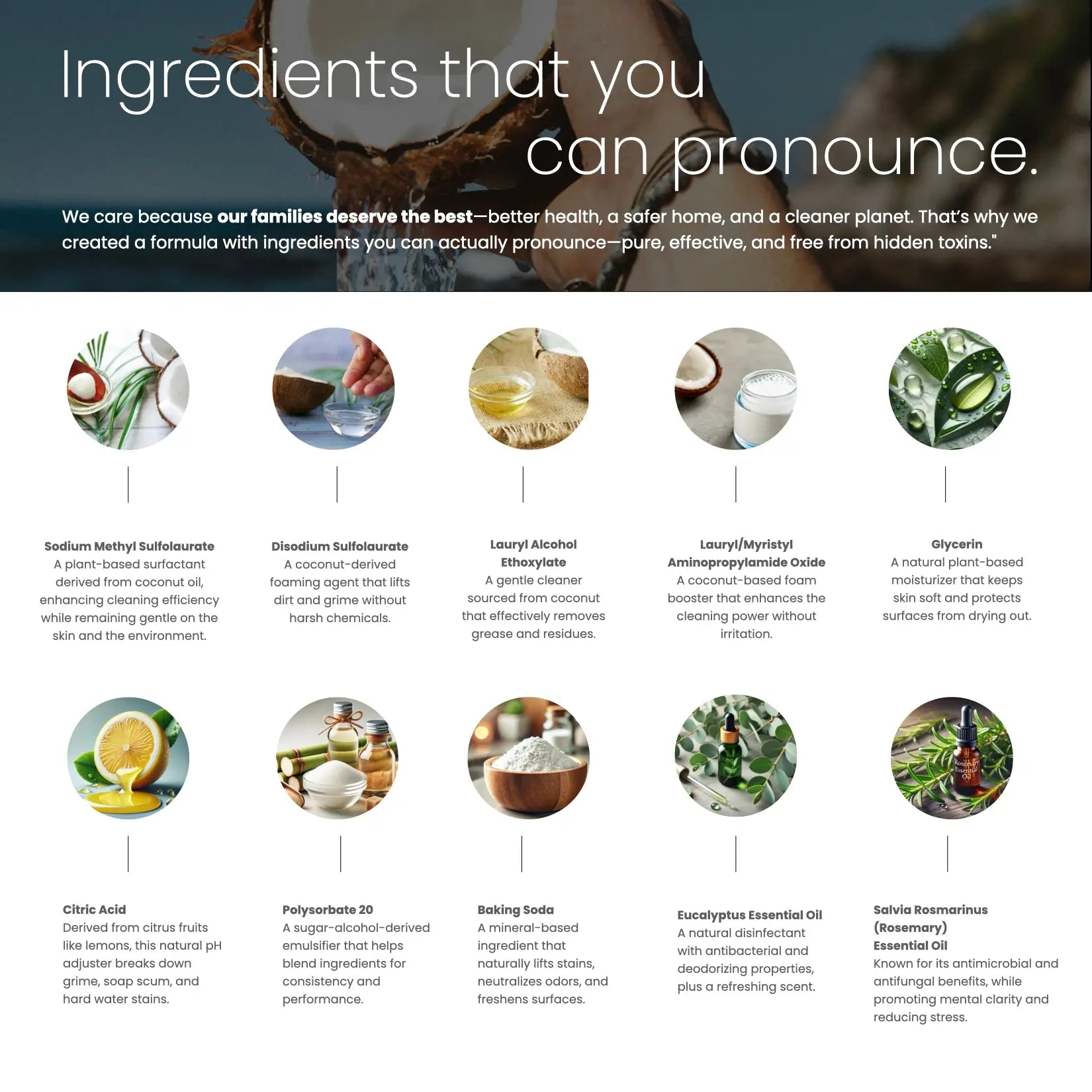
2. Is every ingredient named? Fragrance blends listed only as “fragrance” are the main thing to avoid. Ecolosophy’s Unscented Oasis has no fragrance at all; Citrus Burst and Pure Serenity are scented only with the essential oils named on the label (orange; eucalyptus and rosemary).
3. Is it neutral and easy to handle? The concentrate has a neutral pH (6.5–7.5), but it is an eye irritant and harmful if swallowed, so pack it upright in the quart bag and keep it out of reach of children and pets.
4. Is the packaging travel-stable? Ecolosophy’s minis come in aluminum bottles. Hand-wash them in warm soapy water with the trigger off, and never put them in a dishwasher.
A Note on Fragrance and Travel
This deserves its own paragraph. EWG’s Skin Deep database flags “fragrance” as a term that can conceal anywhere from a handful to over 300 undisclosed chemicals, including known allergens and endocrine disruptors. For travelers with asthma, fragrance sensitivity, or contact dermatitis, conventional travel wipes and sprays with heavy fragrance loads can trigger symptoms in enclosed spaces like planes, hotel rooms with poor ventilation, or rental cars. If you use any cleaner in a closed space, fragrance-free or fully disclosed scent components are not a luxury — they’re a real health consideration. We wrote more about this in our deep dive on hidden toxins in cleaning products.
How Travel Concentrates Stack Up Against the Alternatives
Here’s an honest comparison of the options most travelers reach for:
| Option | TSA Carry-On Legal | Oz of Ready-to-Use Per Oz Packed | Quats/Pesticides | Fragrance Disclosed | Biodegradable (OECD 301F) | Approx. Cost Per Use |
|---|---|---|---|---|---|---|
| Single-use travel wipes (conventional) | ✅ | ~1:1 (wipe = one use) | Often yes | Rarely | Often no | $0.30–$0.60/wipe |
| Mini spray bottle (pre-diluted, 3 oz) | ✅ | 1:1 | Varies | Varies | Varies | $0.10–$0.25/spray |
| Full-size spray (16 oz) | ❌ checked bag only | 1:1 | Varies | Varies | Varies | $0.05–$0.15/spray |
| Concentrate mini (3.38 oz) | ✅ | Several 16 oz refills per mini | No quats | Yes (every ingredient named) | Expected readily biodegradable (SDS) | Mini is $19.95; the 1 L concentrate is about 50¢ per refill |
| Conventional hotel cleaning products | N/A (on-site) | N/A | Often yes | No | Unknown | ”Free” but not free |
The cost-per-use column often surprises people. Single-use wipes feel cheap until you’re using five a day for seven days and realize you’ve spent $10–$21 on wipes alone for one trip. At $49.99 for up to 100 refills, the 1 L concentrate runs about 50¢ a refill, and the $19.95 mini is the carry-on size. Do the same math for any brand before you pack.
For a deeper look at whether non-toxic formulas actually clean as well as conventional ones, see our piece do non-toxic cleaners work, which walks through head-to-head cleaning performance data.
What We Pack (And What You Should Pack)
Here’s the actual travel kit we recommend, whether you use our products or build your own from scratch:
- One concentrate mini of 3.4 oz or less (your quart-bag slot)
- One empty 2–4 oz spray bottle (fill at the hotel)
- Two microfiber cloths (one for surfaces, one for glass — they wash in the hotel sink and dry overnight)
- One bar of fragrance-free castile soap (solid, so not subject to 3-1-1 at all — covers hand-washing and body)
That’s it. Four items replace a dozen single-use products, and the whole kit weighs under half a pound. If you want to travel with something that’s already pre-assembled and tested together, our Pure Serenity Kit is a simple place to start. Check the bottle sizes on the product page against the 3.4 oz limit before you pack.
Understanding why certain surfactants make this work at a chemical level is worth your time if you want to evaluate any concentrate on the market. Our piece on the surfactant distinction breaks down what that label actually means versus what it means on a marketing label.
Your Next Trip Starts With What You Pack Today
Before your next flight, do one thing: pull out whatever cleaning products you currently travel with and check two things on the label. First, look for “fragrance” or “parfum” in the ingredients — if it’s there without further specification, you’re flying with an unknown chemical mixture in a sealed tube. Second, look for any ingredient with “alkyl dimethyl benzyl ammonium” in the name — that’s a quat, and it’s registered as a pesticide with the EPA.
If either of those are present and you’d rather not bring them into a hotel room where your kids sleep or a reef destination where the wastewater eventually goes, it’s worth finding a concentrate that lists every ingredient and passes a real biodegradability standard. You don’t need to buy from us to do that. You just need to read the label before you zip the quart bag.
Sources cited
- TSA 3-1-1 Liquids Rule — Transportation Security Administration — TSA 3-1-1 liquids rule (containers ≤3.4 oz / 100 ml)
- EPA Safer Choice Program — What Makes a Safer Surfactant — EPA Safer Choice safer ingredients criteria
- OECD 301F Ready Biodegradability Test Guideline — OECD 301F biodegradability standard (≥60% in 28 days)
- EWG Skin Deep — Fragrance Ingredient Disclosure Concerns — EWG on undisclosed fragrance chemicals
- EPA Registration of Antimicrobial Pesticides — Quaternary Ammonium Compounds — EPA classification of quaternary ammonium compounds as pesticides