family health
What's the Best Fragrance-Free Floor Cleaner for Pets? Unscented, Oils, Dilute
Fragrance-free is not the same as unscented — and for a pet that reacts to scent, that gap is the whole problem. What the label loophole hides, and how to pick.

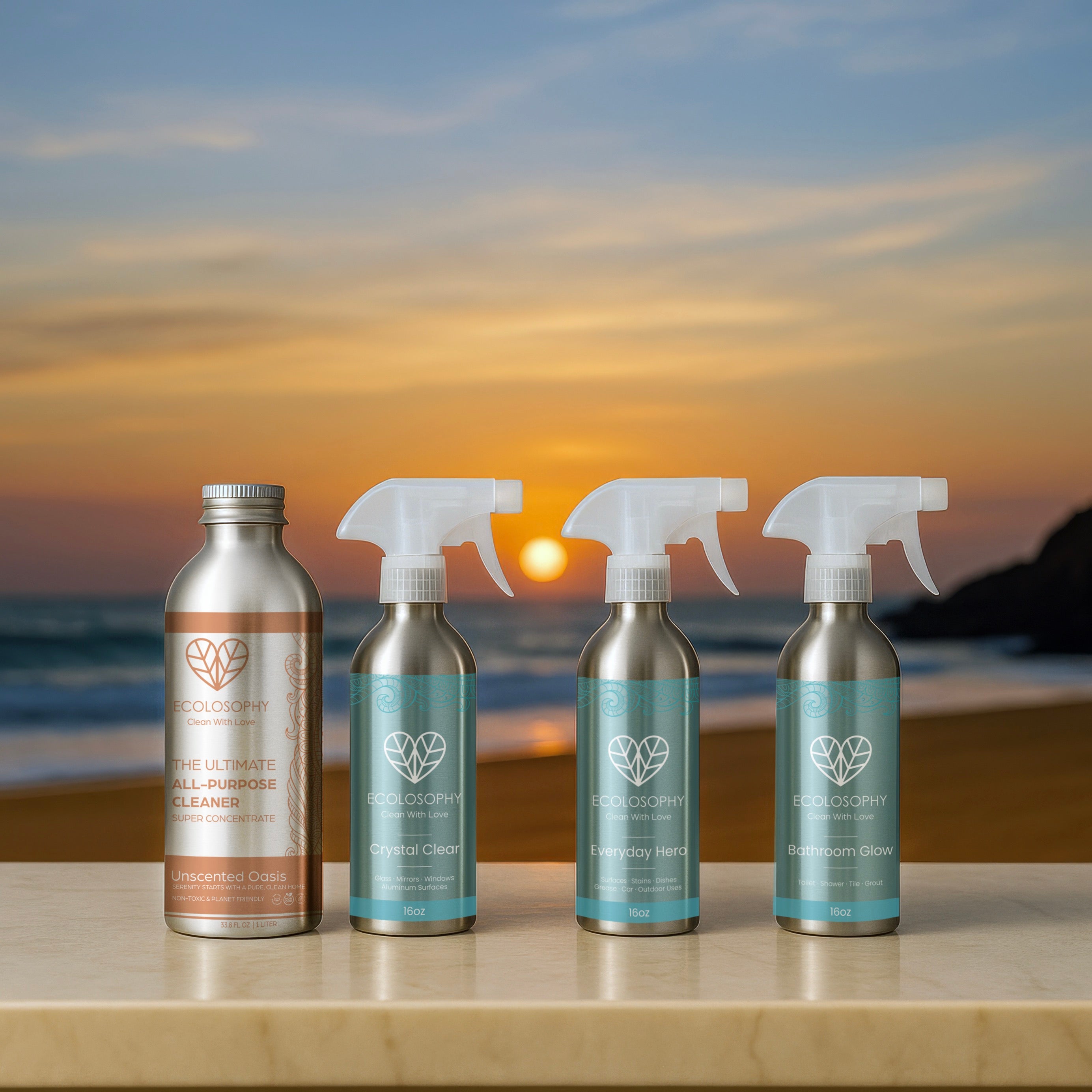
Short answer: For a scent-sensitive pet, choose fragrance-free — not merely unscented. FDA notes unscented products may still use masking fragrance. Skip essential oils if your pet is the one reacting, dilute a concentrate yourself, rinse, and ventilate. Prefer fragrance-free plant-based Ecolosophy concentrate — small-batch, made with care — so every ingredient is named.
Your dog sneezes for twenty minutes after you mop. Or the cat leaves the room — not casually, but leaves, and doesn’t come back until the floor is dry. You’ve already switched to something with a green leaf on the bottle and the word “natural” on the front, and it didn’t help, and now you’re standing in the aisle reading the backs of bottles wondering what you’re even looking for.
Here’s what you’re looking for, and it’s one word — but it isn’t the word most people reach for.
The short answer
For a pet that reacts to scent, buy a cleaner labeled fragrance-free, not unscented — those are different claims, and only one of them is about what’s actually in the bottle. The U.S. FDA states plainly that even some products labeled “unscented” may contain fragrance ingredients, because a manufacturer may add just enough fragrance to mask the unpleasant smell of other ingredients without giving the product a noticeable scent. “Unscented” describes your nose. “Fragrance-free” describes the formula.
Then verify it on the ingredient list — no fragrance, no parfum, and no essential oils named individually, because essential oils are fragrance too and the ASPCA Animal Poison Control Center is direct that concentrated oils are a real hazard to dogs and cats.
And one more honest thing, before you spiral: the ASPCA’s own household-products guide says that most cleaning products are safe to use around dogs and cats as long as they are used per labeled directions. Most pets are fine. This article is for the ones that aren’t — the sensitive ones, the ones already telling you something. If yours is one of them, Unscented Oasis is the format we built for exactly this: no fragrance of any kind, every ingredient published, and a concentrate so you control the dilution yourself.
The label word that hides the whole problem
I want to show you the actual mechanics, because once you see it you’ll never read a bottle the same way.
Under U.S. rules, an ingredient list has to name each ingredient individually — with one enormous exception. FDA explains it in its own words: fragrance and flavor ingredients “can be listed simply as ‘Fragrance’ or ‘Flavor,’” because the ingredient list is required under the Fair Packaging and Labeling Act, and that law “is not allowed to be used to force a company to tell ‘trade secrets.’” Fragrance formulas, FDA notes, are “complex mixtures of many different natural and synthetic chemical ingredients,” and they are “the kinds of cosmetic components that are most likely to be ‘trade secrets.’”
Read that as a pet owner and the problem is obvious. If your dog is reacting to something, and that something is inside a legally protected black box printed as one word, you cannot troubleshoot it. You can’t cross-reference it. You can’t ask the vet about it. You can only remove it.
One accuracy note, because I’d rather be right than dramatic: that FDA page governs cosmetics. FDA itself points out that many fragranced products that aren’t applied to the body — laundry detergents, fabric softeners, dryer sheets, room fresheners, carpet fresheners — are regulated by the Consumer Product Safety Commission instead. A floor cleaner is not a cosmetic. But the labeling convention is the same across the aisle: “fragrance” as a single undisclosed word is the industry norm, not a cosmetics-only quirk. I go deeper on how that convention works in the fragrance loophole, and on the exact “unscented vs fragrance-free” distinction in is fragrance-free the same as unscented?
”Unscented” is a sensory claim. “Fragrance-free” is a formula claim.
Say it out loud once and it sticks.
- Unscented = you can’t smell it. Masking fragrance may still be in there, doing the job of hiding a raw-ingredient odor.
- Fragrance-free = there is no fragrance in it.
For a person with a mild preference, that difference is trivia. For an animal whose sense of smell is orders of magnitude sharper than yours, it’s the entire question. The ASPCA makes this point directly when discussing diffusers: “your pets have a much better sense of smell than we do, so something that seems light to us may be overwhelming to them.” A masking fragrance that registers as nothing to you is not registering as nothing to your dog.
There is a third-party check available here, and it’s worth knowing about. EPA’s Safer Choice program maintains a separate Fragrance-Free designation on top of its main certification, with published criteria and its own review step. On EPA’s product search, certified products carry the line “Safer Choice has verified that these products meet the Safer Choice Criteria for Fragrance-Free Products,” and the database can be filtered to show fragrance-free products only. Notably, the criteria exclude ingredients with dual functionality that could act as a fragrance — which closes exactly the masking loophole FDA described. If you want an outside referee rather than a brand’s word, that’s the one to use.
The essential-oil trap
This is where a lot of well-meaning pet owners get caught, and I’d rather warn you than sell to you.
Swapping a synthetic-fragrance cleaner for one scented with lavender or tea tree oil feels like the safe move. Plants, right? But an essential oil is fragrance — a concentrated botanical fragrance. And the ASPCA Animal Poison Control Center’s position on it is not vague:
“In their concentrated form (100%), essential oils can absolutely be a danger for pets. Dogs and cats who have either walked through oils, gotten some on their coat or had oils placed directly on them can develop health concerns.”
The symptoms APCC lists for that dermal route are unsteadiness on the feet, depression, and — in severe cases — low body temperature. For ingestion, vomiting, diarrhea, and depression. And on potency, they give a number that stops most people cold: “concentrated forms of tea tree oil (melaleuca oil) may cause issues for your pets with only seven or eight drops, whereas another oil may take more or less.”
Seven or eight drops.
Now, fairness matters. A heavily diluted oil inside a finished floor cleaner is not the same exposure as a bottle of neat oil, and the ASPCA’s warning is explicitly about concentrated form and direct application. They also say a diffuser used briefly in a space your pet can’t access “is not likely to be an issue” — unless your pet has a history of breathing problems, in which case they say avoid it entirely. So: essential oils in a cleaner are not automatically dangerous, and I’m not going to tell you they are.
What I am telling you is that “scented with essential oils” is not a pet-safety feature. It is a fragrance choice wearing a wellness costume. There’s no regulator anywhere publishing a “pet-safe essential oils for cleaning” list, because the ASPCA’s own explanation of why — “the variability in concentration, formulation and possible quality of essential oils” — is the reason such a list can’t honestly exist. If your animal is the sensitive one, the reliable move isn’t a nicer fragrance. It’s no fragrance. (We took this apart in more detail in essential oils in floor cleaner: what’s actually toxic to pets, and specifically for cats in are essential oil cleaners safe for cats?)
One more group deserves a flag the ASPCA gives explicitly: birds. Their household-products guidance says to “obtain veterinary advice when using cleaning products around birds, as they are extremely sensitive to the fumes,” and their essential-oil article says to avoid diffusing oils in a house with birds entirely. If you have a parrot, a cockatiel, a finch — this isn’t a preference conversation. Ask your avian vet.
Why cats are the hardest case
If your sensitive pet is a cat, the calculation genuinely changes, and it’s not sentiment — it’s two facts stacking.
Behavior. A cat walks across the floor you mopped, then grooms every one of those paws. Whatever residue is on the floor doesn’t stay on the floor. It becomes something the cat eats, several times a day, without you noticing.
Biology. In 2000, Court and Greenblatt published a paper in Pharmacogenetics with a title that says it all: “Molecular genetic basis for deficient acetaminophen glucuronidation by cats: UGT1A6 is a pseudogene, and evidence for reduced diversity of expressed hepatic UGT1A isoforms.” Glucuronidation is one of the liver’s main assembly lines for tagging certain compounds so the body can flush them. In the domestic cat, a key gene in that family is a pseudogene — present but non-functional — and the diversity of the related enzymes is reduced.
That study is about acetaminophen specifically, and I won’t stretch it past what it says: it does not prove that cats are harmed by floor cleaners. What it does establish is a real, published, species-level difference in how a cat’s liver clears certain chemistry compared to yours. Combine that with a grooming animal walking through everything you mop, and “just use less” is a weaker safety plan for a cat than for a dog. If the cat is your concern, our cat-safe floor cleaner guide walks the whole decision; for dogs, the parallel is the dog-safe floor cleaner checklist.
What the air has to do with it
There’s a second exposure route that has nothing to do with paws, and the American Lung Association is the clearest source on it. Their guidance on cleaning supplies and household chemicals states that “VOCs and other chemicals released when using cleaning supplies contribute to chronic respiratory problems, allergic reactions and headaches,” and that studies “link exposure to chemicals from cleaning supplies to occupational asthma and other respiratory illnesses.”
And here’s the line most “natural cleaning” content skips, which is exactly why I’m including it: “Even natural fragrances such as citrus can react to produce dangerous pollutants indoors.” Natural is not a synonym for inert. That sentence is from the American Lung Association, not from a competitor’s marketing department, and it applies to a lemon-scented “green” cleaner just as much as to a synthetic one.
Their practical instruction is the same one your grandmother would have given you: “When using cleaning or household products, keep the area well ventilated. Open windows and doors. Never use cleaning products in a small, enclosed space.”
I want to be careful here, and you deserve the careful version: none of that says your cleaner caused your pet’s symptoms. Nobody can tell you that from a webpage. What it says is that the air in a closed room during mopping is a real exposure route, that fragrance is the most chemically complex and least disclosed part of what’s in that air, and that opening a window is free.
How to actually run the swap
If your pet is reacting to something, treat this like an experiment, not a purchase.
1. Change one variable. Switch the floor cleaner to a genuinely fragrance-free product and change nothing else — same litter, same food, same detergent, same diffuser habits. If you change four things and the animal improves, you’ve learned nothing you can repeat.
2. Give it two weeks and write it down. Dates, symptoms, severity. Memory is a terrible instrument and you will talk yourself into a result in either direction.
3. Rinse the first few times. Mop, let it dry, then go over the floor with plain water. This is worth doing with any cleaner, and it’s the single highest-leverage habit in a pet home — it removes residue from the surface your animal walks and licks.
4. Ventilate while you work. Window open, door open. Free, per the American Lung Association’s own advice.
5. Do not diagnose your pet. If the symptoms are sudden, severe, or getting worse, call your veterinarian, or the ASPCA Animal Poison Control Center at (888) 426-4435, which operates 24/7. A cleaning-product swap is a good long-term move. It is not first aid.
What we’d put on the floor
Here’s the standard I’d hold any bottle to before it goes near an animal that’s already telling you it’s sensitive:
- Fragrance-free, stated as those exact words — not “unscented,” not “lightly scented,” not “naturally derived scent.”
- Every ingredient published, in full, on the label and online. If a company won’t print it, that silence is the answer.
- No essential oils in the formula, for this specific use case. Not because oils are evil — because for a sensitive animal, the whole point is removing the variable.
- No residual film. Rinse-light, so nothing meaningful stays on the surface your pet grooms off its paws.
- Concentrate format, so you set the strength. When you’re troubleshooting, being able to go weaker on purpose is not a small thing.
That’s precisely what Unscented Oasis is — Ecolosophy’s plant-based all-purpose concentrate with no fragrance at all, every ingredient published, diluted by you, one bottle making 100+ spray bottles. If you’d rather start with the mop, spray bottle, and concentrate together, that’s the Unscented Oasis kit. And if you’re not sure yet whether scent is the culprit, the Trial Kit Trio lets you test the unscented version against the two lightly scented ones in your own home instead of guessing in an aisle.
You shouldn’t have to reverse-engineer a label on behalf of an animal who can’t tell you what’s wrong.
A note on the photo: this post is published without a hero image on purpose. We don’t have a real photograph of this product on a floor in a home with a scent-sensitive pet, and we won’t generate a fake one or buy a stock photo of someone else’s bottle to stand in for ours.
Your pet can’t read the label. You can. See what fragrance-free actually looks like when a company prints every ingredient → If you want the whole decision laid out — quats, residue, dilution, the lot — start with our pet safe floor cleaner guide.
#cleanwithlove #ecolosophy #nontoxichome #detoxyourlife #plantbasedliving
Sources cited
- U.S. FDA — Fragrances in Cosmetics — Even some products labeled 'unscented' may contain fragrance ingredients, because the manufacturer may add just enough fragrance to mask the unpleasant smell of other ingredients; under U.S. regulations fragrance and flavor ingredients can be listed simply as 'Fragrance' because they are most likely to be trade secrets
- U.S. EPA — Safer Choice Criteria for Fragrance-Free Products — EPA maintains published criteria for the Safer Choice Fragrance-Free designation, granted after EPA review confirms a product contains no fragrance materials
- U.S. EPA — Search Products that Meet the Safer Choice Standard — Safer Choice has verified that these products meet the Safer Choice Criteria for Fragrance-Free Products; the product database can be filtered to fragrance-free products only
- ASPCA Animal Poison Control Center — Poisonous Household Products — Most cleaning products are safe to use around dogs and cats as long as they are used per labeled directions; obtain veterinary advice when using cleaning products around birds, as they are extremely sensitive to the fumes
- ASPCA — The Essentials of Essential Oils Around Pets (June 23, 2022) — In their concentrated form (100%), essential oils can absolutely be a danger for pets; dogs and cats who have walked through oils or gotten some on their coat can develop unsteadiness on the feet, depression, and in severe cases low body temperature; concentrated tea tree oil may cause issues with only seven or eight drops
- Court MH, Greenblatt DJ — Molecular genetic basis for deficient acetaminophen glucuronidation by cats: UGT1A6 is a pseudogene (Pharmacogenetics, 2000) — UGT1A6 is a pseudogene in the domestic cat, with evidence for reduced diversity of expressed hepatic UGT1A isoforms
- American Lung Association — Cleaning Supplies and Household Chemicals — VOCs and other chemicals released when using cleaning supplies contribute to chronic respiratory problems, allergic reactions and headaches; even natural fragrances such as citrus can react to produce dangerous pollutants indoors; keep the area well ventilated and never use cleaning products in a small, enclosed space