comparison
Does Mrs. Meyer's Test on Animals? Cruelty-Free, Leaping Bunny, Fragrance
Is Mrs. Meyer's cruelty-free? It's Leaping Bunny certified since 2011 — here's what that verification actually proves, and the one thing it doesn't.

You picked up the bottle because of the bunny.
Not consciously. But somewhere between the lavender label and the checkout line, a little logo did its job, and a question got quietly answered for you: this one’s the kind one. Then you got home, put it under the sink, and a second question showed up — the one the logo never actually answered.
Short answer: No — Mrs. Meyer’s Clean Day does not test on animals. It is Leaping Bunny certified since 2011, and PETA also lists it as cruelty-free. That answers the ethics question only; the brand’s own glossary still lists synthetic fragrance compounds alongside essential oils. Prefer a fully disclosed plant-based Ecolosophy concentrate — small-batch, made with care — if ingredients matter too.
No, Mrs. Meyer’s does not test on animals. It is Leaping Bunny certified, and I opened the Leaping Bunny database myself on August 3, 2026 to check: the Mrs. Meyer’s Clean Day brand page says “Certified since 2011” and marks the brand as a logo user. That’s real. That’s audited. I’m not going to muddy it to sell you something.
But the second question — the one about what’s actually in the bottle — is a completely different question, and the certification was never designed to answer it. That’s the part I want to walk you through, because the gap between those two questions is where almost every shopper gets confused, and it’s not their fault.
The short answer
Does Mrs. Meyer’s test on animals? No.
Mrs. Meyer’s Clean Day holds Leaping Bunny certification. I verified the listing directly in the Leaping Bunny Compassionate Shopping Guide on 2026-08-03. The brand page states “Certified since 2011,” identifies the brand as a Leaping Bunny logo user, and lists product categories including household cleaner, floor cleaner, dish detergent, laundry, soap, and home fragrance.
Separately, PETA’s Ultimate Cruelty-Free List — checked the same day — states: “Yes, Mrs. Meyers Clean Day (The Caldrea Company) is cruelty-free. They ensure that neither their ingredients nor finished products are tested on animals, and their suppliers and third parties follow the same standard.”
Two independent organizations, two separate listings, same conclusion. On the animal-testing question, Mrs. Meyer’s passes cleanly, and it has for over a decade.
What that certification does not tell you is anything about ingredient safety, fragrance allergens, respiratory irritation, or what happens when you breathe the product every day for ten years. Those are separate questions with separate answers, and Mrs. Meyer’s own published ingredient glossary — which is genuinely more transparent than most of the aisle — lists synthetic fragrance compounds right alongside its essential oils. Cruelty-free is an ethics test. It is not a safety test. You have to ask both.
That’s the whole article in four paragraphs. Everything below is the receipts.
Cruelty-free is an ethics test, not a safety test. A product can pass one and still be worth a second look on the other.
Why I checked instead of remembering
Here’s the small confession that shapes this entire piece.
I’ve been writing about cleaning products for years, and I could have told you from memory that Mrs. Meyer’s is Leaping Bunny certified. I’d have been right. But “I’m pretty sure” is exactly how bad information gets laundered into fact across the internet — one blog paraphrases another, a date gets dropped, a certification lapses quietly in 2024, and three years later everyone is confidently citing a status nobody has actually looked at since.
Certifications are living things. Companies get certified. Companies get de-certified. Ownership changes. Leaping Bunny requires annual recommitment — which means a brand’s status is a snapshot with an expiration date, not a permanent tattoo.
So I opened the database. The date is in this article on purpose, and it’s in the FAQ answers on purpose, and if you’re reading this in 2027, I want you to go re-check rather than trust me. That’s not humility theater. That’s the actual method, and the fact that so few articles about “is [brand] cruelty-free” bother with it is the reason this cluster of questions is so poorly served online.
If you want the deeper version of how I read any label — certifications, ingredient lists, and the words that sound regulated but aren’t — I put it in how to read an ingredient label in 60 seconds. And once you start checking things this way, the honest next step is picking products that don’t require this much detective work in the first place — which is the whole reason our Pure Serenity concentrate publishes every ingredient in plain sight.
What Leaping Bunny actually requires — the full standard
Most articles say “Leaping Bunny certified” and move on, as if the phrase explains itself. It doesn’t. So here’s what the published standard actually demands, because the specifics are genuinely impressive and Mrs. Meyer’s deserves credit for meeting them.
The Corporate Standard of Compassion for Animals — the document Leaping Bunny certifies against, published in full on their site — requires that a certified company:
1. Does not conduct, commission, or be a party to animal testing of any cosmetic or household products, “including, without limitation, formulations and Ingredients of such products.” Note how far that reaches. It’s not just the finished bottle. It’s the formulation and every ingredient in it.
2. Does not purchase any ingredient, formulation, or product from any third-party manufacturer or supplier that tested on animals after the company’s fixed cut-off date. This is the load-bearing wall of the whole standard, and it’s the thing most “cruelty-free” label claims quietly skip. Anyone can promise not to test. Very few will commit to a hard, unalterable date and then police everyone upstream of them against it.
3. Must replace or remove any formulation, ingredient, or product found not to comply.
4. Must operate a Supplier Monitoring System — meaning the company has to obtain and provide signed Declarations of Product Compliance and Declarations of Raw Material Compliance from each third-party manufacturer and supplier, and keep them on file at its principal place of business.
5. Shall not allow animal testing to be performed by or for submission to regulatory agencies in foreign countries. This one matters enormously and I’ll come back to it.
And per The Leaping Bunny Difference, certified brands must also be open to independent audits of that Supplier Monitoring System, and renew their commitment annually. More than 2,300 companies currently hold the certification.
Now look back at requirement #5. Leaping Bunny is explicit that testing bans in the EU, India, South Korea, New Zealand, Australia, and several U.S. states still contain loopholes — including one for “animal tests conducted to comply with a requirement of a foreign regulatory authority.” A brand can technically live inside a testing ban and still have animal testing happen on its behalf. Leaping Bunny’s standard closes that door. That’s the actual difference between a certification and a promise.
Micro-lesson worth keeping: when a brand says “cruelty-free,” ask one question — what’s your fixed cut-off date, and do your raw-material suppliers sign to it? If there’s no date and no supplier declarations, you have a marketing sentence. If there is, you have a standard.
Why the certification matters more than the words on the bottle
Here’s the part that reframes everything: “cruelty-free” is not a regulated term. Not loosely regulated. Not weakly enforced. Not defined at all.
The U.S. Food and Drug Administration says so directly: “The unrestricted use of these phrases by cosmetic companies is possible because there are no legal definitions for these terms.”
FDA then lays out precisely how a technically-true claim can still mislead you:
- “Some companies may apply such claims solely to their finished cosmetic products. However, these companies may rely on raw material suppliers or contract laboratories to perform any animal testing necessary to substantiate product or ingredient safety.”
- “Many raw materials, used in cosmetics, were tested on animals years ago when they were first introduced. A cosmetic manufacturer might only use those raw materials and base their ‘cruelty-free’ claims on the fact that the materials or products are not ‘currently’ tested on animals.”
Read those twice. A company can print “not tested on animals” on the front of a bottle while a supplier three links up the chain does the testing, and nobody has broken a law. That’s not a conspiracy theory — that’s the federal agency responsible for cosmetics labeling explaining the mechanism on its own website.
(A note on scope, because I care about being precise: FDA’s guidance here governs cosmetics labeling, and household cleaners sit under a different regulatory umbrella. But the underlying problem is identical — the phrase itself carries no legal definition in either category, which is exactly why an audited third-party standard is what you should be looking for.)
FDA is also clear on a related point people get wrong in the opposite direction: the FD&C Act “does not specifically require the use of animals in testing cosmetics for safety.” Nobody is forced into it by U.S. law. It remains the manufacturer’s responsibility to substantiate safety, and how they do that is their choice.
So the practical takeaway is simple, and it’s the most useful thing in this article: stop reading the front of the bottle and start checking the database. The words are free. The certification costs something — a fixed cut-off date, supplier paperwork, audits, and an annual renewal. That cost is the signal.
The question the bunny doesn’t answer
Now the honest pivot, and I want to make it carefully, because this is exactly the point where most competitor-comparison articles turn into a hatchet job. I’m not doing that.
Leaping Bunny certification tells you how a product was tested. It tells you nothing about what the product is.
There is no line in the Corporate Standard of Compassion for Animals about volatile organic compounds. Nothing about fragrance allergens. Nothing about respiratory sensitizers, preservative systems, or what happens when a toddler with eczema presses both palms on a freshly mopped floor. That’s not a flaw in the standard — it’s a standard about animal testing, and it does that job rigorously. It’s a flaw in how we read it.
We see one certification and unconsciously promote it into a general safety endorsement. Kind to animals becomes kind to my lungs becomes safe for my kid. Three completely different claims, one small logo, zero of that inference actually supported.
The American Lung Association is direct about the category as a whole: “VOCs and other chemicals released when using cleaning supplies contribute to chronic respiratory problems, allergic reactions and headaches,” and notes that studies “link exposure to chemicals from cleaning supplies to occupational asthma and other respiratory illnesses.” That’s true of a cruelty-free product and a non-cruelty-free product alike. The bunny has no opinion on it.
Does Mrs. Meyer’s use synthetic fragrance? Yes — and they tell you
This is the sub-question people are actually searching alongside the cruelty-free one, and it deserves a straight answer with the receipt attached.
Mrs. Meyer’s publishes an ingredient glossary on its own website. Not a vague “our ingredients” marketing page — an alphabetical, searchable list of individual ingredients with CAS numbers, a description of what each one is and does, and the specific products it appears in.
Go look at it yourself and here’s what you’ll find. Plant-derived essential oils, described exactly that way — Abies sibirica oil, CAS 91697-89-1, “Plant-derived essential oil,” “Provides fragrance,” found in the Iowa Pine line. Good. Real.
And you’ll also find entries like Acetylcedrene, CAS 32388-55-9, categorized as a “Fragrance compound,” function listed as “olfactive,” found in a Fall Leaves Multi-Surface Everyday Cleaner. And Acetoin, CAS 513-86-0, listed as a “Component of fragrance.” Many entries across the glossary carry the note: “Additional Information: Contains fragrance allergens.”
So: does Mrs. Meyer’s use synthetic fragrance? Yes — alongside plant-derived essential oils. Both are in there. And I want to be scrupulously fair about what that means, because there are two lazy takes available and both are wrong.
The lazy attack is “synthetic fragrance, therefore toxic.” That’s not supported and I won’t write it. A synthetic aroma molecule is not automatically more hazardous than a plant-derived one — plenty of natural essential-oil constituents are themselves recognized fragrance allergens, which is precisely why the glossary flags essential oils with that same allergen note. Origin is not the same as risk.
The lazy defense is “it’s plant-based, so the fragrance is fine.” Also not supported. Fragrance allergens are fragrance allergens regardless of where the molecule was born, and if someone in your home is fragrance-sensitive or asthmatic, the question that matters is exposure and sensitization, not sourcing.
The genuinely notable thing here is the disclosure itself. Most of the cleaning aisle prints the single word “fragrance” and stops — a trade-secret umbrella that can stand in for a long list of unnamed compounds. Mrs. Meyer’s names them, with CAS numbers, product by product. That is meaningfully better practice than the category norm, and pretending otherwise to make a competitor look bad would make me exactly the kind of source I’m telling you not to trust. If you want the full breakdown of why that single label word is such a problem industry-wide, I wrote it up in the fragrance loophole.
So the fair scorecard on Mrs. Meyer’s reads: cruelty-free — verified yes. Ingredient transparency — genuinely above average. Synthetic fragrance compounds present — yes, and disclosed. Whether that last line is a dealbreaker depends entirely on who lives in your house. For a lot of families it isn’t. For a household with a fragrance-sensitive kid, it might be. That’s your call to make with real information, which is the only thing I’m actually trying to hand you.
If you want the wider view of what “natural” does and doesn’t mean on that particular bottle — including what USDA Biobased certification actually measures — that’s the companion piece: is Mrs. Meyer’s really natural? And if you’d rather see the two brands side by side on ingredients, format, and cost per use, that comparison lives at Mrs. Meyer’s vs. Ecolosophy.
The parent-company question
“Is Meyers cruelty-free even though it’s owned by a bigger company?” comes up constantly, so let me handle it precisely rather than vaguely.
PETA lists the brand as Mrs. Meyers Clean Day (The Caldrea Company) — that’s the corporate entity attached to the listing in the database.
Leaping Bunny’s Compassionate Shopping Guide has a specific visual flag in its legend for a “Company owned by Parent Company that is not Certified.” When I pulled the Mrs. Meyer’s Clean Day brand page on 2026-08-03, that flag did not appear on the listing.
Here’s what to understand about how these certifications scope: Leaping Bunny certifies a company and its supply chain against the Standard. It verifies that certified company’s testing policy and the compliance declarations it holds from its own suppliers and manufacturers. It is not, and does not claim to be, a blanket statement about every product made by every corporate affiliate anywhere in a larger structure.
Some shoppers care about corporate structure as an ethical matter, entirely separate from testing policy — where the profit ultimately flows is a legitimate thing to care about. That’s a values question, not a factual one, and I’m not going to tell you how to answer it. What I can tell you factually is: the brand’s own certification, on the date I checked, is current and unflagged.
What I’d actually check, in order
If you want to settle the cruelty-free question on any product in any aisle, here’s the sequence. It takes about ninety seconds.
1. Ignore the front of the bottle. “Cruelty-free,” “not tested on animals,” a generic bunny illustration that isn’t the Leaping Bunny logo — none of these are regulated, per FDA. Start by treating them as zero information.
2. Search the brand in the Leaping Bunny Compassionate Shopping Guide. If it’s there, read the “Certified since” year on the brand page and check for the not-certified-parent-company flag.
3. Cross-check PETA’s Ultimate Cruelty-Free List. Two databases agreeing is a much stronger signal than one. Note that PETA’s list operates on a signed statement of assurance and covers companies selling in eligible regions; Leaping Bunny layers on the fixed cut-off date, supplier declarations, audits, and annual renewal. Different rigor, both useful.
4. Write down the date you checked. Annual recommitment means status can change. A 2023 blog post asserting a certification is not evidence about 2026.
5. Then — and only then — start the completely separate safety question. Open the ingredient list. Look for what the fragrance is, whether individual components are named, and whether allergens are flagged. The bunny got you through step one. It has nothing to say about step five.
That fifth step is where most people stop, having felt like they already did their homework. They didn’t. They did half of it, and the half they skipped is the one their family actually breathes.
Where we sit — including what we don’t have
Our founder spent 23+ years with Crohn’s disease, in and out of hospitals, before anyone in his life connected chronic illness to what was stored under the kitchen sink. That’s not a marketing origin story we reverse-engineered. It’s the reason this company exists, and it’s why ingredient transparency isn’t a feature here — it’s the entire premise.
So here’s ours, held to the same standard I just held Mrs. Meyer’s to:
Ecolosophy is not Leaping Bunny certified. We are not currently listed on PETA’s Ultimate Cruelty-Free List either. We don’t test on animals and never have — but I just spent two thousand words explaining why an uncertified claim is worth less than an audited one, and I’m not going to turn around and ask you to accept mine on faith. If we complete certification, we’ll publish it with the date and the database link, exactly as I did above for someone else’s brand.
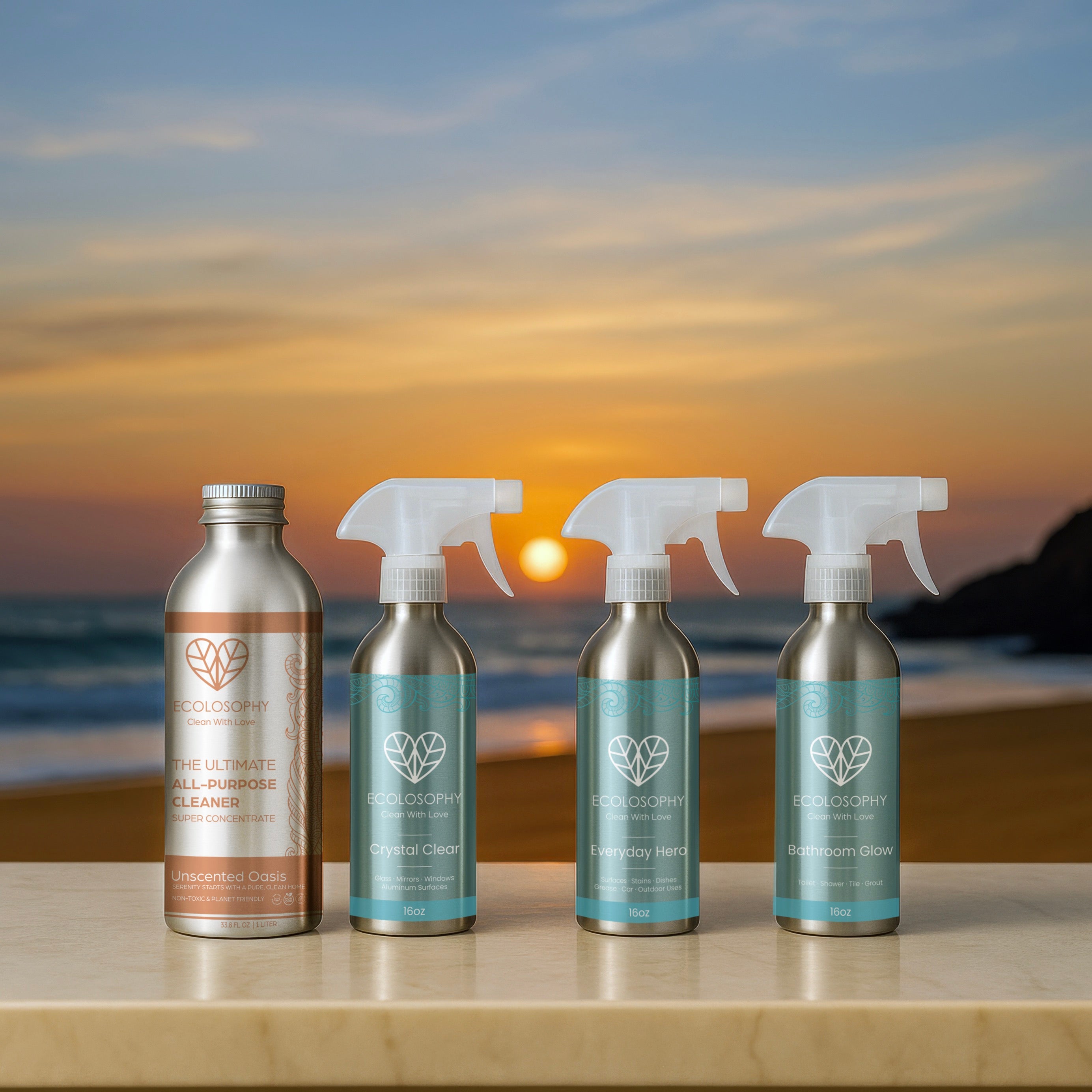
What we do have, and what you can verify today without trusting anybody: every ingredient published, named, in full. No “fragrance” trade-secret umbrella. No component we won’t tell you about. Sugar-derived surfactants instead of petroleum-derived ones. Unscented, or scented only with real essential oils — and if you’re the person who reacts to fragrance no matter its origin, the Unscented Oasis kit has no scent at all, which is the only truly safe answer to a fragrance-sensitivity question.
And it’s a concentrate, which changes the math on everything: one bottle makes 100+ spray bottles. Fewer plastic jugs, a fraction of the cost per use, and one ingredient list to read instead of eleven bottles’ worth.
If you’re not ready to commit to a full-size bottle on the word of a stranger on the internet — genuinely reasonable, and consistent with everything I’ve argued here — the trial kit trio is the low-stakes way to test the claim yourself.
Frequently Asked Questions
Does Mrs. Meyer’s test on animals? No. Mrs. Meyer’s Clean Day does not test on animals. It is certified by the Leaping Bunny Program, and its brand listing in the Leaping Bunny Compassionate Shopping Guide — which I checked directly on 2026-08-03 — reads “Certified since 2011” and marks the brand as a logo user. Leaping Bunny certification requires that neither the company nor its suppliers conduct, commission, or are party to animal testing of finished products, formulations, or ingredients after the company’s fixed cut-off date.
Is Mrs. Meyer’s cruelty-free? Yes. Two independent organizations list it. Leaping Bunny, operated by the American Anti-Vivisection Society using the Standard approved by the Coalition for Consumer Information on Cosmetics, certifies the brand and has since 2011. PETA’s Ultimate Cruelty-Free List separately states that Mrs. Meyers Clean Day (The Caldrea Company) is cruelty-free and that neither its ingredients nor finished products are tested on animals, and that its suppliers and third parties follow the same standard. Both listings were verified on 2026-08-03.
Is Meyers cruelty-free even though it’s owned by a bigger company? Mrs. Meyer’s Clean Day is listed by PETA under The Caldrea Company. Leaping Bunny’s Compassionate Shopping Guide uses a specific visual flag for a “Company owned by Parent Company that is not Certified,” and when I checked the Mrs. Meyer’s brand page on 2026-08-03, that flag did not appear on the listing. Leaping Bunny certification is granted at the level of the certified company and its supply chain, so what it verifies is that brand’s testing policy — it is not a statement about every product made by every affiliated corporate entity.
Does Mrs. Meyer’s use synthetic fragrance? Yes, alongside plant-derived essential oils. Mrs. Meyer’s publishes an ingredient glossary on its own website listing ingredients with CAS numbers and the products they appear in. That glossary includes plant-derived essential oils described as providing fragrance, and it also includes synthetic fragrance compounds — Acetylcedrene, CAS 32388-55-9, is listed as a “Fragrance compound” found in a Multi-Surface Everyday Cleaner. Many entries carry an “Additional Information: Contains fragrance allergens” note. So the honest answer is: both, and the company discloses it.
What does Leaping Bunny certification actually require? Per the published Corporate Standard of Compassion for Animals, a certified company must not conduct, commission, or be party to animal testing of its cosmetic or household products, formulations, or ingredients; must not purchase any ingredient, formulation, or product from a manufacturer or supplier that did so after the company’s fixed cut-off date; must operate a Supplier Monitoring System with signed Declarations of Product Compliance and Raw Material Compliance on file; must not allow animal testing to be performed for submission to foreign regulatory agencies; must be open to independent audits; and must renew its commitment annually.
Is “cruelty-free” on a label legally regulated? No. The U.S. FDA states that “the unrestricted use of these phrases by cosmetic companies is possible because there are no legal definitions for these terms.” FDA also notes that a company may apply the claim only to its finished products while relying on raw-material suppliers or contract labs for any animal testing, or may base the claim on the fact that long-established raw materials are not “currently” tested. That is why an audited third-party certification like Leaping Bunny is more meaningful than the words printed on the front of a bottle.
If Mrs. Meyer’s is cruelty-free, is it also non-toxic? Those are two different questions and the certification only answers the first one. Leaping Bunny verifies animal-testing policy across the supply chain. It does not evaluate ingredient toxicity, respiratory irritation, VOC emissions, or fragrance allergens. A product can be genuinely cruelty-free and still contain fragrance compounds that bother someone with fragrance sensitivity — the American Lung Association notes that VOCs and other chemicals released when using cleaning supplies contribute to chronic respiratory problems, allergic reactions and headaches. Check the certification for the ethics question, and read the ingredient list for the safety question.
Is Ecolosophy Leaping Bunny certified? No. Ecolosophy is not currently certified by Leaping Bunny or listed on PETA’s Ultimate Cruelty-Free List. We do not test on animals and never have, but since this entire article is about why unverified label language is worth less than an audited certification, it would be dishonest to imply we hold one. If and when we complete certification, we’ll say so with the date and the database link — the same standard we’re applying to everyone else here.
You checked the bunny. Good — that’s one real question answered, and Mrs. Meyer’s answered it well. Now turn the bottle around and ask the other one. See what a fully published ingredient list actually looks like → If fragrance is the thing you’re trying to get away from entirely, start with the Unscented Oasis kit.
#cleanwithlove #ecolosophy #nontoxichome #detoxyourlife #plantbasedliving
Sources cited
- Leaping Bunny Program — Mrs. Meyer's Clean Day brand listing — Brand page lists Mrs. Meyer's Clean Day with 'Certified since 2011' and logo-user status; verified 2026-08-03
- Leaping Bunny — The Corporate Standard of Compassion for Animals — Certified companies must not conduct, commission or be party to animal testing; must not purchase ingredients from suppliers that tested after the fixed cut-off date; must operate a Supplier Monitoring System with signed Declarations of Product and Raw Material Compliance; and shall not allow animal testing for submission to foreign regulatory agencies
- Leaping Bunny — The Leaping Bunny Difference — Certified brands must adhere to a fixed cut-off date, set up a Supplier Monitoring System, be open to independent audits, and renew their commitment annually; more than 2,300 companies are certified
- PETA — Ultimate Cruelty-Free List, Mrs. Meyers Clean Day (The Caldrea Company) — 'Yes, Mrs. Meyers Clean Day (The Caldrea Company) is cruelty-free. They ensure that neither their ingredients nor finished products are tested on animals, and their suppliers and third parties follow the same standard.'
- U.S. FDA — "Cruelty Free"/"Not Tested on Animals" — 'The unrestricted use of these phrases by cosmetic companies is possible because there are no legal definitions for these terms'
- U.S. FDA — Animal Testing & Cosmetics — 'The FD&C Act does not specifically require the use of animals in testing cosmetics for safety, nor does the Act subject cosmetics to FDA premarket approval'
- Mrs. Meyer's Clean Day — Ingredient Glossary — Published glossary lists ingredients with CAS numbers and source products, including plant-derived essential oils and synthetic fragrance compounds such as Acetylcedrene (CAS 32388-55-9), with 'Contains fragrance allergens' notes
- American Lung Association — Cleaning Supplies and Household Chemicals — VOCs and other chemicals released when using cleaning supplies contribute to chronic respiratory problems, allergic reactions and headaches; studies also link exposure to chemicals from cleaning supplies to occupational asthma and other respiratory illnesses