

Concentrate Cleaner vs Ready-to-Use: Which One Is Actually Worth It?
Here’s the part the cleaning aisle never tells you: when you buy a ready-to-use spray, you’re paying to ship water in plastic across the country, parking it under your sink, and tossing the bottle in a few weeks. A concentrate flips all of that. Less plastic, less CO2, less money — same clean.
Short answer: Ready-to-use sprays ship water in single-use plastic; a concentrate ships the active cleaner and you add water. An Ecolosophy concentrate makes 100+ bottles — plant-based, fragrance-free options, small-batch, made with care — with strength you control. Keep RTU only when you truly need grab-and-go.
What’s the actual difference between a concentrate and a ready-to-use cleaner?
It comes down to one ingredient: water. A ready-to-use (RTU) cleaner is the spray bottle you grab off the shelf already diluted — pull the trigger and go. By weight and volume, most RTU sprays are somewhere around 90–95% water. You’re paying for a little bit of cleaning power and a whole lot of tap water that’s been pre-mixed, bottled in plastic, and trucked to a store.
A concentrate strips the water back out. Ecolosophy’s All-Purpose Cleaning Concentrate is the active cleaning agents without the filler — plant-based, no artificial scents. You bring the water at home, which is the part that’s free and already in your kitchen. Just add water, shake, clean.
The micro-lesson: a concentrate isn’t a different kind of cleaner. It’s the same cleaner with the dead weight removed. Everything that makes RTU sprays expensive and wasteful — the water, the extra plastic, the shipping — is exactly what the concentrate format deletes. For the exact math, see how one concentrate makes 100+ spray bottles.
Cost-per-use: why one $49.95–$65 bottle beats a cabinet full of sprays
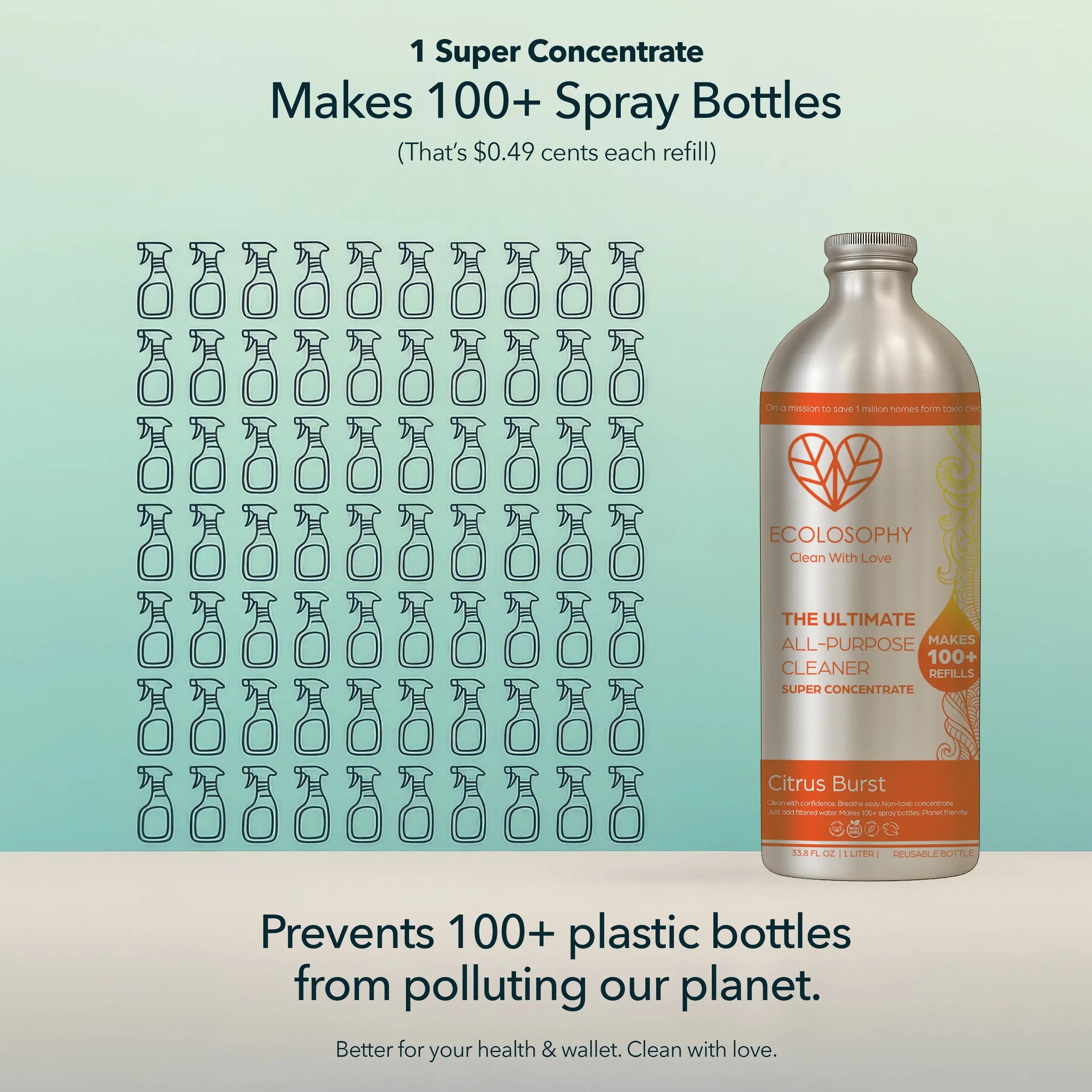
This is where it stops being abstract. A single Ecolosophy concentrate bottle (kit pricing runs $49.95–$65) makes 100+ full spray bottles. Do the division and each finished, ready-to-spray bottle works out to well under fifty cents.
Now compare that to how RTU actually works in a real home. You don’t buy one all-purpose spray — you buy a glass cleaner, a kitchen spray, a bathroom spray, a floor cleaner, a multi-surface spray. Each one is its own plastic bottle, its own checkout line, its own $4–$8. The concentrate replaces dozens of those products because the same disclosed plant-based formula handles counters, glass, floors, and bathrooms once diluted.
So the honest cost comparison isn’t “one concentrate vs. one spray.” It’s one concentrate vs. the rotating cart of single-use sprays most families re-buy every few weeks, forever. One purchase that lasts versus a subscription to plastic you didn’t sign up for.
The plastic problem: how many bottles does ready-to-use actually waste?
Every RTU spray is a plastic bottle that gets used up and thrown out — and most cleaning bottles aren’t made of the easily-recycled plastics, so a large share never actually gets recycled even when you mean well. Multiply one household’s sprays across a year, then across a neighborhood, and you get the ocean-bound bottle problem we exist to fight.
A concentrate breaks the loop in the most boring, durable way possible: you reuse the same spray bottle. One concentrate bottle refills a single trigger sprayer 100+ times. That’s 100+ plastic bottles that never had to be manufactured, filled with water, shipped, sold, and tossed. The plastic you keep is the bottle you already own.
This is the part that turns a cleaning choice into a movement. Ecolosophy’s whole reason for existing is to keep plastic bottles out of the ocean — and the concentrate format is the single most direct way a family does that without thinking about it. You’re not recycling harder. You’re just not creating the waste in the first place.
The carbon math: 42.75 lbs of CO2 saved per bottle
Here’s the inconvenient fact behind RTU convenience: shipping water is shipping weight. When a cleaner is 90%+ water, almost all of the diesel burned to truck it from factory to warehouse to store is spent moving water that was already available, for free, at the destination. That’s pure wasted carbon.
By concentrating the formula and letting you add the water at home, each Ecolosophy bottle avoids roughly 42.75 lbs of CO2 on our own lifecycle estimate — the emissions tied to manufacturing, filling, and freighting all that extra water and all that extra plastic you’d otherwise buy. Less weight to ship, fewer bottles to make, fewer trucks on the road.
The micro-lesson: the most sustainable thing about a concentrate isn’t a clever ingredient. It’s subtraction. Remove the water, and the plastic, freight, and carbon all shrink together. If you're weighing what "sustainable" and "non-toxic" really mean on a label, we break that down honestly here.
Storage and space: a cabinet you can actually close
There’s a smaller, more human win here too. RTU means a cabinet stuffed with half-full bottles — the glass cleaner behind the floor cleaner behind the bathroom spray you forgot you had. A concentrate collapses that into one compact bottle plus the spray bottles you refill on demand.
One bottle on the shelf makes 100+ — so instead of stockpiling, you mix what you need when you need it. Less clutter under the sink, fewer trips to the store, no “are we out of the kitchen one?” mid-clean. The format that’s lighter to ship is also lighter to live with.
Concentrate vs. ready-to-use: the honest side-by-side
| What matters | Ready-to-use spray | Ecolosophy concentrate |
|---|---|---|
| What’s in the bottle | Mostly water (often ~90%+), pre-diluted | Active plant-based cleaning agents — you add water at home |
| Bottles per purchase | One spray bottle, used up in weeks | 100+ spray bottles from a single concentrate |
| Cost per finished spray bottle | Full retail price every refill ($4–$8 each) | Well under $0.50 each ($49.95–$65 kit makes 100+) |
| Plastic waste | A new bottle thrown out every time | Reuse one spray bottle 100+ times |
| Carbon footprint | Ships water + plastic across the country | ~42.75 lbs CO2 saved per bottle (our lifecycle estimate) |
| Storage | Multiple bulky bottles per surface type | One compact bottle + refillable sprayers |
| Ingredients | Varies by brand — check the current label | Plant-based, no artificial scents; family, pet & planet safe |
| Day-one convenience | Grab and spray immediately | One-time dilution, then grab and spray |
Note for honesty: exact water percentages, prices, and ingredient lists vary by brand and product — always check the competitor’s current label and site for their specifics. The pattern, though, is consistent: RTU sells convenience by shipping water and plastic, and a concentrate removes both.
Is the convenience trade-off real?
Let’s be fair to RTU, because greenwashing cuts both ways. The one genuine advantage of a ready-to-use spray is day-one convenience: zero setup, no measuring, instant. For a single rental you’ll leave in a month, that might be enough.
But the “convenience” is front-loaded. After the first thirty-second dilution, a concentrate is exactly as convenient as RTU — you grab the same spray bottle and pull the trigger. The difference is that you do the easy mixing step a handful of times a year instead of paying the plastic-and-carbon tax on every single bottle for the rest of your life. Add water once; save money and waste forever.

Why this got personal for us
“I've battled Crohn’s disease for 23+ years, in and out of hospitals. This is my personal account, not a medical claim — no cleaning product treats or resolves Crohn’s, and I still manage it with my doctors. What it did do was make me pay much closer attention to what I was breathing and touching at home. When we built Ecolosophy, the concentrate format wasn’t a marketing gimmick — it was the honest answer. Why ship water and plastic around the country when the water’s already in your kitchen? Strip it out, disclose every plant ingredient, make it in small batches with care, and you get something cleaner for your family and the ocean at the same time.”
Who should switch — and who maybe shouldn’t
The concentrate is the clear choice if you’re a household that cleans regularly, cares about what your kids and pets touch, and is tired of re-buying plastic. The savings — money, plastic, carbon — compound the longer you use it, and one bottle replaces dozens of products you’d otherwise juggle.
The only case where RTU edges ahead is true one-off use: a single quick job, a place you won’t live long enough to refill twice. For everyone running an actual home, the math runs one direction. One concentrate. 100+ uses. Zero shipped water.
Frequently asked questions
How many spray bottles does one concentrate really make?
Ecolosophy’s All-Purpose Cleaning Concentrate makes 100+ ready-to-use spray bottles from a single bottle. You add water at home to dilute it, so one purchase replaces dozens of single-use sprays instead of one.
Is a concentrate actually cheaper than ready-to-use?
Yes, on cost-per-use. A $49.95–$65 kit makes 100+ finished spray bottles, which works out to well under $0.50 each — far less than the $4–$8 you pay every time you re-buy a single RTU bottle. Because the concentrate also replaces multiple separate cleaners, most families come out well ahead over a year.
How much CO2 does switching save?
Each Ecolosophy concentrate bottle saves roughly 42.75 lbs of CO2 on our own lifecycle estimate, mostly by not shipping water and extra plastic across the country — you supply the water at home for free.
Is diluting a concentrate complicated?
No. You just add water to a spray bottle per the dilution guide and shake — it takes seconds, and after that it’s exactly as easy to use as any ready-to-use spray. See our dilution guide for the simple ratios.
Is the concentrate safe for kids and pets?
It’s plant-based with no artificial scents — plant-based and fully disclosed, and it’s designed to be family-safe, pet-safe, and planet-safe. As always, store it sealed and out of reach like any cleaning product, and dilute before use.
Do ready-to-use brands disclose how much water is inside?
Usually not in plain terms — water percentages and full ingredient lists vary by brand and aren’t always obvious. Check each competitor’s current label and website for their specifics rather than assuming. The reliable pattern is that RTU sprays are mostly water by volume.
📕 Free download · 28 pages
Not ready to switch yet? Get the free playbook.
28 pages, every non-toxic swap, room by room. One email, no spam.
We'll email it from [email protected]. Reply anytime — a real person answers.
Sent. Check your inbox.
The download link is heading to your email. If you don't see it in 2 minutes, look in Promotions or hit resend.
Or grab it right now: Download the 28-page PDF →
Couldn't deliver — try again? Retry
← Back to the full Non-Toxic Cleaning Guide
Keep Reading
Pure Serenity Kit
$69 · 4.97★ · 72 reviews