

How One Concentrate Makes 100+ Spray Bottles
You've been buying water. That heavy jug of cleaner under your sink is roughly 90% tap water — water you paid to ship, water you'll toss in plastic, water that's the whole reason you're restocking again next month. Here's the simple dilution math that turns one bottle into 100+, the plastic and CO2 you stop wasting, and the cost-per-use truth nobody selling single-use sprays wants you to do on a napkin.
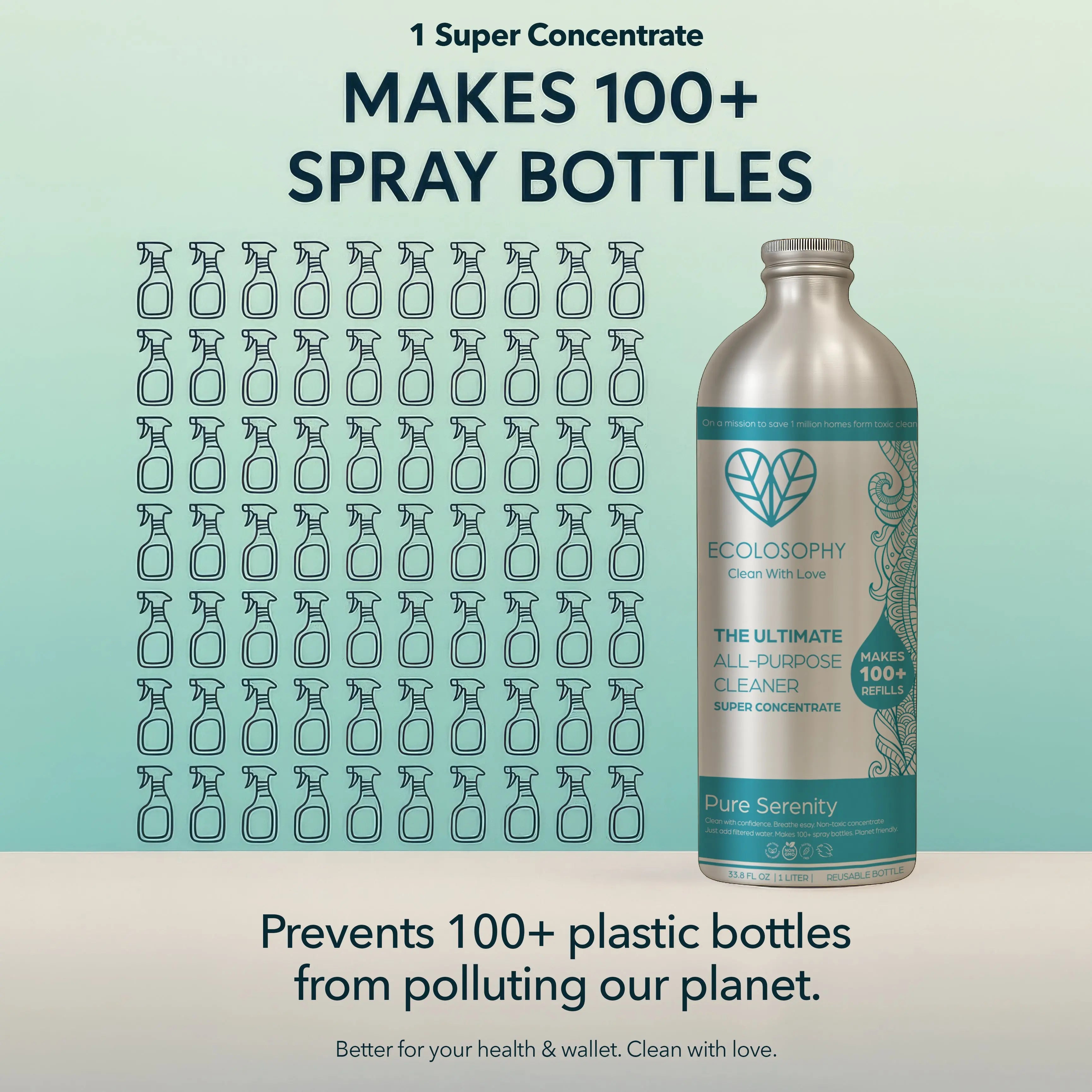
Short answer: A concentrate ships the cleaning agents without filler water; you dilute at home into bottles you already own. One Ecolosophy concentrate bottle makes 100+ sprays — plant-based, fragrance-free options, small-batch, made with care — cutting cost and plastic versus buying pre-mixed cleaners.
The thing nobody tells you: you're mostly buying water
Pick up almost any ready-to-use cleaner — the trigger spray, the mopping liquid, the "all-purpose" jug. Read past the marketing to the ingredient list, and you'll find the very first ingredient, the biggest one by volume, is water. Roughly 90% of what's in that bottle is the same thing that comes out of your tap for free.
That's the whole trick of single-use cleaners. You pay for the bottle. You pay the fuel to truck heavy water across the country. You pay for the shelf space. And then, in a few weeks, you throw the plastic away and do it all again. The actual cleaning part — the plant-based surfactants that lift grease and grime off a surface — is a small fraction of what you carried home.
A concentrate flips that. We take out the water and ship you only the part that cleans. You add your own water at home, in your own reusable bottle. Same clean. A fraction of the plastic, the freight, and the cost. The Ecolosophy All-Purpose Cleaning Concentrate is plant-based, with no artificial scents — plant-based and fully disclosed — family-safe, pet-safe, and planet-safe by design, not by slogan.
"I spent 23+ years living with Crohn's disease — in and out of hospitals, reading every label like my life depended on it, because it did. Then I looked under my own sink and realized I'd never read those labels at all. I was paying to ship water in plastic I'd throw away. Ecolosophy started there: one honest formula, the water taken out, so a family could clean their whole home from one bottle they could actually trust."
— Italo Campilii, Founder of Ecolosophy
The dilution math, explained like a recipe
Here's the part that sounds like chemistry but is really just cooking. A concentrate works because cleaning power is about ratio, not volume. You don't need a full bottle of cleaner on your counter — you need a small, correct amount of cleaning agent mixed into water.
The Ecolosophy method is simple enough to do half-asleep: a capful (or less) of concentrate, plus water, in a clean reusable 16oz spray bottle. That's it. The concentrate is built so one cap makes a full bottle of everyday all-purpose spray.
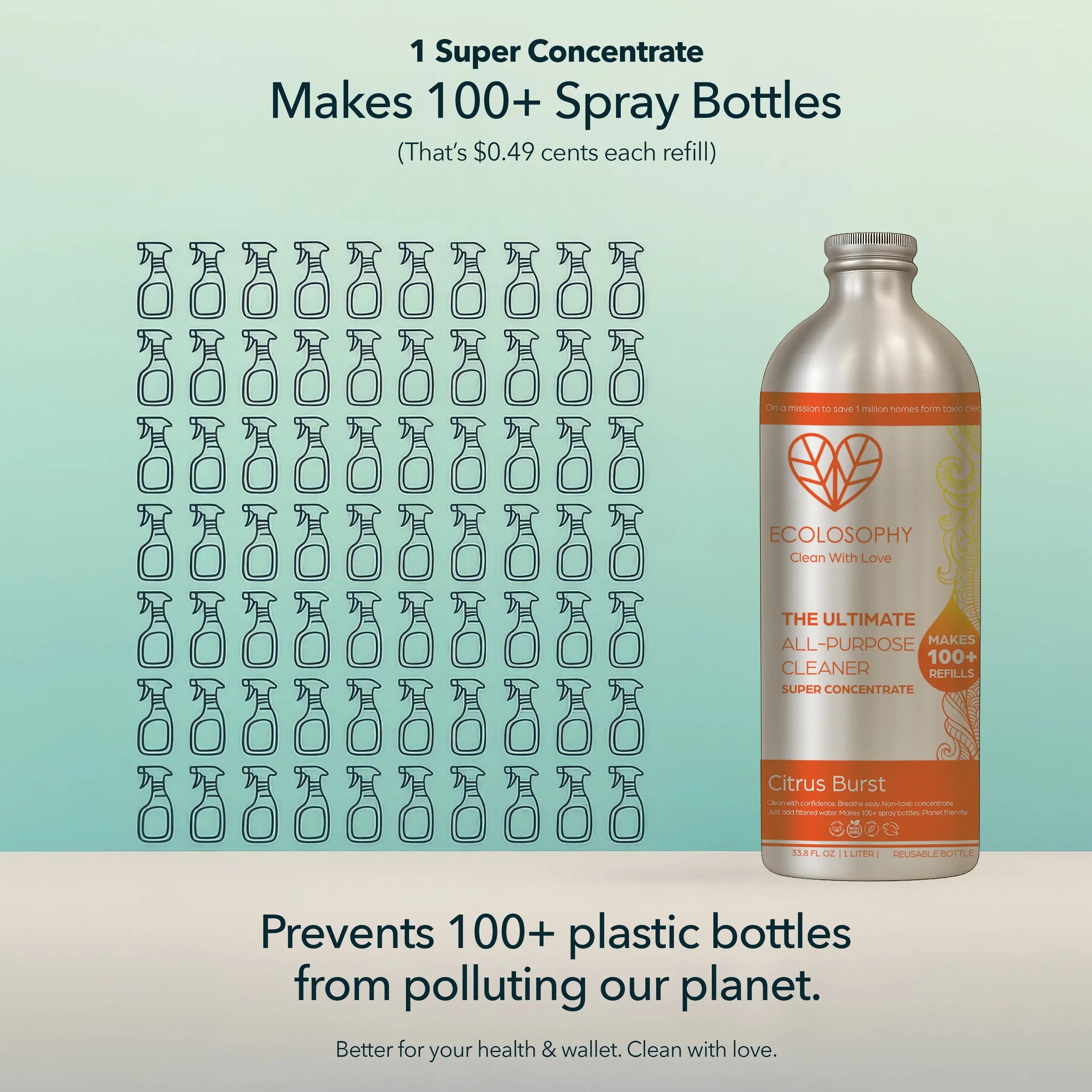
Now do the multiplication. A single bottle of concentrate holds many dozens of those capfuls. Each capful becomes one full 16oz spray bottle. Stack them up and one bottle of concentrate makes 100+ ready-to-use spray bottles. You're not buying 100 bottles of cleaner — you're buying the recipe for 100, and adding the free ingredient (water) yourself, one bottle at a time, only when you need it.
Micro-lesson: a concentrate isn't "stronger" cleaner you have to be careful with — it's the same cleaner with the shipping water left out. The water always goes back in before you spray. More concentrate doesn't mean more clean; past the right ratio it just means more rinsing. Start light, step up only for a tough mess. If you're comparing formats side by side, our concentrate vs. ready-to-use breakdown walks through the tradeoffs in full.
How much to use for each job
One bottle replaces a whole cabinet because the same concentrate becomes different cleaners at different ratios. Dial it up for grease, dial it down for glass. Here's the everyday guide.
| Job | How much concentrate | Use it on |
|---|---|---|
| Glass & mirrors | ½ capful per 16oz water | Windows, mirrors, glass tables — streak-free, no film |
| All-purpose / daily | 1 capful per 16oz water | Counters, tables, appliances, sealed surfaces |
| Bathroom / tile | 2 capfuls per 16oz water | Tubs, tile, sinks, soap scum |
| Heavy-duty degreaser | 2–3 capfuls per 16oz water | Stovetops, range hoods, baked-on kitchen grease |
| Floors (mop bucket) | ~1 capful per gallon of water | Sealed hardwood, tile, laminate |
The "100+ bottles" number uses the everyday all-purpose ratio — one capful per bottle. Use less for glass and you stretch a bottle even further; use more for a deep degrease now and then and it evens out. Either way, you're paying for cleaning, not for water and plastic.
The cost-per-use truth: do the division
A $49.95 refill looks expensive next to a $4 trigger spray — until you do the one piece of math the cleaning aisle is built to keep you from doing: cost per finished bottle.
| What you buy | What it makes | Cost per finished 16oz bottle |
|---|---|---|
| Single-use trigger spray (~$4 each) | 1 bottle, ~90% water, then landfill | ~$4.00 |
| A shelf of separate cleaners (all-purpose + glass + bathroom + floor + degreaser, restocked 3–4×/yr) | A revolving cabinet of bottles | ~$120–180+/yr in spend |
| One Ecolosophy All-Purpose Cleaning Concentrate ($49.95) | 100+ ready-to-use bottles | < $0.50 / bottle |
Under fifty cents a bottle, versus four dollars. That's roughly an 8× difference in cost per use — and the concentrate version is the one you trust around your kids. Because one bottle covers all-purpose, glass, bathroom, floor, and degreasing, families typically replace a $120–180-a-year shelf of sprays with a single refill that lasts most of the year. The upfront number is the cheap one; the per-use number is the honest one. That single bottle is exactly what makes one concentrate replace an entire cabinet of separate sprays.
Micro-lesson: when a cleaner is mostly water, the price on the shelf is hiding the price per use. Always divide the cost by how many finished bottles it actually makes. That single division is why concentrate wins every time.
Want the room-by-room version of this?
The free 7-Day Home Detox walks you through one room a day — what to toss, what to keep, what actually matters.
The plastic you stop throwing away
Every single-use spray bottle is plastic you fill once, empty in a few weeks, and toss. Do that across all-purpose, glass, bathroom, floor, and degreaser cleaners, restocked several times a year, and a household burns through dozens of bottles annually — most of which never actually get recycled and far too many of which end up in waterways and the ocean.
Because one bottle of Ecolosophy concentrate makes 100+ ready-to-use refills, you simply stop buying — and stop tossing — that stream of single-use bottles. You keep a few good reusable bottles, refill them from one concentrate, and the plastic churn stops. That's the difference between recycling plastic (which mostly doesn't happen) and never creating it in the first place.
This is the heart of the mission: prevent plastic bottles from ever reaching the ocean by not making them necessary. One honest bottle, refilled, does the work of a cabinet of throwaways.
The 42.75 lbs of CO2 you save per bottle
Vague "eco" claims are worthless, so here's a concrete one. Using Ecolosophy's own lifecycle estimate, each bottle of concentrate saves roughly 42.75 lbs of CO2 compared with buying the same amount of cleaner pre-mixed and separately bottled.
Where does that 42.75 lbs come from? Three places, and none of them are guesswork:
- Freight. Pre-mixed cleaner is ~90% water. Shipping a concentrate means trucks carry the cleaning agents and not all that water weight — far fewer fuel-burning miles per finished bottle.
- Plastic. Dozens of single-use bottles never get manufactured, because you reuse a few instead. Making plastic is energy-intensive; not making it is the saving.
- Packaging & handling. One concentrate replaces many separately boxed, palletized, and warehoused products.
42.75 lbs of CO2 is real, measurable weight kept out of the atmosphere — per bottle, every time you choose the concentrate over the pre-mixed shelf. It's the kind of number you can stand behind, which is exactly why we publish it instead of saying "eco-friendly" and hoping you don't ask.
How to mix and store it (so every bottle works right)
- Mix: add cool tap water to the bottle first, then the concentrate — it reduces foaming and mixes evenly.
- Bottles: use clean, reusable spray bottles, glass or sturdy plastic, sized for the dilutions above.
- Label: mark each bottle with its job and ratio (e.g., "All-Purpose — 1 cap / 16oz") so everyone in the house uses it correctly.
- Store: keep the concentrate sealed at room temperature, out of direct sun and out of reach of children. Mix what you'll use over a few weeks rather than huge batches.
One honest note on what it does: the concentrate is a cleaner — it removes dirt, grime, and residue from surfaces. It is not an EPA-registered disinfectant and doesn't claim to be one. For the rare moment you truly need to kill pathogens, use a product specifically registered to disinfect. For everyday counters, glass, floors, and grease, thorough cleaning is exactly what you want — and what one bottle of concentrate gives you 100+ times over.
Frequently asked questions
How does one bottle of concentrate make 100+ spray bottles?
A concentrate is the cleaning formula with the shipping water removed. You add water back at home — roughly one capful of concentrate per 16oz spray bottle for everyday cleaning. One bottle of Ecolosophy All-Purpose Cleaning Concentrate holds enough capfuls to make 100+ ready-to-use spray bottles. You're buying the recipe for 100 bottles and supplying the free ingredient, water, yourself.
What does one concentrate cost per spray bottle?
At $49.95 for a bottle that makes 100+ finished bottles, that's well under $0.50 per ready-to-use spray bottle — versus around $4 for a typical single-use trigger spray. The kit runs $49.95–$65 depending on packaging.
How much CO2 does switching to concentrate actually save?
Using Ecolosophy's own lifecycle estimate, each bottle of concentrate saves roughly 42.75 lbs of CO2 versus buying the same volume of cleaner pre-mixed and separately bottled — mostly from not shipping water weight and not manufacturing dozens of single-use plastic bottles.
Is a stronger concentrate harsher or harder on my hands?
No. The concentrate is the same plant-based formula as a ready-to-use spray, just without the shipping water — and you always add the water back before you spray. It's family-safe, pet-safe, with no artificial scents — plant-based and fully disclosed. Start with the lighter dilutions and step up only for tough grease.
How long does one bottle of concentrate last?
For typical family use, one bottle lasts many months to about a year, depending on how much you clean — because each bottle makes 100+ ready-to-use refills covering all-purpose, glass, bathroom, floor, and degreasing jobs.
Does the concentrate disinfect, or just clean?
It cleans — it removes dirt, grime, and residue from surfaces. It is not an EPA-registered disinfectant and doesn't claim to be one. For everyday cleaning that's exactly what you want; for the rare time you need to kill germs, use a product registered specifically to disinfect.
📕 Free download · 28 pages
Not ready to switch yet? Get the free playbook.
28 pages, every non-toxic swap, room by room. One email, no spam.
We'll email it from [email protected]. Reply anytime — a real person answers.
Sent. Check your inbox.
The download link is heading to your email. If you don't see it in 2 minutes, look in Promotions or hit resend.
Or grab it right now: Download the 28-page PDF →
Couldn't deliver — try again? Retry
Pure Serenity Kit
$69 · 4.97★ · 72 reviews