research
How Do You Make a Natural All-Purpose Cleaner? Concentrate, Vinegar, Dilution
How do you make a natural all-purpose cleaner that works? Skip vinegar tricks — dilute a plant-based concentrate.

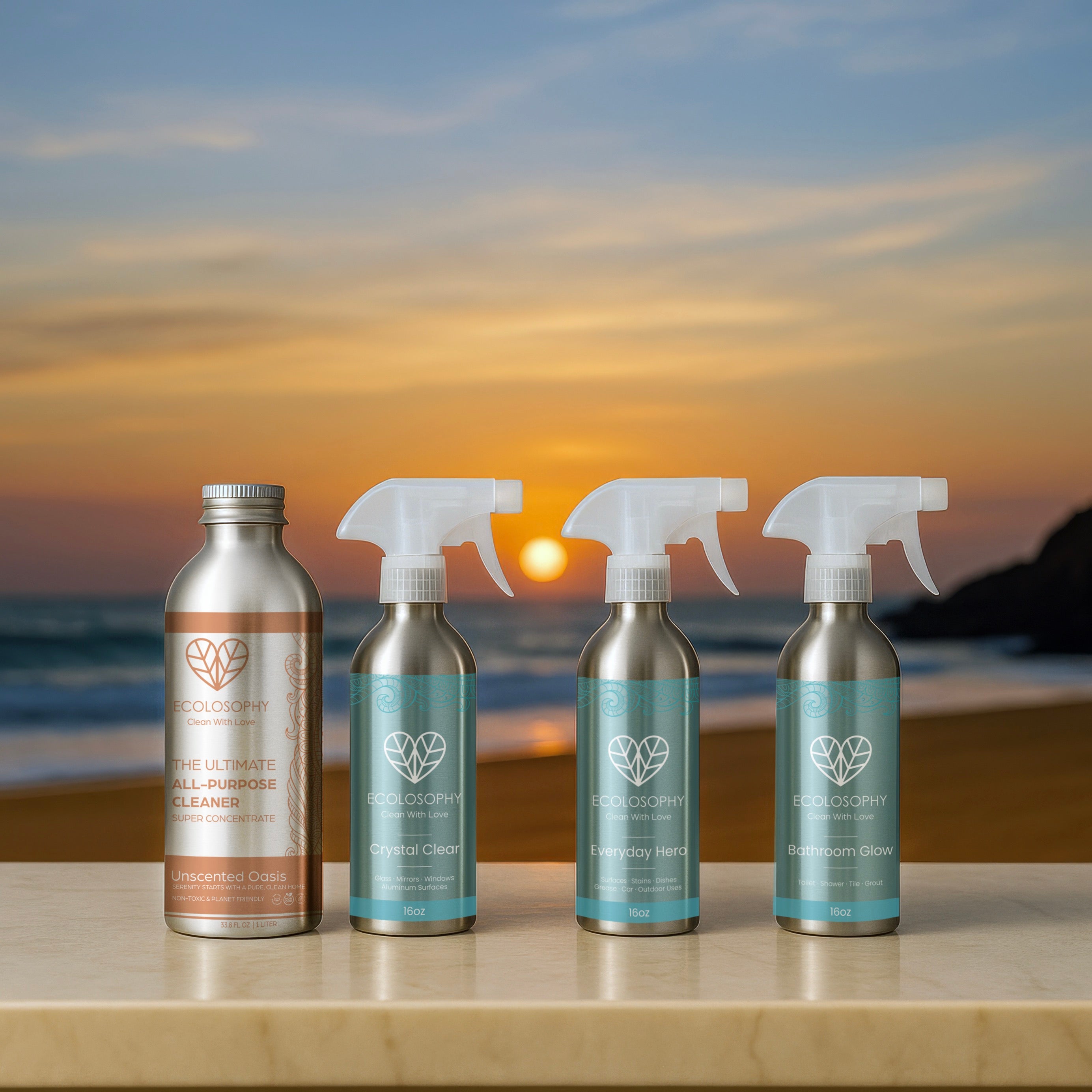
Short answer: Skip vinegar-plus-baking-soda recipes — they neutralize each other, and vinegar can etch stone and hardwood finishes. The reliable DIY method is a plant-derived surfactant concentrate diluted in water in a spray bottle. Prefer a fragrance-free plant-based Ecolosophy concentrate — small-batch, made with care — and adjust the dilution by surface.
They told you that cleaning your home was complicated. That you needed a different product for every surface. A degreaser for the stove, a disinfectant for the toilet, a glass cleaner for the mirrors, a floor cleaner for the tiles.
They were wrong — or rather, they were selling something.
Here’s the truth: one well-formulated, plant-derived cleaning concentrate diluted in water handles almost every surface in your home. And if you want to make your own, this guide gives you the honest version — including the parts most DIY blogs leave out.
Why Making Your Own Cleaner Is Worth It
The financial math is simple. A bottle of spray cleaner at the grocery store costs $4–$6. You probably use two or three different types — kitchen, bathroom, glass. That’s $12–$18 a month, or $144–$216 a year, just on spray bottles.
A good concentrate — whether you make your own blend or buy one — can replace all of that for a fraction of the cost.
But the real reason to make your own cleaner isn’t money. It’s control. You know exactly what’s in it. No “fragrance” (which legally hides hundreds of undisclosed chemicals). No preservatives with names you can’t pronounce. No petroleum-derived surfactants that leave residue on your countertops and in your lungs.
When you control the ingredients, you control what your family is exposed to.
The Problem With Most DIY Cleaning Recipes
Search “DIY all-purpose cleaner” and you’ll find thousands of recipes built on two ingredients: white vinegar and baking soda.
Here’s what they don’t tell you.
Vinegar and baking soda cancel each other out. When you mix an acid (vinegar) with a base (baking soda), they neutralize each other. The fizz is carbon dioxide — a chemical reaction that sounds powerful but leaves you with saltwater. Neither the acid nor the base remains active. You’ve cleaned nothing; you’ve just made a very theatrical mess.
Vinegar is not safe on all surfaces. Yes, vinegar is natural. Yes, it has mild antimicrobial properties. But it is also acidic (pH around 2.4), and that acidity damages:
- Natural stone surfaces (granite, marble, quartz) — etches the surface over time
- Hardwood floors — degrades the finish with repeated use
- Some metals — causes corrosion on aluminum and cast iron
- Rubber seals and gaskets — dries them out and causes cracking
Vinegar has its place. Diluted 50/50 with water, it makes a reasonable glass cleaner and a decent fabric softener alternative. But it is not the all-purpose solution most recipes claim.
“Natural” doesn’t mean safe or effective. Arsenic is natural. Lead is natural. The label “natural” has no legal definition in cleaning products — it means whatever the brand wants it to mean. What matters is the specific ingredients and their safety profile, not the marketing language — which is exactly why learning to actually read a label matters more than any buzzword on the front of the bottle.
The Safest DIY Method: Plant-Derived Concentrate + Water
The most effective and genuinely safe approach is to start with a concentrate built from plant-derived surfactants and dilute it in water yourself.
Here’s why this works better than the vinegar-baking soda approach:
Surfactants are the actual cleaning mechanism. When you clean a surface, what you’re doing is getting dirt, grease, and bacteria to release from the surface and suspend in water so you can rinse it away. Surfactants — surface-active agents — are the molecules that make this happen. They have one end that attracts water and one end that attracts oil, allowing the two to mix.
Plant-derived surfactants (like decyl glucoside, derived from coconut oil and corn sugar) do this job without the petroleum-based solvents, skin irritants, or toxic byproducts found in conventional cleaners.
Concentrate format is more economical and cleaner. When you buy a pre-diluted spray, you’re mostly paying for water in a plastic bottle. A concentrate lets you add water yourself, which means less plastic, less shipping weight, and a fraction of the cost per use — the full math on concentrate vs. single-use is worth seeing laid out.
The Recipe
Basic All-Purpose Cleaner
What you need:
- 1 teaspoon (1 capful) plant-derived cleaning concentrate (like Ecolosophy All-Purpose)
- 16 oz filtered or tap water
- A clean 16 oz spray bottle
Steps:
- Add water to the spray bottle first. (Adding concentrate first causes excessive foaming when you add water.)
- Add 1 teaspoon (1 capful) of concentrate.
- Cap the bottle and swirl gently to combine — do not shake vigorously.
- Label the bottle with what’s in it and the date.
- Use within 30 days for best results.
Adjusting for different tasks:
| Surface | Concentrate | Water |
|---|---|---|
| Glass and mirrors | 1 teaspoon | 16 oz |
| All-purpose (counters, stovetops, most surfaces) | 1 tablespoon | 16 oz |
| Bathroom tile and grout | 2 tablespoons | 16 oz |
| Heavy grease (stove hood, griddles) | 3 tablespoons | 16 oz |
| Floors | 1 teaspoon | 32 oz |
That’s the whole formula. No vinegar required. No baking soda volcano. No chemistry degree.
Frequently Asked Questions
Does it actually disinfect?
This is the most important question to answer honestly: most plant-derived surfactant cleaners are not EPA-registered disinfectants. They clean surfaces by removing dirt, grease, and most bacteria through mechanical action (surfactant + wiping). For true disinfection — killing 99.9% of bacteria and viruses as defined by the EPA — you need a registered disinfectant.
The good news: for most household surfaces, cleaning (removing pathogens) is sufficient. The CDC and most public health authorities distinguish between cleaning, sanitizing, and disinfecting — and for daily home maintenance, cleaning is the right tool for most jobs. Reserve true disinfectants for situations where someone in the home is immunocompromised or actively ill.
How long does the mixed solution last?
A water-diluted concentrate should be used within 30 days. Preservatives in the concentrate are designed for the undiluted formula. Once diluted, microbial activity can begin over time, especially if the bottle is stored in a warm or humid environment. Make small batches and use them up.
Can I add essential oils for scent?
Yes, with caveats. A few drops of essential oil (10–15 drops per 16 oz bottle) can add a pleasant scent. However:
- Essential oils can separate in water-based solutions — shake before each use
- Some essential oils (citrus oils especially) degrade in sunlight — use opaque bottles
- If you have cats, avoid tea tree, eucalyptus, and citrus essential oils — these are toxic to cats even in small amounts
- Essential oils are potent concentrated plant compounds — more is not better
Does it leave residue?
At the dilutions listed above, a well-formulated plant-derived cleaner should leave no sticky residue. If you’re experiencing residue, reduce the concentration. Start with less — you can always add more concentrate if needed.
When to Skip the DIY
Not everything needs to be made from scratch. There are situations where a professionally formulated concentrate makes more sense:
- When you want guaranteed consistency of dilution and performance
- When you need the formula to be tested for safety across many surface types
- When you’re using it around children or immunocompromised family members and want documented safety data
- When you don’t want to measure anything out — just dilute and use
If that’s you, the Ecolosophy All-Purpose Cleaning Concentrate is already formulated with the same plant-derived surfactants described above — decyl glucoside, sodium lauryl glucose carboxylate, citric acid. One bottle makes over 100 spray bottles. No additional ingredients required.
The Bottom Line
You don’t need a cabinet full of chemicals. You need one well-formulated cleaner in a concentrate format and the knowledge to dilute it correctly for different tasks.
The vinegar-baking soda recipes that dominate Pinterest are not effective chemistry — and on some surfaces, they cause long-term damage. Plant-derived surfactants diluted in water are simpler, safer, and more effective.
Make it yourself, or get it already made. Either way, you now know how it works — and you know what to look for.
That’s what clean actually looks like. For more breakdowns like this one, room by room and ingredient by ingredient, The Detox Journal is where we keep them.
Skip the DIY measuring and get the concentrate that’s already formulated right: the Pure Serenity concentrate — plant-derived, no synthetic fragrance, no artificial preservatives, makes 100+ spray bottles per bottle. Want to test-drive the scents first? The Trial Kit Trio lets you try all three before you commit.
Sources cited
- EPA — Safer Choice Program — EPA Safer Choice certification standards for cleaning ingredients
- American Lung Association — Cleaning Supplies and Household Chemicals — American Lung Association on VOC emissions from cleaning products
- Environmental Working Group — Cleaning Products Database — EWG database for cleaning product ingredient safety ratings