

Why You Should Never Mix Cleaning Products
You've probably seen the videos — a toilet bowl swirling with three or four different cleaners, turning bright colors for the camera. It looks satisfying. It's also one of the more avoidable ways to end up in urgent care.
Short answer: mixing cleaning products — especially in a toilet bowl or sink — can create toxic gas, and it's not worth the risk for a video. Certain everyday combinations react chemically to release fumes that irritate your lungs and eyes, even in small amounts. The simplest fix is the one nobody films: use one product at a time, rinse in between, and reach for a single all-purpose concentrate so you never need four bottles open at once.
The trend, in plain terms
Sometimes called "toilet overload" or "product overload," the trend is straightforward: someone pours several different cleaning products — a toilet bowl cleaner, a bathroom spray, maybe a scoop of powder cleanser or a splash of bleach — into the same bowl or sink at the same time. The colors swirl and foam, it makes a satisfying clip, and it spreads fast. Poison control centers and safety organizations have been sounding the alarm on it, because the visual effect is often a byproduct of an actual chemical reaction — and some of those reactions produce gases that are genuinely harmful to breathe.
We're not here to call anyone out. Most people doing this genuinely don't know the chemistry happening in that bowl. That's the whole problem — and it's also completely fixable with a little bit of plain-language science.
The chemistry: why specific combinations are dangerous
This isn't vague "chemicals are scary" messaging. These are three well-documented reactions that chemists and poison control centers have understood for decades. Here's what's actually happening at a molecular level, explained simply.
Bleach + ammonia → chloramine gas
Bleach (sodium hypochlorite) and ammonia are both common in household cleaners — bleach shows up in disinfecting sprays and toilet bowl cleaners, ammonia in some glass and multi-surface cleaners. When they combine, the chlorine in the bleach reacts with the nitrogen and hydrogen in ammonia to form chloramine gas. This is the single most common accidental toxic-gas exposure in homes, and it's exactly why cleaning product labels warn against combining bleach with ammonia-based products. Chloramine gas irritates the respiratory tract and eyes, and at higher concentrations or in an unventilated space it can cause more serious breathing distress.
Bleach + acids (like vinegar) → chlorine gas
Vinegar, and other acidic cleaners like some toilet bowl gels and lime-scale removers, react with bleach differently — the acid destabilizes the hypochlorite in the bleach and releases chlorine gas. This is the same gas used industrially and, in higher concentrations, in chemical warfare — which sounds dramatic, but the point isn't to frighten you, it's to explain why "just a little whiff" in a small bathroom with the door closed is not something to shrug off. Even a brief exposure can cause coughing, burning eyes, and throat irritation.
Bleach + rubbing alcohol → chloroform (and other byproducts)
Less commonly discussed, but real: mixing bleach with rubbing alcohol (isopropyl alcohol) can produce chloroform and other chlorinated compounds. This reaction is less immediately obvious than the other two, which makes it easy to underestimate — there's no big colorful foam moment, just an invisible gas building up in a small room.
Notice the pattern: bleach is the common thread in all three reactions. It's an incredibly effective disinfectant on its own, which is exactly why it should stay on its own — never combined with ammonia, acids, or alcohol-based products.
What exposure actually feels like
We're not going to exaggerate this, because the honest version is concerning enough. Breathing in these gases at cleaning-product concentrations in a typical bathroom can cause:
- Coughing, throat irritation, and a burning sensation in the chest
- Watery, stinging eyes
- Shortness of breath or a tight feeling when breathing
- Headache or dizziness in an enclosed space
- In more concentrated or prolonged exposure, chemical burns to the eyes, skin, or airway
Most people who experience this recover once they get to fresh air, but it's a genuinely unpleasant reaction that sends real people to urgent care and emergency rooms every year — and it's entirely preventable. If you or someone in your home ever experiences these symptoms after cleaning, get to fresh air immediately and contact poison control or emergency services if symptoms don't resolve quickly.
The simple safety rule
Want the room-by-room version of this?
The free 7-Day Home Detox walks you through one room a day — what to toss, what to keep, what actually matters.
You don't need to memorize a chemistry chart to stay safe. Three habits cover almost every scenario:
- One product at a time. Finish with one cleaner, rinse the surface with plain water, and only then reach for a second product if you need one.
- Rinse between products. A water rinse breaks the chain — it removes residue so the next product isn't reacting with leftover chemical from the last one.
- Ventilate. Open a window, run a fan, crack the door. Bathrooms are small, and fumes concentrate fast in a small space.
And the rule underneath all of it: check the label. Most bleach-based products print a warning about never mixing with ammonia or other cleaners — it's there because manufacturers know this exact scenario happens in real homes.
The micro-lesson: the temptation to mix starts with having too many bottles
Here's the truth under the trend. The reason "product overload" is even possible is that most homes have a shelf lined with five, six, ten single-purpose cleaners — a toilet bowl gel, a bathroom spray, a glass cleaner, a disinfectant, a scouring powder. When you've got that many bottles within arm's reach, combining a few of them starts to feel almost inevitable, whether it's for a video or just because you're trying to tackle a stubborn stain and grab whatever's under the sink.
Take away the shelf of single-purpose chemicals, and you take away the setup for the mistake entirely. That's not a scare tactic — it's just how risk works. You can't accidentally mix bleach and ammonia if there's no ammonia-based cleaner in the house to begin with. It's the same reasoning behind keeping pine-oil and phenol-based cleaners off a shelf shared with pets — see is pine cleaner safe for pets for that specific risk.
One concentrate, no mixing temptation
Ecolosophy's Super Concentrate is plant-based — no bleach, no ammonia, and nothing that reacts with other cleaners. It handles the toilet, the sink, the counters, the floors, and the glass with one formula, diluted to different strengths depending on the job. We make it small-batch, with care, and we say plainly what's in it: coconut- and olive-derived surfactants and citric acid doing the actual work of lifting dirt and grime. There's nothing here that reacts badly with itself, because there's only one bottle to reach for in the first place.
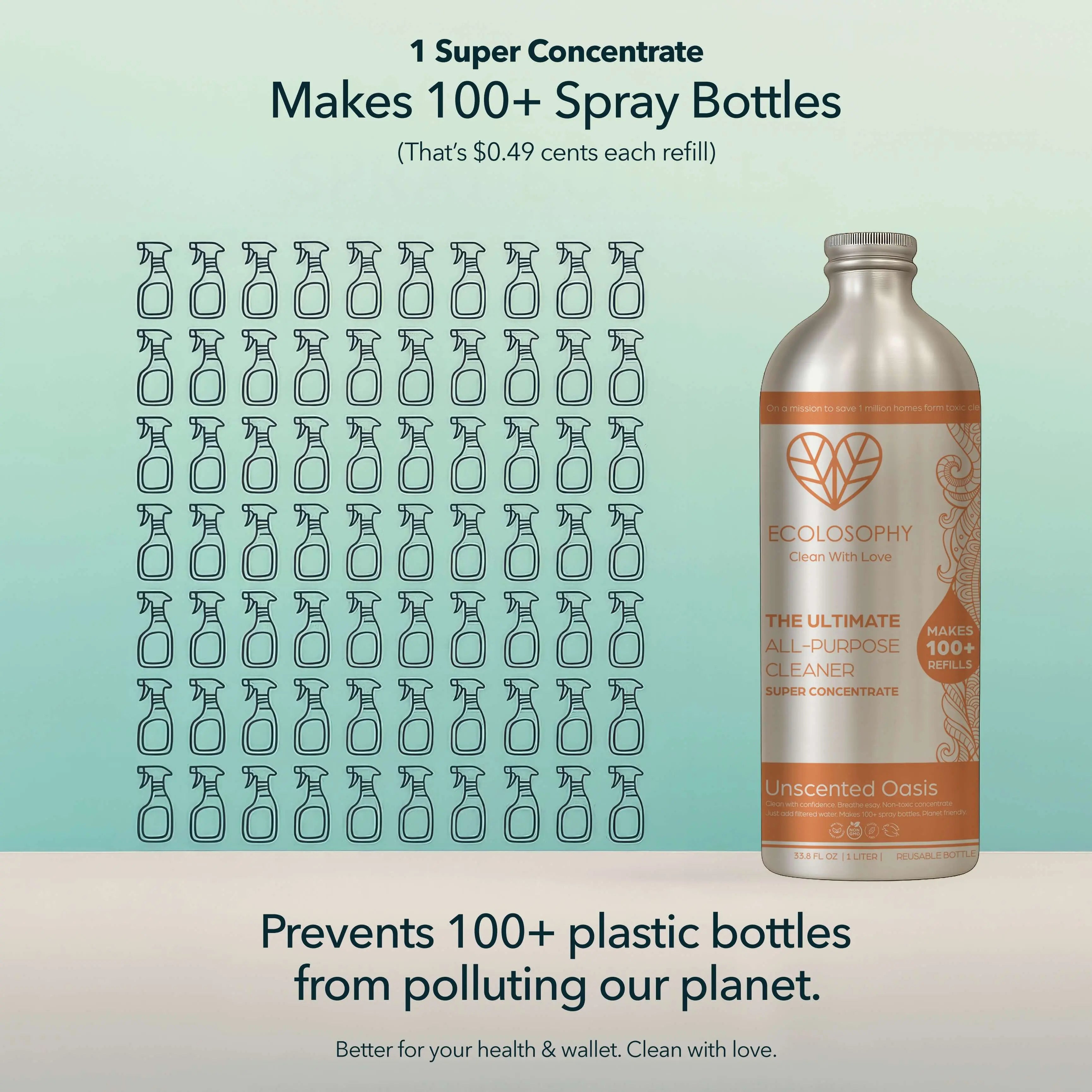
It's a concentrate, so you just add water — a capful per 16oz (½ capful for glass, 1 for all-purpose, 2 for bathroom and toilet). One 33.8oz bottle makes 100+ ready-to-use spray bottles at under $0.49 each, and it's formulated to be family-safe and pet-safe. A quick honesty note: like most everyday cleaners discussed here, our concentrate is not an EPA-registered disinfectant — it's a powerful daily cleaner, not a kill-claims sanitizer.
Frequently asked questions
What is the "toilet overload" or "product overload" trend?
It's a viral trend where people mix several different cleaning products together, often in a toilet bowl or sink, for a colorful visual effect. Safety experts and poison control organizations have warned that some of these combinations release toxic gas.
Why is mixing bleach and ammonia dangerous?
Bleach and ammonia react to form chloramine gas, which irritates the eyes, nose, throat, and lungs. It's one of the most common accidental poisonings in homes and is why bleach-based product labels warn against combining them with ammonia.
Can vinegar and bleach really make toxic gas?
Yes. Bleach reacting with an acid like vinegar releases chlorine gas, which can cause coughing, burning eyes, and throat irritation even in a normal-sized bathroom.
What should I do if I accidentally mixed cleaning products and smell fumes?
Leave the room immediately, open windows and doors for ventilation, and get to fresh air. If you or anyone nearby has trouble breathing, persistent coughing, or eye irritation that doesn't clear up quickly, contact poison control or seek medical attention.
Is it safe to use two Ecolosophy products together?
Yes — our concentrate is plant-based with no bleach or ammonia, so there's no dangerous reaction to worry about. Even so, the same good habit applies everywhere: one product at a time, rinse between steps, and keep the space ventilated.
One Bottle. No Guesswork. No Mixing Required.
The safest cleaning routine is the one where you never have to think about what reacts with what. Trade the crowded shelf for one plant-based concentrate that handles the whole house.
Shop the Unscented Oasis Kit — $69
Prefer the concentrate alone? Get the Unscented Oasis Concentrate for $49.95, explore all concentrates, or browse everything we make.