comparison
Does Ammonia-Free Glass Cleaner Work? Streak-Free, Surfactant, Microfiber
Want an ammonia-free cleaner that leaves glass streak-free? Here's what ammonia really does, why it's risky, and the plant-based swap that works just as well.

Short answer: Yes — an ammonia-free cleaner gets glass streak-free with surfactants and a fast-drying assist, not ammonia. Mist lightly, wipe with clean microfiber, and work out of direct sun. You skip fumes and chloramine risk if bleach is nearby. Prefer a plant-based Ecolosophy concentrate — small-batch, made with care.
An ammonia-free cleaner gets glass streak-free using surfactants and a fast-drying solvent instead of ammonia — and it works just as well. A plant-based concentrate diluted with water, wiped with a clean microfiber cloth, leaves windows and mirrors clear without ammonia’s fumes, eye sting, or risk of toxic gas.
The blue bottle convinced a generation that streak-free meant ammonia. It never did. Here’s the real story.
Do Ammonia-Free Cleaners Clean Glass Streak-Free?
Yes — an ammonia-free cleaner gets glass streak-free using surfactants and a fast-drying solvent instead of ammonia. Diluted with water and wiped with a clean microfiber cloth, it leaves windows and mirrors clear without ammonia’s fumes, eye sting, or the toxic gas that forms if ammonia meets bleach.
What ammonia actually does in glass cleaner
Ammonia is in classic glass cleaners for one reason: it evaporates fast and helps cut greasy film, so the glass dries quickly with fewer streaks. That’s the entire trick. It’s a real chemical doing a real job — but it’s also the source of every downside on the can.
According to CDC/NIOSH, ammonia is a respiratory and eye irritant. That sharp smell that hits you when you spray a mirror in a small bathroom? That’s the irritant entering your airways. In a tight, unventilated space, with kids underfoot, you’re all breathing it.
The hidden danger: ammonia + bleach
This is the one that lands people in the emergency room. Ammonia and bleach react to form chloramine gas, which can cause serious respiratory harm. It happens by accident — someone uses a bleach product on the counter, then an ammonia glass cleaner on the mirror above it, in a closed bathroom. Keeping ammonia out of your routine removes that risk entirely. We covered the bleach side of this in natural alternatives to bleach.
Ammonia can also wreck your stuff
Ammonia damages tinted windows, can cloud or strip coatings on electronic screens (phones, laptops, TVs), and harms some sealed or treated surfaces. The thing marketed as the ultimate glass cleaner is one you’re told not to use on half the glass in your house.
The truth about streak-free glass
Here’s what the cleaning industry doesn’t lead with: streak-free is mostly technique, not ammonia. Streaks come from three things, and ammonia fixes none of them:
- Too much product. Excess cleaner pools and dries unevenly. Light mist wins.
- A dirty or low-quality cloth. Paper towels shed lint; a damp-then-dry microfiber cloth doesn’t.
- Wiping in direct sun. The cleaner flash-dries before you can buff it. Work in shade.
Fix those three and almost any quality cleaner gives you clear glass. The ammonia was never the hero.
Ammonia glass cleaner vs. plant-based concentrate
| Factor | Ammonia glass cleaner | Plant-based concentrate |
|---|---|---|
| Cleaning power on glass | Surfactant + ammonia | Plant-based surfactants + light alcohol assist |
| Streak-free finish | Yes, with technique | Yes, with technique |
| Eye / lung irritation | Yes | No |
| Toxic gas risk with bleach | Yes (chloramine) | No |
| Safe on tinted windows & screens | No | Yes (test screens with a damp cloth) |
| Works on more than glass | Glass-only usually | Glass + counters + most surfaces |
| Bottles used | New bottle each time | One concentrate makes 100+ bottles |
The quiet advantage at the bottom of that table is range. A plant-based concentrate isn’t a glass-only product — it’s a glass and counter and most-surfaces product. One bottle replaces the blue glass spray, the all-purpose spray, and a few others.
How to get streak-free glass, ammonia-free
- Dilute your concentrate to the directed strength — more product is not more clean.
- Mist lightly onto the glass, or onto the cloth for mirrors and screens.
- Wipe with a clean microfiber cloth, then buff dry with a second dry one.
- Work out of direct sun so it doesn’t flash-dry.
- For screens, spray the cloth, never the device, and use a barely-damp pass.
That’s it. No ammonia, no fumes, no “do not use on tinted windows” asterisk.
Why one ammonia-free cleaner can replace several bottles
Walk through most homes and you’ll find a blue glass spray, a separate all-purpose spray, a “granite” or “stainless” spray, maybe a bathroom spray — four bottles doing jobs that overlap almost entirely. That’s not because the surfaces are wildly different. It’s because selling four specialized bottles makes more money than selling one honest one.
The chemistry doesn’t actually require all that. The thing that cleans glass — surfactants that lift greasy film, plus a fast-drying assist — is the same thing that cleans a countertop, a cabinet door, a light switch, or an appliance front. Ammonia-free, plant-based concentrates lean into that. One concentrate, diluted, covers glass and the rest of the house, which is why the “ammonia-free glass cleaner” question usually ends with people owning fewer products, not a one-for-one glass swap.
That consolidation is also a plastic story. Four single-use spray bottles become one refilled bottle topped up from a concentrate. And those trigger sprayers aren’t as innocent as they look — every pump sheds microscopic plastic, which we dug into in microplastics in spray bottle triggers. Fewer triggers, refilled instead of replaced, means less of that in your home and your sink.
A quick note on “streak-free” marketing
Notice how many glass cleaners put “streak-free” on the front as if it’s a special ingredient. It isn’t an ingredient at all — it’s a result, and results come from technique. Any brand can print “streak-free” because the cleaner can technically achieve it; whether you get streaks depends on the cloth and the amount, not the formula’s marketing. Don’t pay a premium for a promise that’s really in your own hands. Once you’ve got the light-mist, clean-microfiber, out-of-the-sun routine down, “streak-free” stops being a feature you shop for and starts being just how you clean.
While you’re swapping, check the label
If you’re replacing an ammonia cleaner, it’s worth a beat to make sure the replacement is genuinely cleaner and not just rebranded. A lot of “fresh scent” glass sprays hide their fragrance mix the same way everyone else does — see the fragrance loophole — and the front of the bottle rarely tells you what’s inside. Our 60-second guide, reading an ingredient label, makes that quick.
Ammonia-free, surface by surface
People hesitate to drop their ammonia glass cleaner because they’re not sure one bottle can really handle everything. Here’s the room-by-room reality with a plant-based concentrate:
Windows and mirrors. Light mist, clean microfiber, buff dry. Out of direct sun. Streak-free, every time, no ammonia.
Phones, tablets, laptop and TV screens. This is where ammonia was always a liability — it can strip screen coatings. Spray the cloth, never the device, and use a barely-damp pass followed by a dry one. Ammonia-free is genuinely safer here, not just gentler.
Kitchen counters and tables. The same diluted cleaner lifts food, grease, and sticky spots. Because there’s no ammonia residue, you don’t have to worry about what’s left where your family eats.
Stainless steel and appliances. A light wipe with the cloth, following the grain, then buff. No streaky ammonia haze.
Bathroom surfaces. Sinks, chrome fixtures, and tile clean up without the eye-watering fumes a small, closed bathroom traps — and with no risk of accidentally mixing ammonia and a bleach product in the same tight space.
One concentrate, the whole house, no asterisks. That’s the quiet payoff of going ammonia-free: not just a safer mirror, but a simpler cabinet.
When you might still reach for something stronger
Ammonia-free cleaning handles the cleaning. For the rare case where you need to disinfect a bathroom surface — illness in the house, for example — clean first, then use a registered disinfectant or 3% hydrogen peroxide with the proper contact time, as we covered in natural alternatives to bleach. That keeps disinfecting to the moments that warrant it, instead of fuming up the room every day for a routine wipe.
The real swap
You shouldn’t need to crack a window and hold your breath to clean a mirror in your own home. And you definitely shouldn’t need to worry that two cleaners in the same bathroom might make a gas.
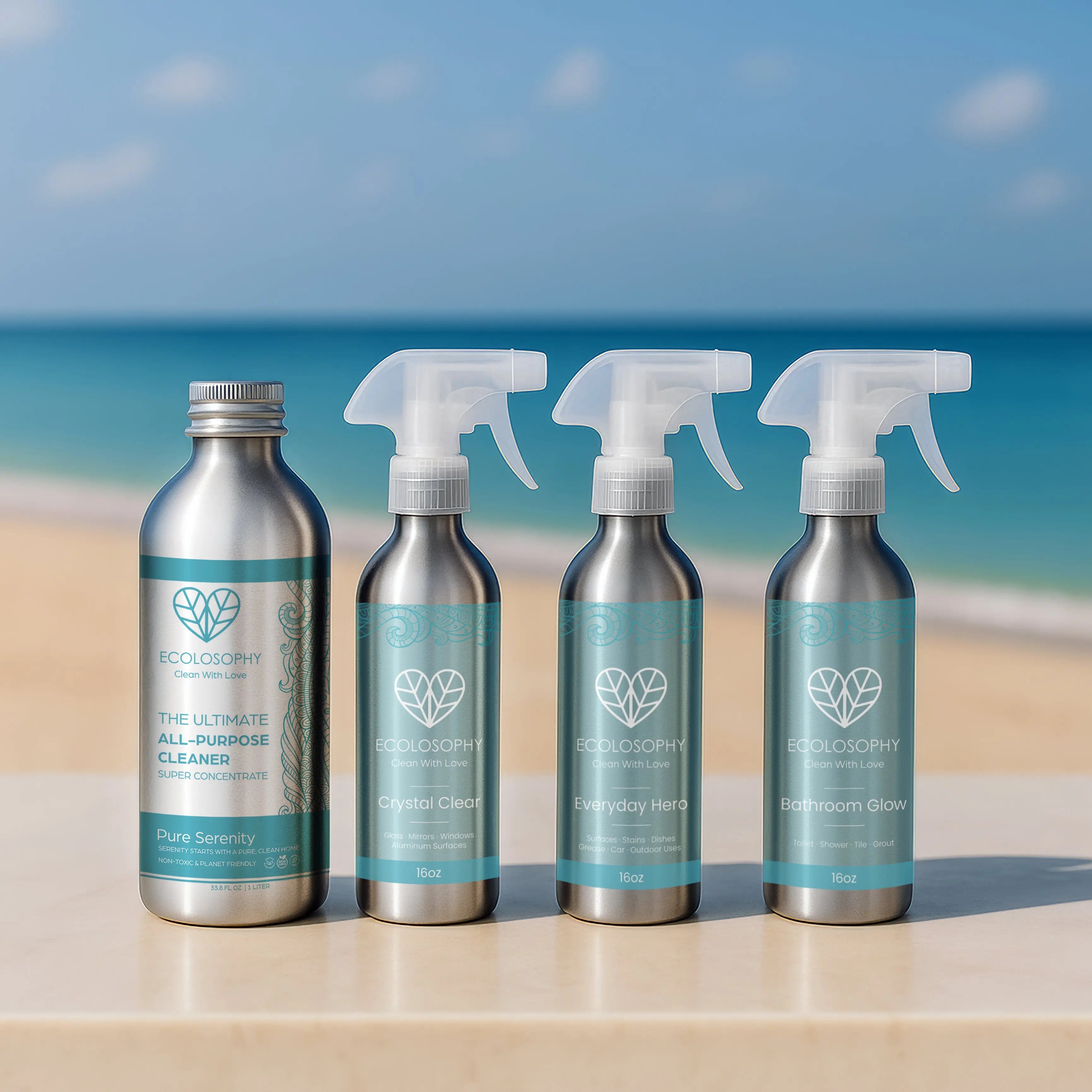
Our Pure Serenity Concentrate cleans glass, mirrors, and everyday surfaces streak-free with plant-based surfactants — no ammonia, no synthetic fragrance, and one bottle makes 100+ spray bottles. Want it scent-free for screens and sensitive noses? Unscented Oasis Concentrate does the same job with nothing added. Not sure which? The Trial Kit Trio lets you test all three before you choose.
Clean with love. Clear glass, clear air.