ingredient investigation
Does Green Cleaning Actually Help? Indoor Air, Biodegradability, Safer Choice
Verified green cleaning benefits: lower VOC exposure, fewer spray triggers, and surfactants that biodegrade downstream.
Green cleaning is not about a label that makes you feel good. It is about removing the specific chemistry that the research keeps tying to harm.
— Italo Campilii, co-founder, Ecolosophy
Short answer: Yes — when you skip high-VOC sprays and undisclosed fragrance. EPA indoor VOC levels run 2–5× outdoors; a long cohort tied cleaning sprays to faster lung-function decline in women. Biodegradable surfactants and Safer Choice screening are the verifiable planet and product wins. Consider a fragrance-free Ecolosophy concentrate — small-batch, made with care.
What Green Cleaning Actually Means — and What It Doesn’t
Green cleaning means choosing products that skip the chemicals most strongly tied to indoor air pollution, breathing problems, and water contamination. The benefits are real, but they are specific: lower VOC exposure, fewer respiratory triggers, and surfactants that biodegrade instead of persisting downstream. Anything beyond that, sold to you with the word “eco-friendly” and no ingredient list, is marketing.
I learned to make that distinction the hard way. I spent 23+ years managing Crohn’s disease, in and out of hospitals, before I started connecting my flare patterns to the chemistry in my own home. So I have no patience for green-washing. What follows is only what the research and the regulators actually verify — and where the honest limits of that evidence are.
The Indoor Air Benefit Is the Most Verified One
The single best-documented reason to switch is the air inside your home.
The EPA states plainly that concentrations of volatile organic compounds (VOCs) indoors are routinely 2 to 5 times higher than outdoor levels, and can spike far higher during and immediately after activities like cleaning. VOCs are the compounds that evaporate off a spray and into your breathing zone. When you spritz a conventional all-purpose cleaner in a closed bathroom, you are aerosolizing that chemistry and inhaling it directly.
This isn’t a fringe claim. It comes from the EPA’s own indoor air quality research. And the health link is more than theoretical.
In 2018, researchers published a 20-year cohort study in the American Journal of Respiratory and Critical Care Medicine (Svanes et al.) following more than 6,000 people. Women who regularly cleaned with sprays — whether at home or professionally — showed accelerated lung-function decline over those two decades. The authors compared the magnitude of decline to long-term smoking in that population. That is a real, peer-reviewed finding, and it is the honest version of a statistic you may have seen exaggerated elsewhere: it describes a long-term cohort trend, not a one-to-one “spray equals cigarette” equivalence.
The practical takeaway is simple. Sprays are the highest-exposure format because they go straight into your lungs. They are the first thing worth replacing.
Fewer Undisclosed Chemicals, Especially Fragrance
The second verified benefit is that a genuinely green product removes the chemicals a conventional label is allowed to hide.
The biggest culprit is synthetic fragrance. Under U.S. law, the single word “fragrance” can stand in for a proprietary blend of many undisclosed compounds — including phthalates, which are used to make scent linger and which the National Institute of Environmental Health Sciences identifies as endocrine-disrupting compounds. Endocrine disruptors interfere with hormone signaling, which is why they draw particular concern around children and pregnancy.
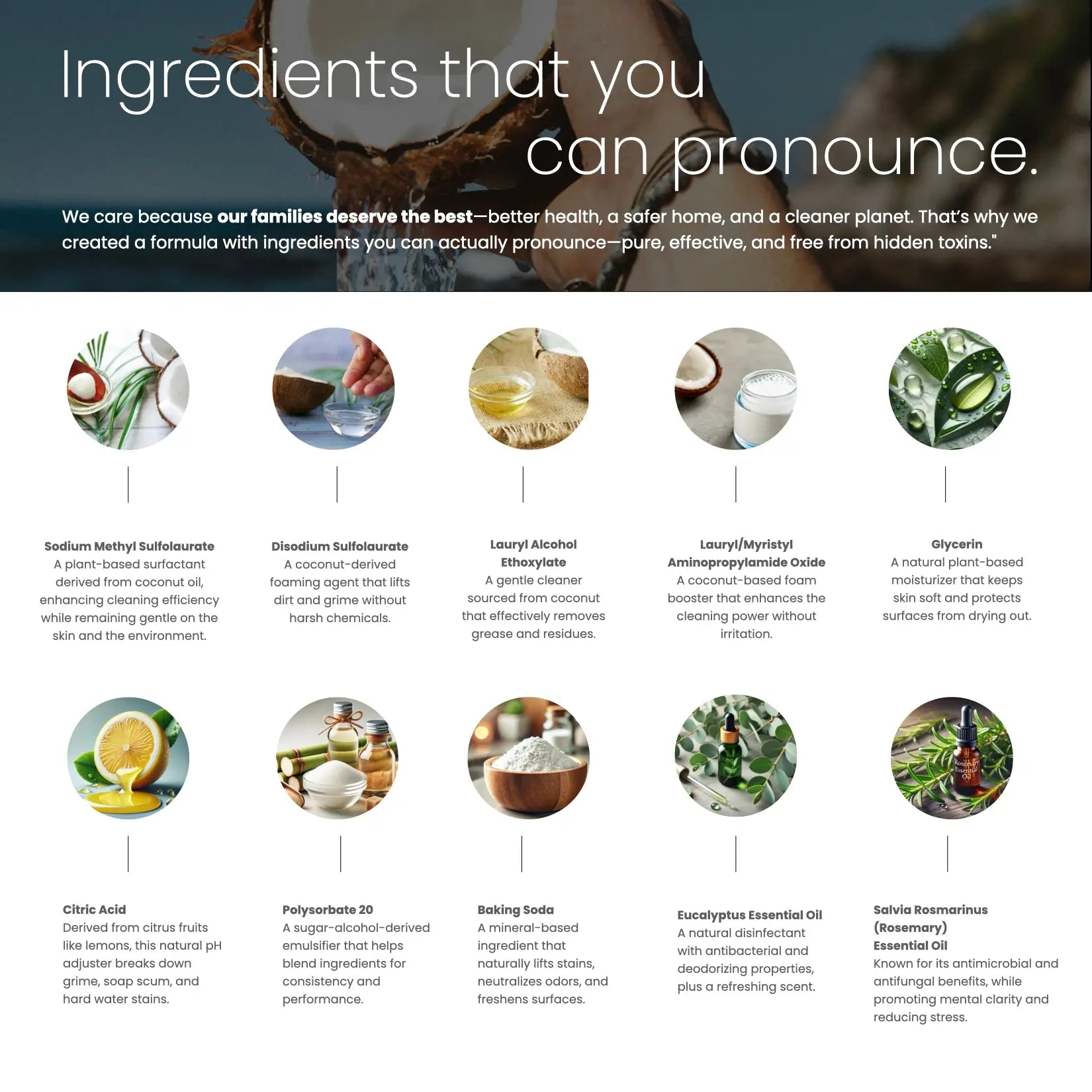
Our non-negotiables start with fragrance: no synthetic fragrance, no quaternary ammonium compounds, no dyes. Not because “natural smells nice,” but because fragrance is the largest single category of undisclosed cleaning chemistry in the average home. It’s why the Unscented Oasis concentrate has no scent at all, and why even the scented Pure Serenity concentrate lists its essential oils by name.
If you want the full mechanics of how that disclosure gap works, we wrote a dedicated breakdown of hidden toxins in cleaning products and a separate one on the real cost of greenwashing so you can spot the difference between a claim and a fact.
The Environmental Benefit Comes Down to Biodegradability
Here is where I want to be careful, because the environmental case for green cleaning is where the most exaggeration happens.
The clearest, defensible benefit is biodegradability. The OECD 301F test is the international benchmark: it measures whether a surfactant breaks down by at least 60% within 28 days under aerobic conditions. Surfactants that pass break down in municipal wastewater instead of persisting and accumulating in aquatic life. Many conventional cleaners use surfactants that were never required to pass this bar.
The second defensible benefit is packaging and transport. A concentrated format ships the cleaning chemistry without the water — and conventional ready-to-use cleaners are roughly 90% water. Skip shipping the water and you cut packaging weight, plastic, and transport fuel per cleaning use. We ran the full dollars version of this in our refill vs. disposable math.
What I won’t claim is a precise “reduces pollution by X%” figure, because those numbers depend heavily on the specific product and study. The honest statement is narrower and stronger: verified-biodegradable surfactants and concentrated packaging measurably reduce what ends up in your water and your landfill.
Does Green Cleaning Actually Clean?
The fair skeptic’s question. If a safer product doesn’t work, you’ll just use more of it, and you’ve gained nothing.
The reassuring part is chemistry. Most household grime — grease, food residue, soap scum, everyday soil — responds to the same mechanism: a surfactant that lowers surface tension and lifts the mess off the surface. You don’t need a different molecule for your kitchen than your bathroom. You sometimes need a different dilution or a little dwell time.
EPA Safer Choice certification requires products to meet efficacy thresholds, not only safety thresholds. So a Safer Choice cleaner has demonstrated cleaning performance comparable to conventional products. The cases where “natural” cleaners disappoint are almost always under-diluted formulas or weak products hiding behind a leaf graphic — not the category as a whole. We addressed this head-on, with testing context, in do non-toxic cleaners actually work.
How to Verify a Green Cleaner in Under a Minute
You don’t have to take any brand’s word for it — including ours. Here’s the fast check:
- Look for EPA Safer Choice certification. It means every intentionally added ingredient, fragrance included, was screened against hazard criteria. Search the free database at epa.gov/saferchoice.
- Cross-check on the EWG Guide to Healthy Cleaning. A and B grades mean transparent disclosure and no high-hazard components.
- Choose fragrance-free over “unscented.” “Unscented” can mean masking chemicals were added. “Fragrance-free” means none were.
- Ignore unbranded words. “Natural,” “non-toxic,” and “eco-friendly” have no legal definition for cleaning products. They are not evidence of anything by themselves.
The Honest Bottom Line
Green cleaning, done right, gives you three things the research actually supports: cleaner indoor air, fewer undisclosed and hormone-active chemicals in the home, and surfactants that break down instead of building up downstream. It does not require you to believe every dramatic statistic on the internet — and it shouldn’t.
That skepticism is exactly the muscle we try to build. Our free Ecolosophy Academy walks you through reading a label, verifying a claim, and making the switch without falling for the marketing on either side. Start there, verify everything, and let the evidence — not the packaging — make the decision for you.
When you’re ready to make the switch, you can browse every concentrate — each one prints every ingredient on the label (8 for Unscented Oasis, 9 for Citrus Burst, 10 for Pure Serenity) — or start small with the Three-Scent Discovery Kit and test all three scents before you commit to a full bottle.
Sources cited
- EPA — Volatile Organic Compounds' Impact on Indoor Air Quality — EPA VOC indoor air quality reference
- Svanes et al., 2018 — Cleaning at Home and at Work in Relation to Lung Function Decline (Am. J. Respir. Crit. Care Med.) — 20-year cohort linking cleaning sprays to lung-function decline
- EPA Safer Choice Program — Product Standards — EPA Safer Choice ingredient screening standard
- EWG — Guide to Healthy Cleaning — EWG cleaning product safety ratings database
- NIEHS — Endocrine Disruptors — Phthalates and related fragrance carriers identified as endocrine-disrupting compounds