ingredient investigation
Which Toxic Cleaners Should You Remove First? Fragrance, VOCs, Sprays
Remove fragrance, VOC-heavy solvents, and aerosol sprays first — highest daily exposure without dumping the cabinet.
You don't need to fear every bottle under your sink. You need to know which three to remove first.
— Italo Campilii, co-founder, Ecolosophy
Short answer: Start with the short list: synthetic fragrance and its carriers, VOC-heavy solvents, and spray or aerosol formats that send chemistry into your breathing zone. Those three drive most daily exposure. Replace them as they run out; you do not need to trash every bottle at once. Consider a fragrance-free Ecolosophy concentrate — small-batch, made with care.
Start With the Short List, Not the Whole Cabinet
The toxic chemicals worth worrying about in cleaning products are not spread evenly across every bottle under your sink. They cluster in a short list: synthetic fragrance and the phthalate carriers behind it, VOC-heavy solvents, and the spray and aerosol formats that send all of it straight into your lungs. Remove those first and you eliminate most of your family’s daily exposure — without throwing away a cabinet full of half-used product or spending $200 in a panic.
I want to be straight with you, because this is personal for me. I spent 23+ years fighting Crohn’s disease, and somewhere in the worst of it I started tracing my flare-ups to the chemistry in my own home. That experience taught me to distrust both the brands selling fear and the brands selling fake reassurance. So here is the honest version — only what the science and the regulators actually support.
The Hidden Danger Is Mostly in the Air
People assume the risk from a cleaner is what touches their skin. The bigger, better-documented risk is what they breathe.
The EPA reports that indoor concentrations of volatile organic compounds (VOCs) are routinely 2 to 5 times higher than outdoor levels, with conventional cleaning products a primary contributor. VOCs are the compounds that vaporize off a spray and hang in the air of the room where your kids play and sleep. We spend most of our lives indoors, so this is the exposure that compounds quietly over years.
It is not just irritation. A 2018 cohort study in the American Journal of Respiratory and Critical Care Medicine (Svanes et al.) followed more than 6,000 people for two decades and found that women who regularly used cleaning sprays showed accelerated lung-function decline over that period. That is a real, peer-reviewed long-term finding — not a scare headline.
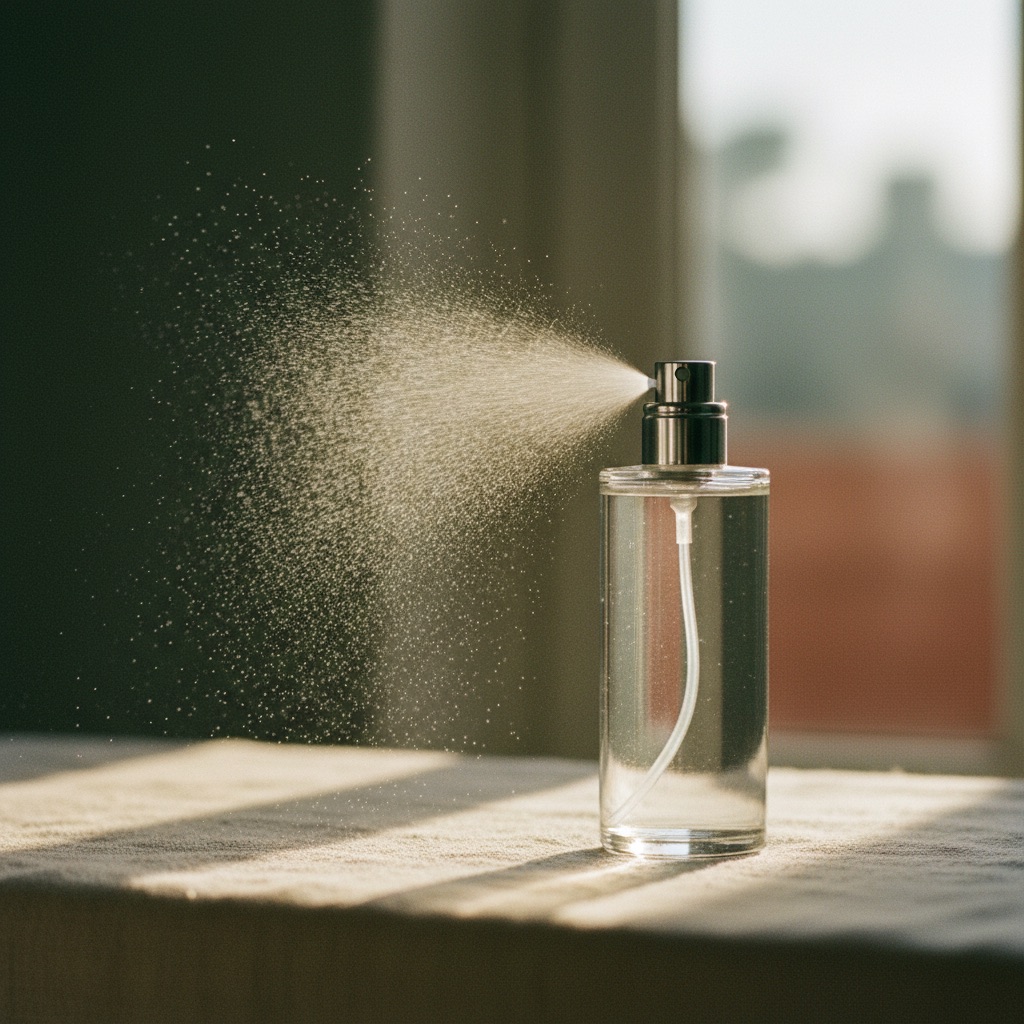
This is why the format matters as much as the formula. Sprays aerosolize chemistry into your breathing zone. If you change one thing today, change your spray all-purpose cleaner.
Fragrance: The Largest Pile of Undisclosed Chemistry
If there is a single worst offender, it is the word “fragrance.”
Under current U.S. law, “fragrance” can stand in for a proprietary blend of many undisclosed compounds. Among the common ones are phthalates, used to make scent linger — and the National Institute of Environmental Health Sciences identifies phthalates as endocrine-disrupting compounds, meaning they can interfere with hormone signaling. That is the specific reason fragrance draws concern around children and pregnancy. Several individual fragrance and solvent components also appear on California’s Prop 65 list of chemicals known to cause cancer or reproductive harm.
We pulled this loophole fully apart in the fragrance loophole, and we mapped the broader hormone-active chemistry in endocrine disruptors under your sink. The short version: fragrance is the easiest high-impact thing to remove, because removing it removes a whole category of chemicals you were never allowed to see.
Our base has no synthetic fragrance, no quaternary ammonium compounds and no dyes. Not for the smell. For what the smell was carrying.
The Real Environmental Case (and Its Honest Limits)
The environmental argument for switching gets oversold constantly, so let me give you the parts that hold up.
Biodegradability. Plant-derived surfactants that pass the OECD 301F test break down by at least 60% within 28 days, so they don’t persist in waterways or build up in aquatic life the way some conventional surfactants do. This is verifiable and meaningful.
Plastic and water. Conventional ready-to-use cleaners are roughly 90% water by volume. Every bottle you buy is mostly water wrapped in single-use plastic and trucked across the country. A concentrate skips the water and the bottle. At Ecolosophy, a concentrate format is our most direct lever on single-use plastic, because you reuse one bottle instead of discarding dozens. It’s why every concentrate we make ships as a small bottle that becomes up to 100 spray bottles. We ran the full numbers in refill vs. disposable math.
What I will not do is throw a precise “saves the planet by X%” figure at you. Those numbers vary by product and study, and inflating them is exactly the greenwashing I built this company to push back on.
What Should You Remove First?
You do not need to fear every bottle. You need a sequence:
- Spray all-purpose cleaner — highest inhalation exposure, used daily. Replace this first.
- Anything scented — sprays, “air-freshening” cleaners, scented bathroom products. This is where the undisclosed fragrance chemistry lives.
- Bathroom and disinfectant sprays — confined space, poor ventilation, high VOC accumulation.
- Everything else, as it runs out — floor cleaner, oven cleaner, specialty products. No need to waste what you already paid for.
For the full deeper inventory of what hides in mainstream “clean” products, hidden toxins in cleaning products is the reference we point people to most.
How to Verify a Replacement (Don’t Take Anyone’s Word)
Including ours. The 30-second check:
- EPA Safer Choice certification screens every intentionally added ingredient, fragrance included.
- EWG’s Guide to Healthy Cleaning — look for an A or B grade.
- Fragrance-free, not “unscented.” Unscented can mean masking chemicals were added.
- Ignore unbranded buzzwords. “Natural,” “non-toxic,” and “eco-friendly” have no legal definition for cleaning products.
The Bottom Line
A non-toxic home isn’t built by panic-buying or by trusting a green label. It’s built by removing a short, evidence-backed list of chemicals — fragrance and its phthalate carriers, harsh VOC solvents, and aerosol sprays — in order, starting with what enters your lungs first.
If you want a guide who will show you how to verify every claim for yourself, our free Ecolosophy Academy walks through label-reading, the highest-priority swaps, and how to tell real safety from marketing. Start there — and make every brand, including this one, earn your trust with evidence.
When your spray all-purpose cleaner is the first thing to go, the Pure Serenity concentrate is the one-bottle replacement — or, if you prefer no scent at all, the fragrance-free Unscented Oasis concentrate does the same job with no essential oils.
Sources cited
- EPA — Volatile Organic Compounds' Impact on Indoor Air Quality — EPA VOC indoor air quality reference
- NIEHS — Endocrine Disruptors — Phthalates and parabens identified as endocrine-disrupting compounds
- Svanes et al., 2018 — Cleaning and Lung Function Decline (Am. J. Respir. Crit. Care Med.) — 20-year cohort linking cleaning sprays to lung-function decline
- California OEHHA — Proposition 65 Chemical List — California Prop 65 list of chemicals known to cause cancer or reproductive harm
- EWG — Guide to Healthy Cleaning — EWG cleaning product safety ratings database