how to
Why We Sell Concentrate (and Why Pre-Mixed Spray Is a Sustainability Lie)
Pre-mixed spray bottles are 90–95% water. Here's what that costs the planet—and your wallet—and why concentrate changes the math.

Shipping a bottle that is 90% water isn't a cleaning product—it's a logistics problem dressed up in a spray nozzle.
— Italo Campilii, co-founder, Ecolosophy
Pick up a bottle of a popular pre-mixed all-purpose cleaner—Mrs. Meyer’s, Method, Grove Co, take your pick—and read the ingredients label. Water is listed first, because under FDA and industry labeling norms, ingredients appear in descending order by weight. That water isn’t incidental. Independent formulation analyses and EPA Safer Choice documentation consistently show that pre-mixed household cleaners are 90–95% water by volume. The other 5–10% is doing all the actual work: surfactants, fragrance, preservatives, maybe a pH buffer. You are, in the most literal sense, paying a premium price for tap water in a virgin plastic bottle, then paying again—in carbon—to ship that water from a factory to a warehouse to a truck to your doorstep.
That is the sustainability lie baked into the pre-mixed spray format. And it is hiding in plain sight on every grocery store cleaning aisle.
The Weight Problem Nobody Talks About
When a pallet of pre-mixed spray bottles leaves a manufacturing facility, the vast majority of its weight is water. Transport emissions for consumer goods are tightly coupled to weight and volume—heavier loads require more fuel per unit delivered. This isn’t a fringe claim: the EPA’s own Safer Choice Standard explicitly identifies concentration and packaging reduction as key levers for decreasing a cleaning product’s lifecycle environmental impact, including transport-phase emissions.
Think about what that means at scale. A cleaning brand selling 1 million bottles of pre-mixed spray per year is, in effect, running a water-delivery operation with a small cleaning-products business attached. Every truck in that supply chain is moving liquid ballast.
What Concentrate Actually Changes
A concentrate formula inverts that ratio. Instead of shipping a bottle that is 5% actives and 95% water, you ship a bottle that might be 20–40% actives—or higher, depending on the chemistry—and the consumer adds tap water at home. The functional cleaning dose is identical. The physical shipment is a fraction of the size and weight.
One concentrate bottle designed to replace 30 spray bottles doesn’t just save plastic (though it saves a lot of plastic). It means 29 fewer bottles manufactured, 29 fewer bottles filled, 29 fewer bottles on a truck, and 29 fewer bottles in a recycling bin—or more likely, a landfill, since mixed plastic recovery rates in the US remain stubbornly low.
The Plastic Math Is Even Worse Than You Think
Let’s put numbers to what “up to 90% less plastic” actually means in practice.
| Format | Bottles per year (average household) | Estimated plastic per bottle (HDPE) | Total plastic / year |
|---|---|---|---|
| Pre-mixed all-purpose spray | 12–18 | ~50 g | 600–900 g |
| Concentrate (1 bottle = 30 sprays) | 0.4–0.6 | ~40 g | 16–24 g |
| Concentrate with refill pouch system | 0.4–0.6 bottle + 1–2 pouches | ~40 g bottle + ~8 g pouch | 24–56 g |
The numbers aren’t close. A household running through a bottle of pre-mixed cleaner every three to four weeks generates roughly 600–900 grams of plastic packaging from all-purpose spray alone, per year. A household using concentrate generates somewhere between 16 and 56 grams, depending on whether they use refill pouches. That’s a reduction of 93–97% in plastic from this one product category.
And this is one cleaner. Multiply across bathroom spray, glass cleaner, floor cleaner, dish soap—the conventional pre-mixed versions of all of them—and the plastic accumulation is substantial.
The EWG’s Guide to Healthy Cleaning flags packaging format as an environmental criterion precisely because of this dynamic. Products that require frequent repurchase in single-use plastic containers carry a higher environmental load independent of what’s inside them.
”But Isn’t Making Concentrate Harder on the Environment?”
This is a fair question, and it deserves a direct answer.
Yes, concentrated formulas require more precise manufacturing. The active ingredients have to be stable at higher concentrations, which sometimes demands more sophisticated chemistry or different preservative systems. But the manufacturing phase is a small slice of a cleaning product’s total lifecycle impact compared to packaging production, distribution, and end-of-life disposal.
The EPA Safer Choice program—which is the most rigorous third-party standard for cleaning product ingredients in the US—specifically recognizes concentration as an environmental improvement strategy in its standard documentation. That recognition isn’t about marketing; it reflects lifecycle assessment methodology. The upstream manufacturing complexity does not come close to offsetting the downstream gains in plastic reduction and transport efficiency.
The Ingredient Quality Argument
There’s a secondary benefit to concentrate that doesn’t get enough attention: when water isn’t the primary ingredient, there’s no financial incentive to pad the formula. Pre-mixed products have an implicit pressure to keep active ingredient concentrations low—partly because high concentrations can be unstable in dilute aqueous solution over a shelf life of 18–24 months, and partly because water is cheap and increases bottle weight without increasing cost.
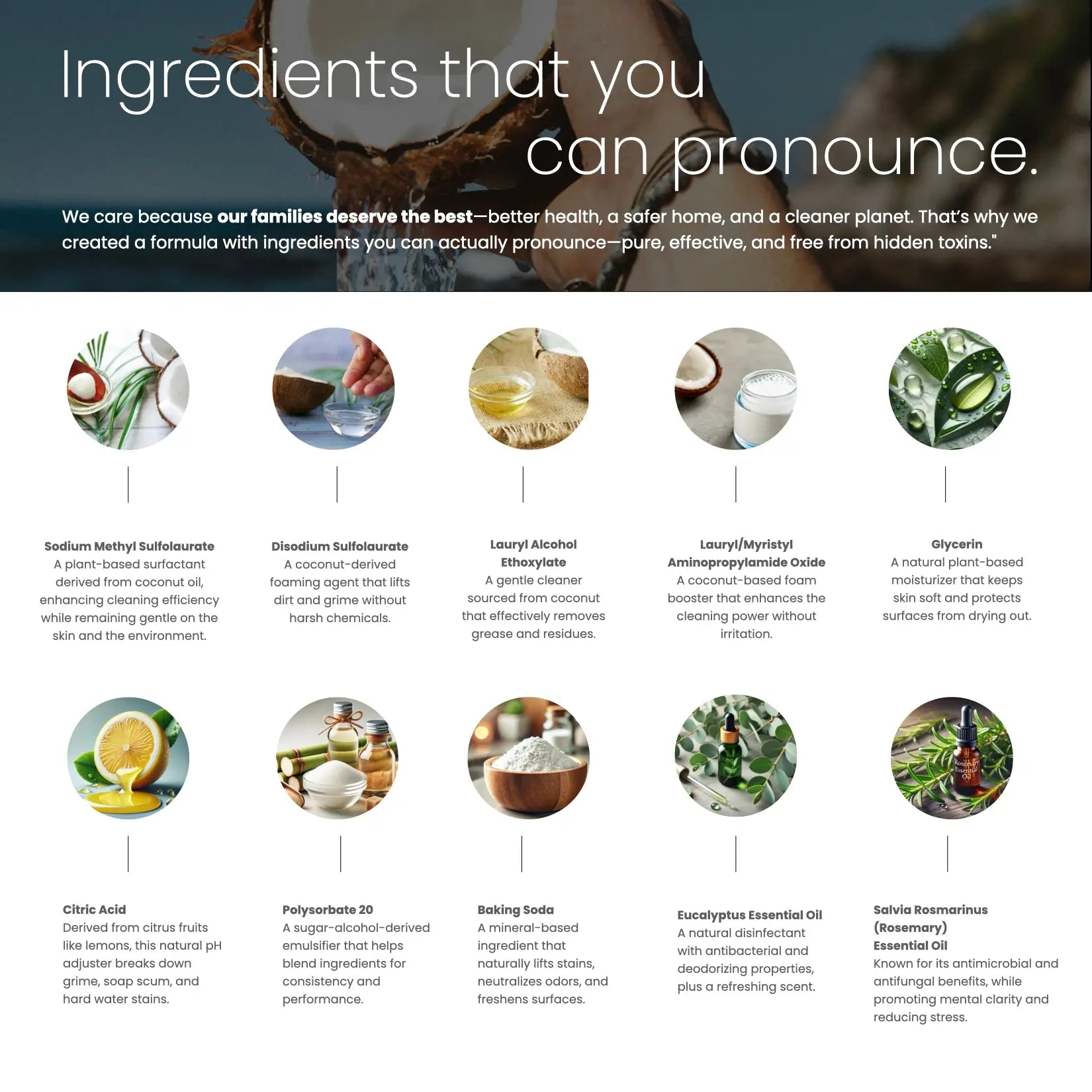
Concentrate formats allow formulators to focus the entire formula on ingredients that do something. That’s part of why Elizabeth, our PhD chemist co-founder, insists on concentrate: it’s not just an environmental decision, it’s a formulation-quality decision. You can choose better surfactants, better biodegradability profiles, and skip the preservative systems needed to keep a mostly-water formula stable for two years on a warehouse shelf.
Speaking of biodegradability: any serious concentrate formula should be able to demonstrate OECD 301F compliance—meaning the surfactant system biodegrades ≥60% within 28 days under aerobic conditions. That’s the international standard. If a brand can’t tell you their biodegradability test methodology, that’s meaningful information. For more on how to read surfactant claims, see our piece on the surfactant distinction in plant-based cleaners.
The Refill Model Isn’t a Trend—It’s a Return to Baseline
Before the postwar plastics boom, concentrated cleaning products were the norm. Soap came in bars or dense pastes. Ammonia and vinegar were diluted at home. The idea of shipping water across the country in a single-use plastic bottle and calling it a cleaning product would have struck a 1940s homemaker as wasteful to the point of absurdity.
The pre-mixed spray format is a roughly 40-year experiment in convincing consumers that convenience requires disposable liquid-filled plastic. That experiment has a well-documented cost: hundreds of millions of plastic bottles annually in the US alone, a recycling infrastructure that cannot keep pace, and a consumer base that is, in many households, paying $4–6 per bottle for something that is mostly tap water.
The refill model isn’t novel. It’s a correction.
There’s also a health dimension here that Italo talks about openly. When he was managing Crohn’s disease and trying to eliminate chemical exposures from his home environment, pre-mixed cleaners were a source of real concern—not just because of what was in the active fraction, but because of the preservatives, synthetic fragrances, and stabilizers required to keep a mostly-water formula shelf-stable. Concentrated formulas with short, transparent ingredient lists were easier to evaluate and, in practice, carried fewer problematic additives. If you want to understand the broader landscape of what’s hiding in conventional cleaners, our article on hidden toxins in cleaning products walks through the specific ingredient categories to watch.
Does Concentrate Actually Work? (Yes, With One Caveat)
The one place concentrate skepticism is legitimate: dilution discipline. A concentrate that gets under-diluted wastes product and money. One that gets over-diluted may underperform. The format only delivers on its promise when the dilution ratio is clearly communicated and easy to follow.
Good concentrate products solve this with measuring caps, clearly marked spray bottles, or pre-portioned tablets. Bad ones leave consumers guessing with vague “add a capful” instructions that vary wildly by cap size. If you’re evaluating a concentrate, look for a specific volumetric dilution ratio (e.g., 1:30, meaning one part concentrate to 30 parts water) and a dedicated dilution bottle.
Cleaning performance at correct dilution is equivalent to—or better than—pre-mixed, because the surfactant system is doing the same work at the same concentration. For a deeper look at how non-toxic cleaners compare to conventional products on actual cleaning efficacy, see do non-toxic cleaners work.
Your Next Step (No Purchase Required)
Before you buy anything, do this: pick up the pre-mixed cleaners currently under your sink and look at the ingredient list. If water is the first ingredient and you’re paying $5+ per bottle, you now understand what you’re buying.
Then look up those products on the EWG’s Guide to Healthy Cleaning—a free, searchable database that scores products on ingredient safety and transparency. See whether the brands you’re using disclose their full ingredient lists and what ratings they receive.
If you decide to switch to concentrate, choose a product that gives you a specific dilution ratio, discloses every ingredient, and can cite a biodegradability test methodology. That’s the baseline. Everything else is negotiable. If you want to see what that looks like in practice, our Unscented Oasis Kit is built around exactly those criteria—but the point is the standard, not the brand. Hold every concentrate you consider to it.
Stop shipping water. The planet will notice.
Sources cited
- EPA Safer Choice Program — Concentration and Packaging — EPA Safer Choice Standard, Section on Packaging and Concentration
- OECD 301F Ready Biodegradability Test Guideline — OECD Guideline for Testing of Chemicals, Test No. 301: Ready Biodegradability
- EWG Guide to Healthy Cleaning — Product Format and Dilution — EWG Guide to Healthy Cleaning, Product Database and Format Criteria
- EPA — Safer Choice Ingredient Standards and Surfactant Criteria — EPA Safer Choice Safer Ingredients List
- NIH / NLM — Household Chemical Exposures and Indoor Air Quality — Steinemann A. (2017). Ten questions concerning air fresheners and indoor built environments. Building and Environment, 111, 279–284.
Frequently asked
Does concentrate actually clean as well as pre-mixed spray?
Yes—cleaning performance depends on the active surfactant concentration at point of use, not the format it ships in. When you dilute concentrate to the correct ratio, you get the same—or higher—active ingredient concentration as a pre-mixed product, often with better-quality ingredients because there's no incentive to pad with water.
Isn't making concentrate more complicated to manufacture, making it worse for the environment?
Manufacturing a concentrated formula does require precise chemistry, but the upstream environmental savings—less water use in formulation, far less plastic packaging, dramatically lower transport weight—outweigh any added complexity. The EPA Safer Choice program specifically recognizes concentration as an environmental improvement pathway.
How much plastic does switching to concentrate actually save?
If one concentrate bottle replaces 30 pre-mixed spray bottles, and each spray bottle uses roughly 50 g of HDPE plastic, that's approximately 1,500 g of plastic avoided per concentrate purchase cycle. Real-world savings vary by brand and dilution ratio, but the order of magnitude is significant.
What does OECD 301F mean on a cleaner label?
It means the formula was tested under OECD Guideline 301F and biodegraded ≥60% within 28 days under aerobic conditions—the international benchmark for 'readily biodegradable.' It's one of the most credible biodegradability claims a cleaning product can carry.
Are refill pouches actually better than just buying another bottle of concentrate?
Refill pouches use significantly less plastic than rigid bottles and are easier to ship flat. However, their recyclability depends heavily on local infrastructure. A concentrate bottle you refill at home with tap water remains one of the lowest-impact formats available, because it eliminates the refill pouch entirely.