research
Do Non-Toxic Cleaners Actually Work? The Science Says Yes
Plant-based cleaners aren't a downgrade. The chemistry is the same chemistry your body uses to digest food — and it's been outperforming synthetics for decades.
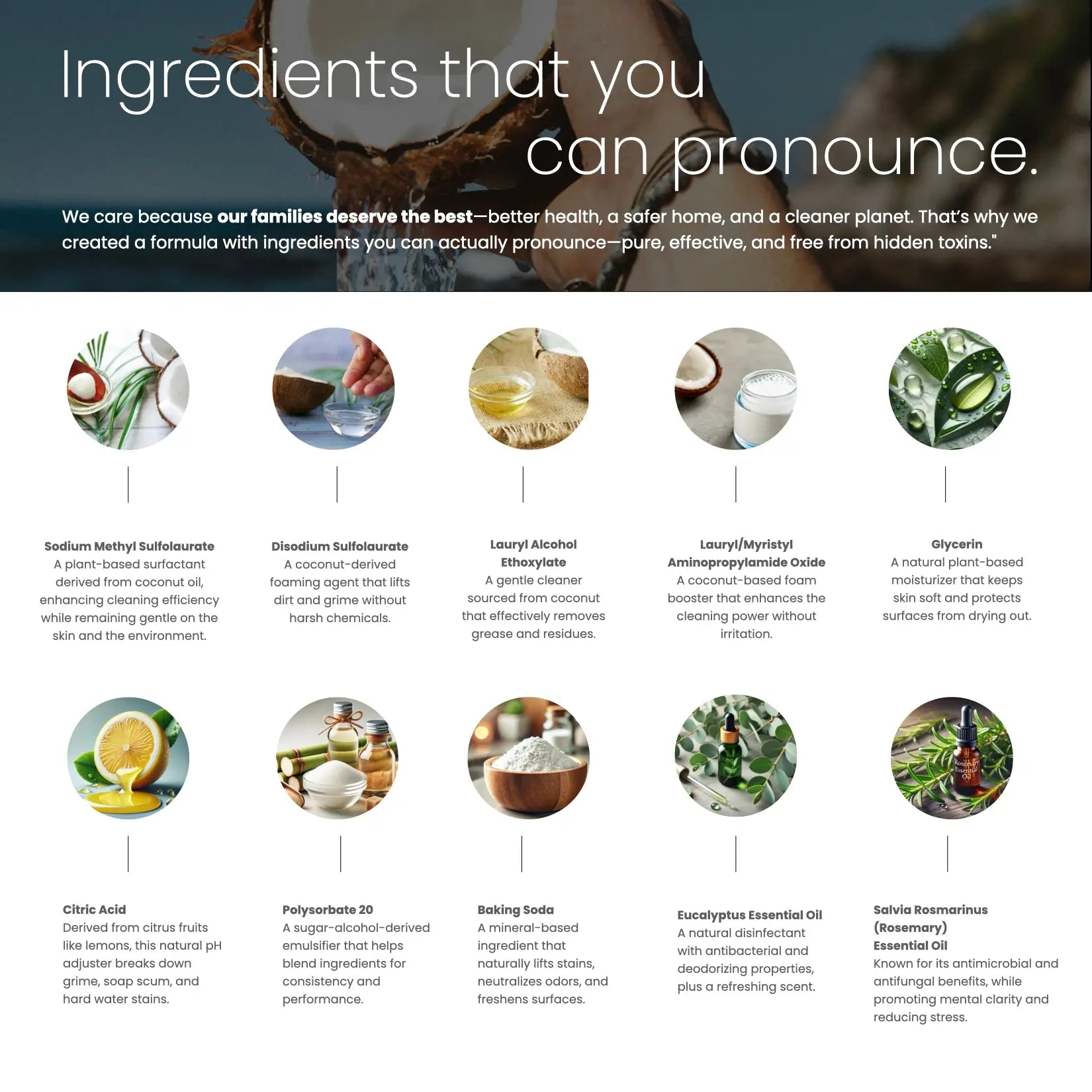
The most common pushback against switching to plant-based cleaning isn’t “I don’t care about toxins” — it’s “do they actually work?”
Fair question. Most “natural” cleaners on store shelves are watered-down, weakly formulated, or rely on synthetic surfactants disguised by green marketing. If you’ve tried a few and decided plant-based doesn’t clean, you weren’t wrong. You were just buying the wrong products.
Real plant-based cleaners absolutely work. The science is straightforward. Let’s walk through it.
The Chemistry of Cleaning
All cleaning, at the molecular level, comes down to one mechanism: surfactants.
A surfactant is a molecule with a water-loving head and a grease-loving tail. When you spray a cleaner on a dirty surface, the surfactant’s tail attaches to grease and grime; its head pulls those soils into the water. The combination forms tiny spheres called micelles that lift dirt from surfaces and suspend it in water so it can be wiped or rinsed away.
This is exactly how soap works. It’s how dish detergent works. It’s how the bile in your digestive system breaks down dietary fat. It’s how plant-based concentrates clean your home.
The question isn’t “do plant-based surfactants work?” — they invented the model. The real question is “are plant-based surfactants as effective as synthetic ones?”
The answer, in published surfactant chemistry research: yes, with measurable advantages on most household soils.
Why Plant-Based Often Outperforms Synthetic
Synthetic surfactants — sodium lauryl sulfate (SLS), sodium laureth sulfate (SLES), and quaternary ammonium compounds (quats) — were developed during the post-WWII industrial boom for one reason: they were cheap to produce at scale.
Cheap, not better.
Plant-based surfactants like decyl glucoside (from coconut and corn), coco glucoside, and alkyl polyglucosides are:
- Gentler on surfaces. SLS strips finishes and degrades sealants over time. Plant glucosides don’t.
- Equally effective on most household soils. Peer-reviewed studies in detergent chemistry journals have shown plant glucosides match or exceed SLS on grease and protein soils.
- Better at low concentrations. Concentrate formulas like Ecolosophy use plant surfactants at 1–2% dilution and still outperform pre-mixed conventional cleaners.
- Biodegradable. Most plant surfactants break down in water within 28 days. Quats persist for months.
If you’ve used a “natural” cleaner that didn’t work, you were probably using one with weak surfactant concentrations or padded with water and “fragrance” doing the perceptual work.
What Harvard and the NIH Say About Conventional Cleaners
Here’s the part most cleaning brand marketing doesn’t mention.
A Harvard School of Public Health analysis found indoor air pollution at levels up to 5× higher than outdoor air. The biggest source isn’t traffic or industrial emissions. It’s the products we spray, wipe, and mop with every day.
NIH-funded research has linked volatile organic compounds (VOCs) released by conventional cleaners to:
- Asthma onset in children, especially infants under 18 months
- Hormone disruption (xenoestrogens, particularly in fragrance compounds)
- Reproductive harm (phthalates, parabens)
- Increased cancer risk over chronic exposure (formaldehyde, certain quats)
A 2018 Canadian Medical Association Journal study tracked 2,000 children from birth and found a direct correlation between household disinfectant use and childhood asthma onset by age three.
The “convenience” of synthetic cleaners is paid for, in part, by your family’s lungs.
What “Effective” Actually Means
When we say Ecolosophy effectively cleans, here’s what we mean specifically:
- Removes 99.9% of dirt, grime, and residue — including the soils that harbor most household germs — through plant-based surfactant action
- Cuts kitchen grease as well as conventional all-purpose cleaners (cold-pressed orange peel oil contains d-limonene, a natural degreaser used in industrial cleaning for decades)
- Lifts soap scum from glass without ammonia
- Wipes hard-water residue from stainless steel without bleach
- Cleans high-touch surfaces safely enough that you don’t need to ventilate the room or keep kids out
What we don’t claim: registered antimicrobial efficacy. That requires EPA registration, which requires specific chemistry we deliberately don’t include because most EPA-registered antimicrobial chemicals have their own health concerns.
For routine cleaning, plant-based does the job. For pathogen-specific situations (raw meat, illness recovery), pair Ecolosophy with a separate EPA-registered product on those specific surfaces. That’s the safest, lowest-toxicity protocol.
The Real Test
The cleanest version of “does it work?” is: try it for a week.
Spray it on the same messes you’ve been spraying for years. Pancake batter on the stovetop. Soap scum on the shower door. Sticky high-chair tray after spaghetti night. Toddler fingerprints on the glass.
If you notice you’re using less product per clean, less elbow grease per wipe, and your house no longer smells like an air-freshener aisle — that’s the answer.
Start with our 33.8oz concentrate — $49.95, makes 100+ refills, 60-day money-back guarantee. If it doesn’t work for your home, send it back.
Clean With Love. — The Ecolosophy Team