ingredient investigation
1,4-Dioxane: The "Coconut-Derived" Carcinogen Hiding in Plant-Based Brands
"Plant-based" doesn't mean safe. 1,4-Dioxane is a likely carcinogen found in coconut surfactants—here's what the lab data actually shows.
Calling a surfactant 'coconut-derived' tells you nothing about whether 1,4-dioxane was left behind in the process that made it.
— Elizabeth Uria, PhD — Co-founder, Ecolosophy
Picture this: you’re standing in a natural grocery store aisle, reaching for a dish soap whose front label reads “plant-based,” “coconut-derived,” and “gentle on the earth.” You’ve done everything right. You read the marketing. You paid the premium. And somewhere in that bottle, invisible and unlistable by law, is a compound the EPA classifies as a likely human carcinogen—one that no brand will ever voluntarily put on a label because, technically, no brand deliberately put it there.
That compound is 1,4-dioxane. And understanding how it gets into “clean” products is one of the most important things you can do for your household’s health right now.
What 1,4-Dioxane Actually Is (And Isn’t)
1,4-Dioxane is not an ingredient anyone chooses. It’s a contaminant—a byproduct of a manufacturing process called ethoxylation, in which ethylene oxide is reacted with a fatty acid (often derived from coconut or palm oil) to produce a surfactant that lathers better and feels milder on skin. The problem is that ethylene oxide is itself a carcinogen, and 1,4-dioxane is the chemical ghost it leaves behind.
The compound is a cyclic ether, meaning its molecules form a ring structure. It’s miscible with water, meaning it doesn’t separate out or degrade easily. The EPA’s Integrated Risk Information System (IRIS) assessment classifies it as a likely human carcinogen based on animal data showing kidney and liver tumors at high doses, and the International Agency for Research on Cancer (IARC) places it in Group 2A—probable human carcinogen—alongside red meat, glyphosate, and night-shift work. California’s Office of Environmental Health Hazard Assessment lists it under Proposition 65 as a known carcinogen.
None of this is fringe science. It’s regulatory consensus.
Why “Coconut-Derived” Doesn’t Get Brands Off the Hook
Here’s where the greenwashing problem gets precise. A surfactant like sodium laureth sulfate (SLES) can be derived from coconut oil. That’s true. What’s also true is that the “-eth” in “laureth” signals that it went through ethoxylation. The original fatty acid source—tropical, sustainable, cold-pressed, whatever the marketing says—is irrelevant to what happened in that reactor. If the manufacturer didn’t remove residual 1,4-dioxane afterward, it’s in there.
As Elizabeth Uria, PhD, our co-founder, puts it: calling a surfactant “coconut-derived” tells you nothing about whether 1,4-dioxane was left behind in the process that made it.
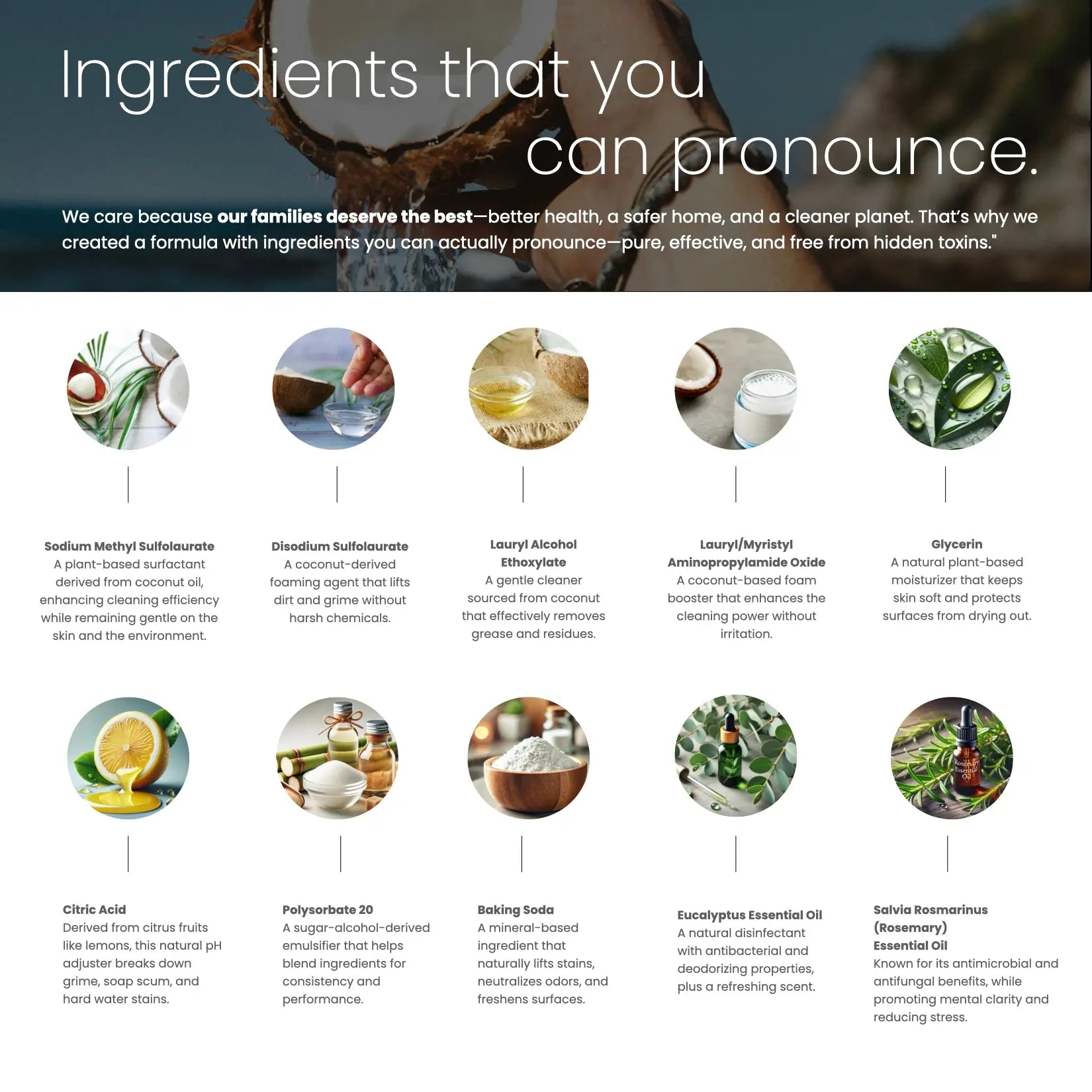
Common ethoxylated surfactants to watch for on ingredient labels include anything ending in -eth (sodium laureth sulfate, sodium myreth sulfate), anything starting with PEG- (polyethylene glycol compounds), and polysorbates.
How Much Is Actually in Products?
When New York State passed its Household Cleansing Product Information Disclosure Program—and then followed it with a 2021 law capping 1,4-dioxane at 10 parts per million (ppm) in household products—it became the strictest regulatory standard in the U.S. What triggered that law was testing. And the testing was not reassuring.
The Environmental Working Group’s research found detectable levels of 1,4-dioxane across dozens of consumer products, including ones positioned as natural or green. Independent labs commissioned by journalists and advocacy groups found concentrations ranging from trace amounts to over 80 ppm in some products—well above New York’s new threshold.
For context, the EPA’s recommended maximum contaminant level for 1,4-dioxane in drinking water is 0.35 micrograms per liter. We’re talking about a compound that water regulators want nearly eliminated—and it was showing up at measurable concentrations in products people use to wash dishes, hands, and babies.
The Brands You’d Expect to Be Safe
This is the uncomfortable part. It’s not just generic store brands. Third-party testing over the past several years has found 1,4-dioxane in products from companies that built their identity around “natural” and “plant-based” positioning. I won’t name names without current third-party data to back it up—but I will say this: the problem doesn’t correlate with price, green credentials, or the number of leaf logos on the packaging. It correlates with whether the brand uses ethoxylated surfactants and whether they’ve done anything about residual contamination.
The Solution Exists—Brands Just Have to Choose It
Here’s what’s genuinely frustrating: removing 1,4-dioxane is not technically difficult. A purification process called vacuum stripping—essentially using heat and low pressure to volatilize and remove the contaminant before the surfactant is incorporated into a product—can reduce 1,4-dioxane concentrations to below 1 ppm. Some manufacturers go further and simply avoid ethoxylated surfactants altogether, using non-ethoxylated alternatives like decyl glucoside, coco glucoside, or other alkyl polyglucosides, which are derived from plant sugars and don’t require ethoxylation.
The choice not to do this isn’t a chemistry problem. It’s a cost and prioritization problem.
Below is a practical comparison of surfactant types, their ethoxylation status, and what that means for 1,4-dioxane risk:
| Surfactant Type | Examples | Ethoxylated? | 1,4-Dioxane Risk |
|---|---|---|---|
| Alkyl polyglucosides | Decyl glucoside, coco glucoside | No | None |
| Amine oxides | Coco amine oxide | No | None |
| Sodium lauryl sulfate (SLS) | SLS | No | None |
| Sodium laureth sulfate (SLES) | SLES, “coconut-derived SLES” | Yes | Present unless stripped |
| PEG compounds | PEG-40, PEG-100 | Yes | Present unless stripped |
| Polysorbates | Polysorbate 20, 80 | Yes | Present unless stripped |
| Ethoxylated alcohols | Laureth-7, Ceteth-20 | Yes | Present unless stripped |
What EPA Safer Choice Actually Screens For
One legitimate signal worth knowing: the EPA’s Safer Choice program requires that certified products be screened for 1,4-dioxane. Products earning that certification must use either non-ethoxylated surfactants or demonstrate that ethoxylated ingredients have been treated to bring 1,4-dioxane below acceptable thresholds. It’s not a perfect program—certification is voluntary and the list of certified products is limited—but it’s one of the few third-party checks that specifically addresses this contaminant.
If a brand claims to be non-toxic but hasn’t pursued Safer Choice certification and can’t provide third-party 1,4-dioxane test data, that’s a gap worth questioning.
Why This Hits Differently for People With Gut and Immune Conditions
When I was in the worst years of managing Crohn’s disease, I became obsessed with reducing my body burden—the cumulative chemical load my gut and immune system were dealing with. I didn’t have the language for it then, but the science supports the instinct: people with compromised gut barriers may have altered absorption of compounds that healthy individuals process more efficiently. 1,4-Dioxane is water-soluble and dermally absorbed. Dermal absorption studies have confirmed that skin exposure can contribute meaningfully to systemic dose, not just inhalation or ingestion.
That’s not a reason to panic. It’s a reason to make a different choice when a better option exists—and to demand that brands earning “clean” margins actually deliver clean chemistry.
For a broader look at how surfactant chemistry separates genuine non-toxic products from marketing-first ones, our deep dive on plant-based surfactants is worth reading before your next purchase. And if you want the full picture of how many common cleaning ingredients are inadequately regulated in the U.S., the hidden toxins in cleaning products piece lays out the regulatory gaps clearly.
You might also want to check our breakdown of whether non-toxic cleaners actually work—because avoiding 1,4-dioxane shouldn’t mean accepting a product that leaves your counters sticky.
Your Practical Next Action
You don’t need to throw everything out today. But here’s a clear, three-step process:
1. Audit your current products for ethoxylated surfactants. Flip every bottle you use for cleaning and personal care. Look for ingredients ending in -eth, starting with PEG-, or labeled as polysorbates. These are flags, not automatic disqualifiers—but they mean you need more information.
2. Ask brands for their 1,4-dioxane testing data. Email or DM the companies whose products you use. Ask specifically: “Do you test for residual 1,4-dioxane in your finished products, and can you share third-party documentation?” A brand confident in its chemistry will answer this clearly.
3. Prioritize EPA Safer Choice certified products or products using non-ethoxylated surfactants. Alkyl polyglucosides (like decyl glucoside and coco glucoside) are effective, well-studied, and don’t carry this risk. Brands that formulate around them don’t have to choose between clean marketing and clean chemistry—they’ve actually built the latter.
The word “plant-based” on a label is a starting point for a conversation, not the end of one. Now you know which question to ask next.
Sources cited
- EPA — 1,4-Dioxane Hazard Summary — EPA IRIS assessment classifying 1,4-dioxane as a likely human carcinogen
- NIH PubMed — Ethoxylation and 1,4-Dioxane Byproduct Formation — Peer-reviewed study on 1,4-dioxane contamination in personal care products
- EWG — 1,4-Dioxane in Cleaning Products — EWG report on 1,4-dioxane detection in consumer products
- California OEHHA — Proposition 65 List — California Prop 65 listing of 1,4-dioxane as a known carcinogen
- NIH PubMed — Vacuum Stripping to Reduce 1,4-Dioxane — Research on manufacturing techniques that reduce 1,4-dioxane to below 1 ppm
Frequently asked
Is 1,4-dioxane the same thing as dioxin?
No. They sound similar but are chemically unrelated. Dioxins are chlorinated compounds associated with industrial pollution. 1,4-Dioxane is a cyclic ether that forms as a manufacturing byproduct during surfactant ethoxylation. Both are concerning, but they're different substances with different risk profiles.
How do I know if my cleaner has 1,4-dioxane in it?
You can't tell from the label—it's a contaminant, not an ingredient, so it won't be listed. Look for ethoxylated surfactants (anything ending in '-eth,' like sodium laureth sulfate, or 'PEG-' compounds). Then ask the brand directly for third-party testing data, or look for EPA Safer Choice certification, which screens for it.
Does 'plant-based' or 'natural' mean a product is free of 1,4-dioxane?
No. 1,4-Dioxane forms during a chemical manufacturing step (ethoxylation) applied to surfactants regardless of their original source. Coconut-derived sodium laureth sulfate can carry just as much residual 1,4-dioxane as petroleum-derived versions if the same process is used without a purification step.
What is the safe level of 1,4-dioxane in a cleaning product?
New York State currently caps it at 10 ppm in household cleaners. California's Prop 65 imposes warning requirements above certain exposure thresholds. Some toxicologists argue that given its likely carcinogen status, the safest target is as close to zero as technically achievable—which vacuum stripping can accomplish.
Which cleaning brands have tested clean for 1,4-dioxane?
Brands that avoid ethoxylated surfactants entirely—or use vacuum stripping and publish third-party test results—are your safest bet. EPA Safer Choice certification requires screening for 1,4-dioxane. Always ask for documentation rather than taking a marketing claim at face value.