
Are Fragrance, Quats & Preservatives in Cleaners Safe? The Honest Answer
They told us “clean” meant a house that smells like lavender chemicals. They lied. Three invisible ingredient classes hide inside the bottles under your sink — and your baby crawls right through them. Here is the cited, two-sided truth, and what a family can actually do about it today.
Short answer: Synthetic fragrance, quats (quaternary ammonium compounds), and certain preservatives (isothiazolinones, formaldehyde releasers) carry real, peer-reviewed links to asthma, contact dermatitis, and hormone disruption — yet they remain legal and largely undisclosed because of regulatory gaps, not because they are proven safe. The simplest fix for a family with kids or pets is a plant-based concentrate with a fully disclosed formula and zero added fragrance, such as Ecolosophy Unscented Oasis. Below, the full science on all three classes — the part no single competitor covers honestly in one place.
What are quats (quaternary ammonium compounds), and which products contain them?
Quats are a family of nitrogen-based cationic surfactants — benzalkonium chloride (BAC), didecyldimethylammonium chloride (DDAC), alkyl dimethyl benzyl ammonium chloride (ADBAC) and others — used as disinfectants, sanitizers, and fabric softening agents. They kill microbes by disrupting cell membranes, and they cling to surfaces, which is exactly why they ended up in so many everyday products.
You’ll find quats in:
- Disinfecting wipes (the canister kind in nearly every kitchen)
- Antibacterial sprays and “kills 99.9% of germs” multi-surface cleaners
- Fabric softeners and dryer sheets (the “softness” is a quat coating)
- Hard-surface and bathroom cleaners
- Antibacterial hand soaps
The micro-lesson: a quat’s superpower — sticking to surfaces and membranes — is also the reason it lingers on your countertop, your child’s sippy cup tray, and in the air you breathe after spraying.
Are quats safe? What the science actually says
Here is where honesty matters. The peer-reviewed record on quats is not “harmless,” and it is not “poison” either — it is concerning, especially with chronic exposure.
- Asthma & respiratory irritation: Quats are documented respiratory sensitizers. NCBI StatPearls and occupational-health literature link benzalkonium chloride exposure to work-related asthma and airway irritation, particularly among cleaners and healthcare workers who aerosolize these products daily.
- Contact dermatitis: Quats are recognized skin irritants and allergens; repeated hand contact is associated with irritant and allergic contact dermatitis.
- Reproductive / fertility signals: A series of mouse studies (Melin et al., published in Reproductive Toxicology and Birth Defects Research) reported reduced fertility and increased neural tube defects in mice exposed to the common quat mixture ADBAC+DDAC. These are animal findings, not proof of human harm — but they are exactly the kind of signal that should trigger more testing, not less.
The truth most labels won’t print: “disinfects” and “safe to breathe every day” are two different questions.
Why are quats under-regulated?
This is the angle the industry FAQs skip. Quats fall into a regulatory blind spot created by how old laws were written.
- Pre-1976 TSCA grandfathering: When the Toxic Substances Control Act passed in 1976, roughly 62,000 chemicals already in commerce — including many quats — were “grandfathered in” and presumed safe without new health testing.
- Registered as pesticides, not health-tested for chronic exposure: The EPA regulates quats primarily as antimicrobial pesticides. That registration confirms they kill germs effectively — it does not require the chronic, low-dose human exposure studies you might assume stand behind a product you spray in your kitchen daily.
- California DTSC review: California’s Department of Toxic Substances Control has flagged certain quats (DDAC, ADBAC) for review under its Safer Consumer Products program — an acknowledgment from a regulator that the existing safety picture has gaps worth re-examining.
What is ‘fragrance’ on a cleaning label — and why is it a legal loophole?
“Fragrance” (or “parfum”) is one word that can legally stand in for a blend of dozens to over 100 individual chemicals. Per the FDA's own cosmetics-labeling guidance, fragrance ingredients are among those "most likely to be granted trade secret status," and no US law requires cleaning-product makers to disclose the individual chemicals inside "fragrance." (fda.gov) The blend is treated as a protected trade secret.
So a label can say “fragrance” and tell you almost nothing — not the solvents, not the synthetic musks, not the carriers. You can read every word on the bottle and still have no idea what you just sprayed near your child’s face. That is the loophole: not that the chemicals are listed and scary, but that they are legally allowed to be hidden.
Are fragrances safe? Allergies, asthma, and the phthalate connection
Fragrance mixtures are among the most common triggers of allergic and irritant reactions in consumer products. Documented effects include allergic contact dermatitis, headaches, and asthma exacerbation — airborne fragrance is a recognized asthma trigger, and aerosolized cleaning sprays make it worse.
But the deeper problem hides inside the word. Phthalates are frequently used as fragrance carriers and fixatives to make a scent last. Research summarized by health advocates has found that independent testing has found that the majority of fragranced products tested contained phthalates that appeared nowhere on the label, because they shelter under “fragrance.”
What are phthalates, and why are they endocrine disruptors?
Phthalates are a class of plasticizers and solvents (DEP, DBP, DEHP and others). The concern isn’t acute toxicity — it’s that several phthalates behave as endocrine disruptors, meaning they can mimic or interfere with the body’s hormones at low doses. Peer-reviewed studies have linked certain phthalates to reproductive and developmental effects, altered hormone levels, and adverse outcomes in pregnancy and early childhood.
The micro-lesson: hormone-disrupting chemicals don’t follow “the dose makes the poison” the way classic toxins do. Timing — pregnancy, infancy — can matter as much as amount. That’s why a hidden phthalate in a cleaner you use every day deserves more scrutiny than its tiny percentage suggests.
What preservatives are in cleaners, and are they safe?
Water-based cleaners are a buffet for microbes, so most need preservatives. The three classes that draw the most concern:
- Isothiazolinones (MIT / methylisothiazolinone and MCI / methylchloroisothiazolinone): potent preservatives and well-documented skin sensitizers.
- Formaldehyde releasers (e.g. DMDM hydantoin, quaternium-15): they slowly release formaldehyde, a known human carcinogen by inhalation, to keep the product preserved.
- Parabens: preservatives with weak estrogenic activity that have drawn endocrine-disruption scrutiny.
Why was methylisothiazolinone ‘Contact Allergen of the Year’?
Methylisothiazolinone (MIT) was named Contact Allergen of the Year in 2013 by the American Contact Dermatitis Society after a sharp rise in sensitization tied to its growing use in cosmetics and household products. The European Union responded by banning MIT from leave-on cosmetic products (and tightening rinse-off limits) in 2016–2017 — a regulator concluding the exposure simply wasn’t worth the risk. It’s a clean example of the transatlantic gap: an ingredient restricted in the EU can still appear in US household cleaners.
What are safer preservative alternatives — and how do concentrates help?
Gentler preservative systems do exist. Caprylhydroxamic acid and caprylyl glycol are commonly used multifunctional, lower-sensitization alternatives to isothiazolinones and formaldehyde releasers.
But the most elegant answer is structural: use less water. A concentrate is mostly active cleaning agents, not water, so it offers far less of the microbial environment that demands aggressive preservation — and you dilute it fresh at home. Less water means less need for synthetic preservative and no fragrance “masking” agents required to cover up chemical smells. That’s the quiet advantage behind Ecolosophy’s format — the same reason it's a common first swap for families dealing with allergies or asthma, and it's worth comparing against what Method actually discloses before you assume every "clean" brand is playing by the same rules.
Regulators vs. health advocates: who’s right, and who should you trust?
This is the section nobody writes honestly — so we will. You will read “quats are safe when used as directed” from the American Cleaning Institute and Chemical Safety Facts, and you will read “these chemicals are harmful” from the Environmental Working Group, MADE SAFE, and the Toxics Use Reduction Institute (TURI). Here’s how both can be technically true:
| Position | What they actually mean | Where it holds up |
|---|---|---|
| Industry (ACI, Chemical Safety Facts): “Safe as directed” | At label-specified doses, for acute effects, these ingredients meet existing regulatory thresholds. | True for short-term, single-use, label-compliant exposure. |
| Advocates (EWG, MADE SAFE, TURI): “Harmful” | Real-world daily, cumulative, aerosolized exposure — plus hormone-disruption endpoints — isn’t what the “as directed” testing was built around. | True for chronic, repeated, whole-family exposure and endocrine effects. |
The gap between them is the regulatory gap: grandfathered chemicals, pesticide-not-health registration, and trade-secret fragrance rules. The honest takeaway isn’t “panic” or “relax.” It’s: when the safety case rests on “technically compliant,” and you have a baby on the floor, choosing a fully disclosed plant-based formula is a rational, low-regret decision.
How to read a cleaning label and spot all three classes
| What you see on the label | What it really is | Health concern | Safer swap |
|---|---|---|---|
| Benzalkonium chloride, ADBAC, DDAC, “quaternary ammonium” | Quat disinfectant / softener | Asthma, dermatitis, animal fertility signals | Plant-based surfactant cleaner; reserve true disinfection for when it’s genuinely needed |
| “Fragrance” / “Parfum” | Undisclosed blend of up to 100+ chemicals | Allergy, asthma trigger, hidden phthalates | Fragrance-free, or real disclosed essential oils |
| Methylisothiazolinone, methylchloroisothiazolinone (MIT/MCI) | Isothiazolinone preservative | Potent skin sensitizer (Allergen of the Year 2013) | Caprylhydroxamic acid, caprylyl glycol — or a concentrate that needs less |
| DMDM hydantoin, quaternium-15 | Formaldehyde releaser | Releases a known carcinogen | Non-formaldehyde preservative system |
| Phthalates (often unlisted, hiding in “fragrance”) | Plasticizer / scent fixative | Endocrine disruptor | Fragrance-free, fully disclosed formula |
Want the room-by-room version of this?
The free 7-Day Home Detox walks you through one room a day — what to toss, what to keep, what actually matters.
Which certifications actually mean something?
- EWG VERIFIED: products meet EWG’s strictest standards and must fully disclose ingredients — including what’s in “fragrance.” The disclosure requirement is the point.
- MADE SAFE (Nontoxic Certified): a separate program that audits ingredients against a banned-substances list with a supply-chain lens. (EWG VERIFIED and MADE SAFE are two different certifications — don’t conflate them.)
- Leaping Bunny: certifies no animal testing — an ethics mark, not a toxicity mark.
- EU Ecolabel: a European environmental-performance standard for the product’s lifecycle.
Note on honesty: neither Ecolosophy nor competitor Branch Basics is an EPA-registered disinfectant. We clean and remove dirt, grime & residue — we don’t claim to be a registered germ-killer, and you should be suspicious of plant-based brands that do.
The Ecolosophy story: why this got personal
“Twenty-three years of an autoimmune disease and the hospital stays that came with it forced me to become my own researcher — reading every ingredient list because doctors couldn’t tell me what in my environment was making things worse. So we built the cleaner I wished existed: plant-based, fully disclosed, no synthetic fragrance, made in small batches with care. Not because it’s a clever business — because my body forced me to learn what ‘clean’ was supposed to mean.”
What should a family with kids or pets do today?
The vulnerable-population reality is the whole reason this matters: your baby crawls on the floor and puts hands in their mouth. Your dog licks the tile. Your pregnant partner’s exposure window is the one that matters most for endocrine disruptors. Clinical sources rarely say it plainly, so we will: the floor cleaner is a family-health decision.
A simple, low-regret protocol:
- Toss anything listing “fragrance/parfum” with no disclosure, isothiazolinones, or formaldehyde releasers.
- For everyday cleaning, switch to a fully disclosed plant-based concentrate. For the most sensitive homes — newborns, eczema, asthma, pregnancy — go fragrance-free with Unscented Oasis.
- If you want real scent from real plants instead of synthetic perfume, Citrus Burst (cold-pressed orange, our most popular) or Pure Serenity (eucalyptus & rosemary) use disclosed essential oils, not “fragrance.”
Frequently asked questions
Are ‘unscented’ and ‘fragrance-free’ the same thing?
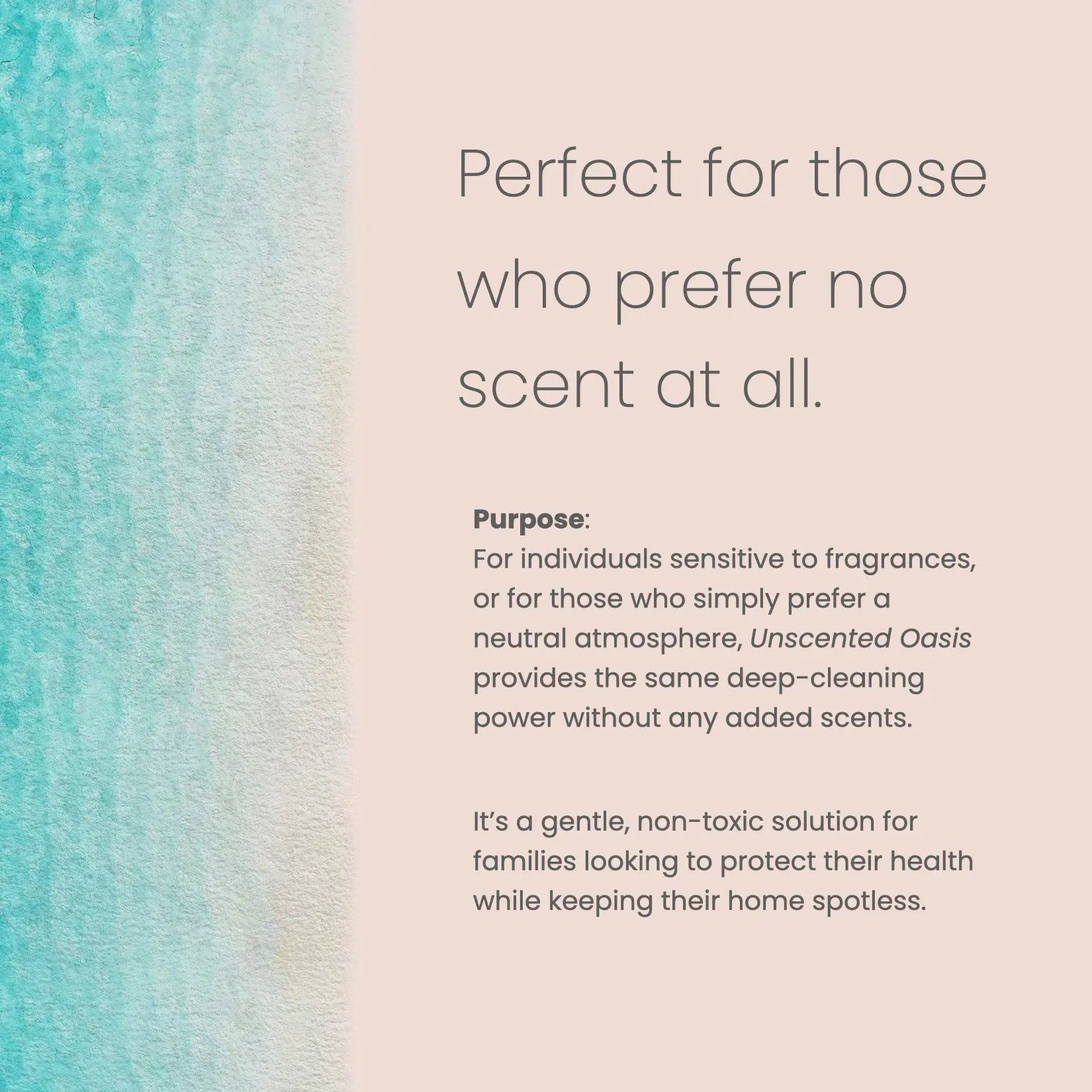
No — and this trips up almost everyone. “Fragrance-free” means no fragrance materials were added. “Unscented” can mean a masking fragrance was added to cover up the smell of other ingredients — so an “unscented” product can still contain fragrance chemicals. Ecolosophy Unscented Oasis is genuinely fragrance-free: no essential oils, no perfume, no masking agents.
Is ‘natural fragrance’ safe?
“Natural fragrance” is still an undisclosed blend — the word “natural” isn’t regulated here and doesn’t require listing the components. Natural-sourced aromatics can still trigger allergies and asthma. The safer move is a product that names its actual plant oils (e.g. “cold-pressed orange peel oil,” “eucalyptus”) rather than hiding them under “fragrance” of any kind.
Are quats necessary to disinfect?
For everyday cleaning — removing dirt, grease, and grime — no. Most of what families do daily is cleaning, not disinfecting, and a good plant-based surfactant removes dirt, grime & residue without quats. True disinfection (registered germ-kill) has its place — during illness, for raw-meat surfaces — but it doesn’t need to be your default for wiping a high chair.
Are these chemicals worse for kids and pregnancy?
The evidence points that way for the endocrine-disrupting ones especially. Developing bodies — fetuses, infants — are more sensitive to hormone-mimicking chemicals like certain phthalates, and kids have more floor-and-mouth contact with residues. That’s precisely why fragrance-free, fully disclosed formulas are the conservative choice for these households.
How does Ecolosophy compare to Branch Basics?
Both are plant-based concentrate brands, and neither is an EPA-registered disinfectant. See our full Ecolosophy vs. Branch Basics comparison for the head-to-head on formula, scent options, and cost per bottle.
📕 Free download · 28 pages
Not ready to switch yet? Get the free playbook.
28 pages, every non-toxic swap, room by room. One email, no spam.
We'll email it from [email protected]. Reply anytime — a real person answers.
Sent. Check your inbox.
The download link is heading to your email. If you don't see it in 2 minutes, look in Promotions or hit resend.
Or grab it right now: Download the 28-page PDF →
Couldn't deliver — try again? Retry
← Back to the full Non-Toxic Cleaning Guide
Keep Reading
Unscented Oasis Kit
$69 · 4.97★ · 72 reviews