comparison
Mrs. Meyer's vs Ecolosophy: What 30+ Years of Fragrance Doesn't Tell You
Mrs. Meyer's smells like a garden. But what's actually in that scent—and why does it matter for your lungs, skin, and sink drain?

Smelling clean and being clean are two entirely different things—and that gap is where your health lives.
— Elizabeth Uria, PhD — Co-founder, Ecolosophy
The Lavender Illusion
Picture the cleaning aisle at Whole Foods. Mrs. Meyer’s Clean Day is everywhere — muted sage-green bottles, hand-drawn flowers, a story about Iowa and herb gardens and a mother named Thelma. It smells genuinely wonderful. Lavender, basil, lemon verbena. The branding is warm, the price is reasonable, and the word “plant-derived” is on every bottle. For a decade, millions of households bought in — including mine, before Crohn’s disease forced me to read every label like a tax document.
Here is what the label does not say: the word “fragrance” on that bottle is a legal black box. Under current U.S. law, a manufacturer can list “fragrance” as a single ingredient and never disclose what’s inside it — not to you, not to the FDA, not to anyone. That one word can legally represent dozens of individual chemical compounds. And some of those compounds have a research record that smells nothing like lavender.
This is not an attack on a brand. This is a guide to reading what the bottle won’t tell you.
What “Fragrance” Actually Hides
The FDA does not require manufacturers to disclose fragrance components in household cleaning products. The agency acknowledges this explicitly on its website — fragrance formulas are protected as trade secrets, and no pre-market safety review is required for these mixtures. That regulatory gap is not a conspiracy; it is a 50-year-old policy built for an era when we knew far less about cumulative chemical exposure.
The result is a consumer blind spot. A 2018 study by Anne Steinemann, published in Air Quality, Atmosphere & Health and indexed on PubMed, found that 34.7% of the U.S. population reports adverse health effects from exposure to scented products — including air fresheners, cleaners, and laundry products. Among those, 15.1% report breathing difficulties, and a significant subset reports migraine-level headaches. These are not rare sensitivities. They represent roughly one in three Americans.
The Synthetic Musk Problem
One class of fragrance chemicals deserves specific attention: synthetic musks, including nitro musks and polycyclic musks, which are used as scent fixatives in countless cleaning products. The EPA’s own Safer Choice program flags these compounds because peer-reviewed studies have detected them in human breast milk, adipose tissue, and aquatic organisms. They are lipophilic — they dissolve in fat and accumulate rather than passing through. Mrs. Meyer’s has not published a full fragrance ingredient breakdown, so it is impossible to confirm or deny their presence. That opacity is itself the problem.
California Prop 65 — the state’s list of chemicals known to cause cancer or reproductive toxicity — includes several fragrance-adjacent compounds like coumarin and styrene. The OEHHA list is publicly searchable, and cross-referencing it with undisclosed fragrance mixtures is, by design, impossible. You cannot look up what you cannot see.
The EWG Score Nobody Talks About in the Marketing
Mrs. Meyer’s has built a reputation as a “safer” alternative to conventional cleaning brands. That reputation is partially earned — they removed some of the most egregious surfactants years ago. But the EWG’s Cleaning Product Guide tells a more complicated story.
EWG currently rates the Mrs. Meyer’s Clean Day Multi-Surface Concentrate a D, citing concerns about fragrance, preservative systems (specifically methylisothiazolinone, a known skin sensitizer), and limited ingredient disclosure. A D on the EWG scale means moderate-to-high hazard concern — this is not a passing grade for a product positioned as a health-conscious choice.
For context:
| Product | EWG Rating | Fragrance Disclosed? | Surfactant Biodegradability Data Published? |
|---|---|---|---|
| Mrs. Meyer’s Multi-Surface Concentrate | D | No (listed as “fragrance”) | Not publicly available |
| Method All-Purpose Cleaner | C | Partially (via SmartLabel) | Not publicly available |
| Blueland Multi-Surface Spray | B | Partially | Not publicly available |
| Grove Co. Glass Cleaner | C | No | Not publicly available |
| Ecolosophy All-Purpose Concentrate | A (target) | Yes — full disclosure | Yes — OECD 301F |
EWG ratings sourced from EWG.org Cleaning Product Guide. Ecolosophy OECD 301F data on file.
The table above is not meant to shame competitors. Most of the natural cleaning industry has a fragrance disclosure problem. What it shows is that “plant-derived” branding and actual ingredient transparency are not the same thing — and only one of them protects you.
What a Genuinely Transparent Formula Looks Like
When Elizabeth Uria and I started formulating Ecolosophy, the Crohn’s diagnosis that had upended my life for three years was still fresh. I had already spent months reading ingredient lists the way gastroenterologists read biopsy reports — looking for anything that could be making the inflammation worse. Synthetic fragrance was one of the first things I removed from our home. The difference, for me, was noticeable within weeks. I am not claiming causation. But I am claiming that when you live with a condition that makes your gut a canary in a coal mine, you stop tolerating opacity very quickly.
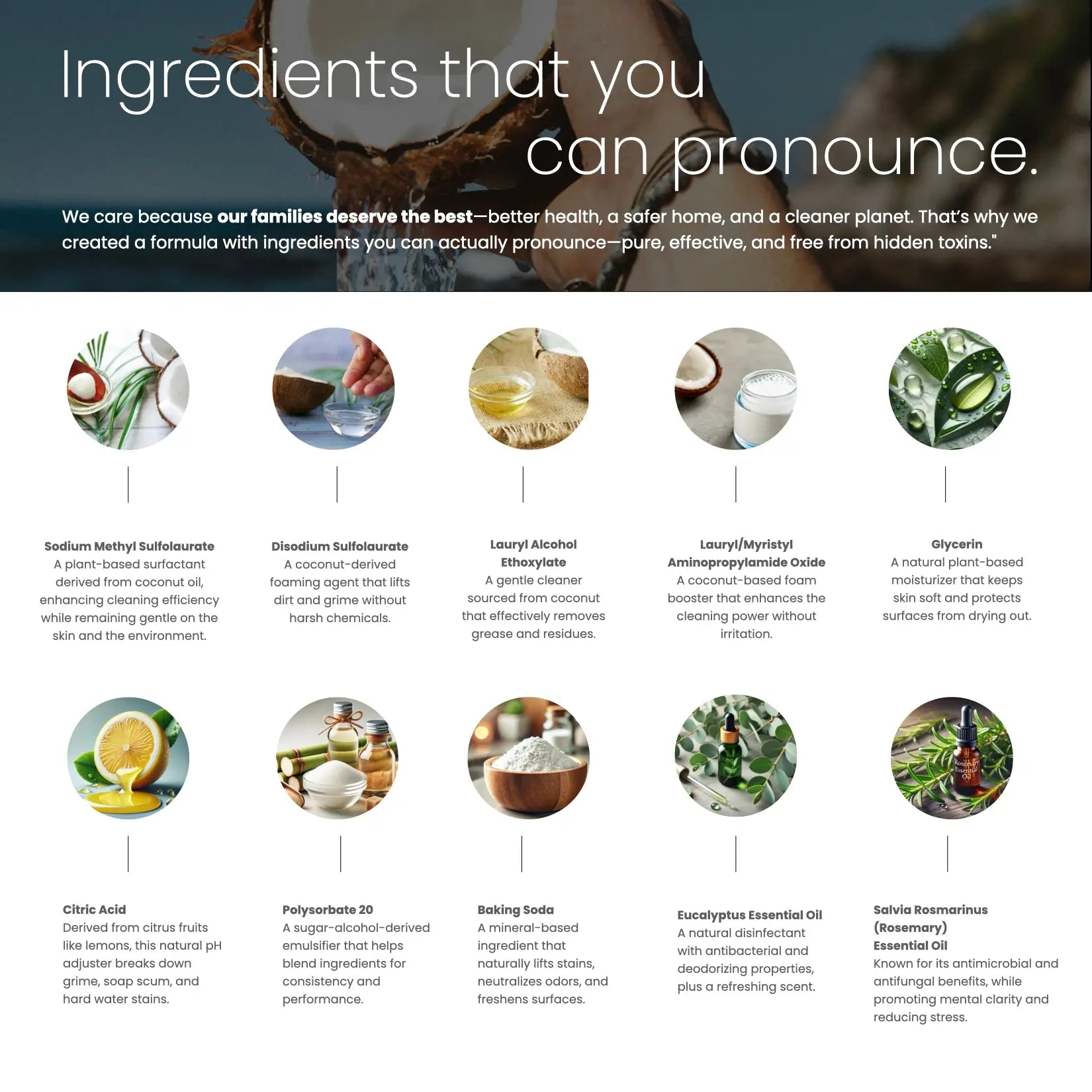
Elizabeth, whose PhD is in environmental chemistry, drew a hard line in our formulation process: every ingredient must be disclosed, every surfactant must pass OECD 301F for ready biodegradability, and no fragrance mixture goes in unless we can publish every component. That last rule is harder than it sounds. Most fragrance suppliers sell blended compounds and guard their formulas. Building a fully disclosed scent profile means sourcing differently — single-origin botanicals, cold-pressed citrus, no fixatives with bioaccumulation potential.
What OECD 301F Actually Tests
The OECD 301F test is the international gold standard for determining whether a surfactant is “readily biodegradable.” The threshold: 60% degradation within 28 days in a closed-bottle aerobic aquatic environment. If your cleaning product’s surfactant doesn’t pass 301F, it is building up somewhere — in wastewater treatment effluent, in river sediment, in the tissues of the organisms that live there.
Most cleaning brands — including Mrs. Meyer’s — do not publish OECD 301F data for their full surfactant blend. That data exists, or it should, because any responsible formulator would run it. The fact that it is not published is a transparency choice, not a logistics obstacle.
If you want to go deeper on what separates genuinely biodegradable surfactants from marketing language, our piece on the surfactant distinction in plant-based cleaners breaks it down without the chemistry degree requirement.
The Air Quality Angle You Haven’t Considered
There is one more dimension to fragrance in cleaners that rarely makes the label conversation: what happens when you spray it.
Scented cleaning products release volatile organic compounds (VOCs) into the air during and after use. The EPA Safer Choice program specifically evaluates VOC content for this reason — airborne exposure can exceed dermal exposure by a wide margin, particularly in poorly ventilated bathrooms and kitchens. Some synthetic fragrance components react with ozone in indoor air to form secondary pollutants, including formaldehyde and ultrafine particles.
This is not theoretical. It is why Elizabeth reviews every formula against EPA Safer Choice’s VOC limits and fragrance restrictions before anything goes into a bottle. It is also why our piece on cleaning products and indoor air quality is one of the most-read things we’ve published — because nobody expects their kitchen spray to be degrading the air in the room.
And if you want the full picture of what undisclosed ingredients can look like across product categories, our breakdown of hidden toxins in cleaning products is the right place to start.
Your Practical Next Step
You do not need to throw out every bottle of Mrs. Meyer’s tonight. But you do need better information than the label is giving you.
Here is a three-step audit you can do this weekend:
-
Search your current cleaners on EWG’s Cleaning Product Guide (ewg.org/guides/cleaners). Any rating below a C deserves a second look. Filter by “fragrance” as a concern.
-
Look for fragrance disclosure. Does the label say “fragrance” or does it list actual components? If it says “fragrance,” the company has chosen opacity. That is a choice, not a legal requirement — EPA Safer Choice certified products are required to disclose fragrance ingredients.
-
Ask about biodegradability data. Email the brand. Ask if their surfactant blend has been tested to OECD 301F. A responsible formulator will have the data and share it. If they don’t respond or deflect, that tells you something.
If you want a starting point with full disclosure already done for you, our Unscented Oasis Kit was built specifically for people who are done guessing — no fragrance, every ingredient named, OECD 301F data published. The garden on the Mrs. Meyer’s bottle is beautiful. Your lungs deserve to know what’s actually growing in it.
Sources cited
- EWG Skin Deep — Mrs. Meyer's Clean Day Multi-Surface Concentrate — EWG rates Mrs. Meyer's Multi-Surface Concentrate with a D score due to fragrance and preservative concerns
- FDA — Fragrances in Cosmetics and Consumer Products — FDA does not require manufacturers to disclose fragrance components on product labels
- NIH PubMed — Perceived fragrance intolerance and respiratory effects (Steinemann, 2018) — 34.7% of the U.S. population reports health problems from scented products; 15.1% report breathing difficulties
- EPA — Safer Choice Fragrance Policy — EPA Safer Choice requires fragrance ingredient disclosure and restricts carcinogens, mutagens, and reproductive toxins in certified products
- California OEHHA — Proposition 65 List of Chemicals — Several fragrance components including coumarin and styrene appear on California's Prop 65 list of chemicals known to cause cancer or reproductive harm
Frequently asked
Is Mrs. Meyer's actually natural?
Not fully. Mrs. Meyer's describes itself as 'plant-derived' but uses synthetic fragrances and preservatives. 'Natural' is not a regulated term in U.S. cleaning products, so it carries no legal guarantee of ingredient safety or disclosure.
What does 'fragrance' on a label actually mean?
Under U.S. law, 'fragrance' is a blanket term protecting trade secrets. A single 'fragrance' listing can legally represent dozens or even hundreds of individual chemical compounds, none of which must be disclosed to consumers.
Does Mrs. Meyer's lavender scent cause respiratory problems?
Research by Anne Steinemann (2018, PubMed) found 34.7% of Americans report adverse health effects from scented products. Lavender fragrance itself is not the problem—undisclosed synthetic carriers and fixatives often are.
Is Ecolosophy fragrance-free?
Ecolosophy's core formulas are either unscented or use only disclosed, single-origin botanical scents with no synthetic fixatives. Every ingredient is published on the label and the product page.
What is OECD 301F and why does it matter?
OECD 301F is the internationally recognized test for 'readily biodegradable.' A surfactant passes if 60%+ degrades within 28 days. It matters because ingredients that fail can accumulate in waterways and wildlife.