family health
The Crohn's-to-Cleaning-Cabinet Connection — Italo's Story Behind Ecolosophy
Italo Campilii survived Crohn's disease and traced part of his recovery to eliminating household toxins. Here's the science that backs his instinct.

My gastroenterologist never once asked me what I cleaned my bathroom with — but the moment I changed it, something shifted.
— Italo Campilii, co-founder of Ecolosophy
The Crohn’s-to-Cleaning-Cabinet Connection — Italo’s Story Behind Ecolosophy
It was 2017, and I was kneeling on a bathroom floor I had just scrubbed with a name-brand disinfectant spray — the kind with the blue liquid that promises to kill 99.9% of bacteria. Within an hour, I was back in the bathroom for a different reason entirely. That was not a coincidence I understood yet. I was in the middle of a Crohn’s disease flare that had been dragging on for eleven weeks, I had been compliant with every medication my gastroenterologist prescribed, and not once — not in a single appointment — had anyone asked me what I was using to clean my home. This article is the story of how that question became a company, and why the science now suggests it was exactly the right question to ask.
What Crohn’s Disease Actually Does to Your Body’s Chemistry
Crohn’s disease is a form of inflammatory bowel disease (IBD) that causes chronic inflammation anywhere along the gastrointestinal tract. It is not simply a “sensitive stomach.” It is an immune system in a state of sustained, misdirected war — and the battlefield is the gut lining. Research published in Gastroenterology and reviewed by Glassner et al. (2020) confirms that a disrupted gut microbiome — specifically a loss of microbial diversity and an overgrowth of pro-inflammatory species — is both a hallmark and a likely driver of IBD flares. (NIH PubMed)
What that means practically: anything that repeatedly insults the gut microbiome is not a neutral event for someone with Crohn’s. The gut is not a sealed system. Chemicals ingested, inhaled, or absorbed through skin can reach the GI tract and interact with the microbial communities living there. This is not a fringe hypothesis. It is basic toxicokinetics.
The Microbiome Is Not Just Inside You
Here is the part most people miss: the gut microbiome doesn’t live only in your colon. It communicates with the entire body through what researchers call the gut-immune axis and the gut-brain axis. When you inhale aerosolized disinfectants while cleaning — which you do, every single time you spray and wipe a surface — some fraction of those compounds enters your bloodstream through lung tissue. From there, they reach the gut. The EPA confirms that indoor air VOC concentrations from household cleaning products can be 2 to 5 times higher than outdoor air, and can spike to 1,000 times outdoor levels immediately after use. (EPA)
For someone with a healthy gut and no underlying inflammatory condition, those spikes may be inconsequential. For someone with Crohn’s — whose gut lining is already compromised, whose microbiome is already dysbiotic — they may not be.
The Specific Chemicals That Concerned Me Most
Elizabeth Uria PhD, who co-founded Ecolosophy with me and has a background in biochemistry and formulation science, helped me build a shortlist of the cleaning product ingredients with the strongest mechanistic links to gut disruption. Three categories kept surfacing.
Quaternary Ammonium Compounds (Quats)
Quats — benzalkonium chloride, didecyldimethylammonium chloride (DDAC), and related compounds — are the active antimicrobial agents in most conventional disinfectant sprays, wipes, and floor cleaners. They are effective at killing pathogens. They are also, by design, membrane-disrupting agents. The problem is that they do not distinguish between a pathogen’s membrane and a beneficial gut bacterium’s membrane. A 2019 study by Hrubec et al. found that chronic low-dose quat exposure in mice significantly altered gut microbiome composition and triggered immune dysregulation. (NIH PubMed) Human data is still catching up, but the mechanistic logic is sound. EWG rates benzalkonium chloride as a high-concern ingredient for respiratory and immune effects. (EWG)
Synthetic Fragrance and Phthalates
“Fragrance” on a cleaning product label is legally a trade secret in the United States. Under current FDA and EPA regulations, manufacturers are not required to disclose the individual chemicals that make up a fragrance blend. Those blends often contain phthalates — plasticizing compounds used to make scents linger — which have been linked to inflammatory pathway activation. Rusyn et al. (2019) reviewed phthalate exposure data and found associations with elevated markers of gut inflammation, including increased intestinal permeability — what many researchers call “leaky gut.” (NIH PubMed) For a Crohn’s patient, increased intestinal permeability is not a metaphor. It is a measurable, dangerous condition.
A Quick Comparison: Conventional vs. Reformulated Cleaners
| Ingredient Concern | Typical Conventional Cleaner | EWG Verified / EPA Safer Choice Cleaner |
|---|---|---|
| Quaternary ammonium compounds | Common (benzalkonium chloride, DDAC) | Absent or replaced with H₂O₂ |
| Synthetic fragrance / phthalates | Frequently undisclosed | Must disclose or be fragrance-free |
| Formaldehyde-releasing preservatives | Present in many formulas | Prohibited under EWG Verified standard |
| Plant-derived surfactants | Rare or mixed with petrochemicals | Primary cleaning agent |
| VOC contribution to indoor air | High (spray formats especially) | Low to negligible |
| Transparency of full ingredient list | Rare | Required for certification |
The gap is real. It is not marketing. You can verify every claim in that table against EWG’s Cleaning Supplies database or the EPA Safer Choice ingredient list.
What Changed When I Changed My Cleaning Cabinet
I want to be precise here, because I am not going to tell you that switching cleaning products cured my Crohn’s. They did not. I still have Crohn’s. I still work with a gastroenterologist. Medication is part of my life. But when I systematically eliminated conventional disinfectants, synthetic-fragrance products, and aerosol sprays from my home over a period of about six weeks in early 2019, the frequency of my flares dropped noticeably — and the correlation was consistent enough that I could no longer explain it away. Elizabeth’s analysis of what I had removed, chemical by chemical, is what convinced her to join me in building a different kind of cleaning brand.
You can read more about the specific chemicals I found in my old cabinet in our deep-dive on hidden toxins in cleaning products. What I found was not alarming in a dramatic, headline-grabbing way. It was alarming in the quiet, cumulative way that chronic exposure always is.
The Incidence Question Nobody Wants to Answer
Crohn’s disease incidence has roughly doubled in high-income countries over the past 30 years. The timeline maps uncomfortably onto the rise of antibacterial household products, which became mainstream consumer items in the 1990s. This is correlation, not causation — I know that, Elizabeth knows that — but it is the kind of correlation that warrants serious research attention. The hygiene hypothesis, and its more recent refinement the “old friends” hypothesis, suggests that we have disrupted our relationship with the microbial world in ways that our immune systems were not designed to handle. Broad-spectrum antimicrobial home cleaners are one part of that disruption.
For more on how cleaning products affect the air quality your family breathes daily — not just gut health — our piece on breathing easier in 2026 covers the VOC data in detail.
What Elizabeth Uria PhD Wanted Every Formulation to Prove
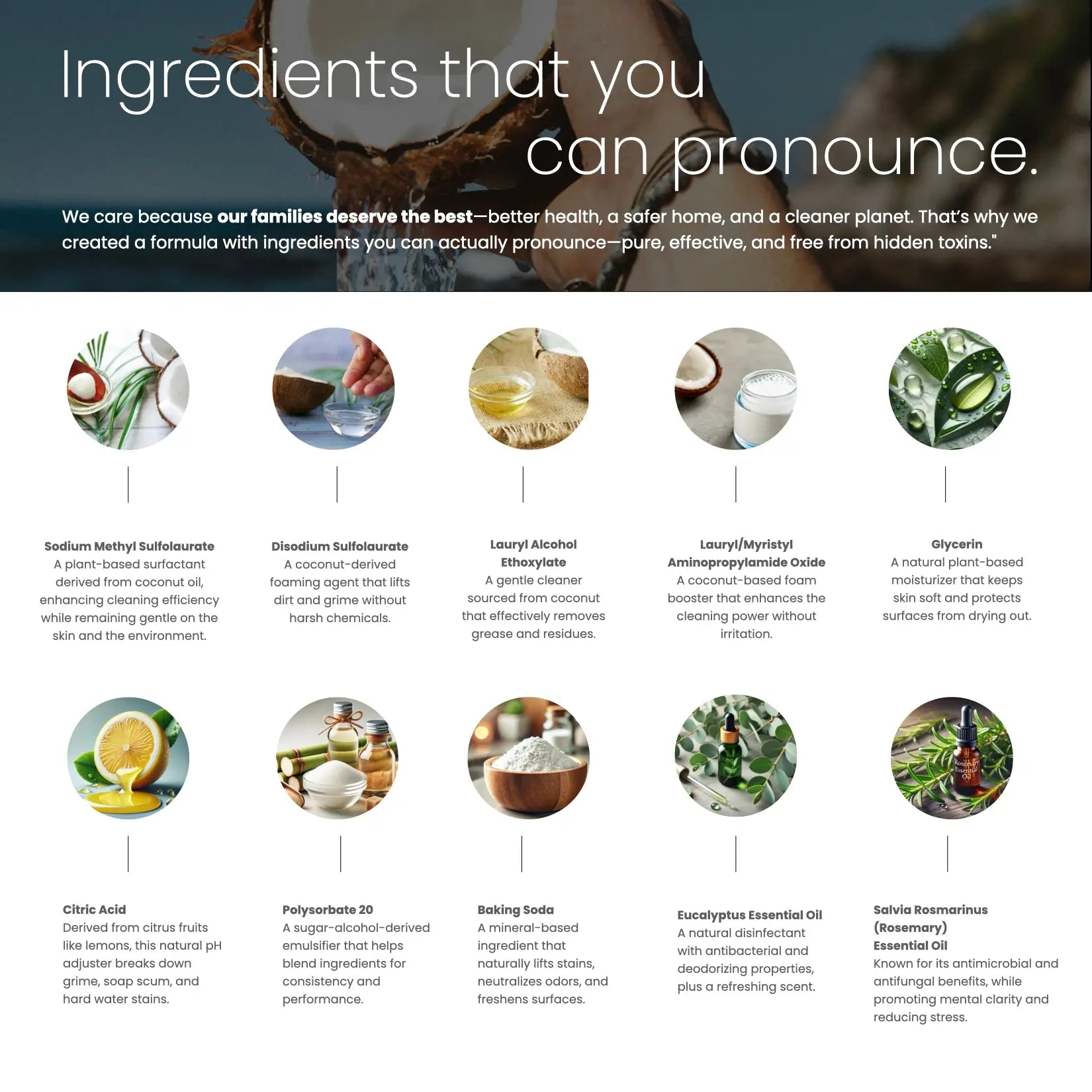
When Elizabeth joined the founding team, she set three non-negotiable formulation principles: no quaternary ammonium compounds, no synthetic fragrance of any kind, and full ingredient transparency — every compound disclosed, no trade-secret hiding. She also required that any surfactant used pass the OECD 301F biodegradability test, meaning it breaks down in the environment rather than accumulating in water systems and eventually re-entering the food chain.
The result is a cleaning line that functions by physical soil removal — surfactants lifting grease, dirt, and organic matter from surfaces — rather than broad-spectrum chemical killing. For everyday household cleaning, physical removal is sufficient and has been the basis of effective cleaning science for decades. You don’t need to sterilize your kitchen counter. You need to remove what’s on it. That distinction — between cleaning and disinfecting, and knowing when each is appropriate — is something we cover in depth in our article on the surfactant distinction in plant-based cleaners.
Your Practical Next Step (No Purchase Required)
Flip over the cleaning products under your sink right now — every bottle. Look for these three words: “fragrance,” “benzalkonium chloride,” and “DDAC.” If you find any of them, you are not looking at a neutral product. You are looking at a repeated, low-dose input that the gut-health research community is increasingly taking seriously as a variable worth controlling.
If you have Crohn’s, ulcerative colitis, IBS, or any other gut-inflammatory condition, show that ingredient list to your gastroenterologist at your next appointment. Ask them directly: “Could repeated inhalation of these compounds affect my microbiome?” Watch what happens. Most GI specialists have not yet integrated household chemical exposure into their patient assessments — but the question is legitimate, it is evidence-informed, and it is yours to ask.
That is the whole point of why this company exists. Not to sell you a cleaner. To hand you a better question.
Sources cited
- EPA — Indoor Air Quality and Household Chemicals — EPA on VOCs and indoor air quality
- NIH PubMed — Quaternary Ammonium Compounds and Microbiome Disruption — Hrubec et al., 2019 — reproductive and microbiome effects of quats in mice
- NIH PubMed — The Gut Microbiome in Inflammatory Bowel Disease — Glassner et al., 2020 — IBD and microbiome dysbiosis review
- EWG — Cleaning Supplies and Your Health — EWG guide to cleaning product health risks
- NIH PubMed — Phthalates and Gut Inflammation — Rusyn et al., 2019 — phthalate exposure and inflammatory pathways
Frequently asked
Can cleaning products really trigger Crohn's flares?
There's no direct clinical trial proving a single product causes a flare. But mechanistic research shows that quaternary ammonium compounds and phthalates — common in conventional cleaners — disrupt gut microbiome balance and activate inflammatory pathways. For someone with Crohn's, reducing those inputs is a low-risk, evidence-informed step.
What specific chemicals in cleaners are most concerning for gut health?
The main suspects are quaternary ammonium compounds (benzalkonium chloride, DDAC), synthetic fragrance phthalates, and formaldehyde-releasing preservatives. All three appear on EWG's high-concern list and have mechanistic links to gut microbiome disruption or systemic inflammation in published research.
Is fragrance-free always safer for people with IBD?
Fragrance-free removes the primary delivery mechanism for phthalates in cleaning products. It's not a guarantee of safety — you still need to check for quats and preservatives — but it eliminates one significant variable. Elizabeth Uria PhD helped us formulate specifically around this.
How long does it take to see any gut-health benefit from switching cleaners?
Nobody can promise a timeline. The microbiome responds dynamically to environmental inputs, but meaningful compositional shifts in gut bacteria have been measured in as little as 3–4 days after dietary change. Removing chemical stressors works on a similar principle, though human cleaning-exposure studies are still limited.
Do plant-based cleaners actually clean as well as conventional ones?
When formulated correctly — with the right surfactant type and concentration — yes. EWG Verified and EPA Safer Choice–certified plant-based surfactants have demonstrated equivalent soil removal. We've written more on this in our article on the surfactant distinction.