research
The Microplastic Crisis Hiding in Your Spray Bottle Trigger
Your spray bottle trigger may be shedding microplastics into the air and onto surfaces. Here's what the research shows and what to do about it.
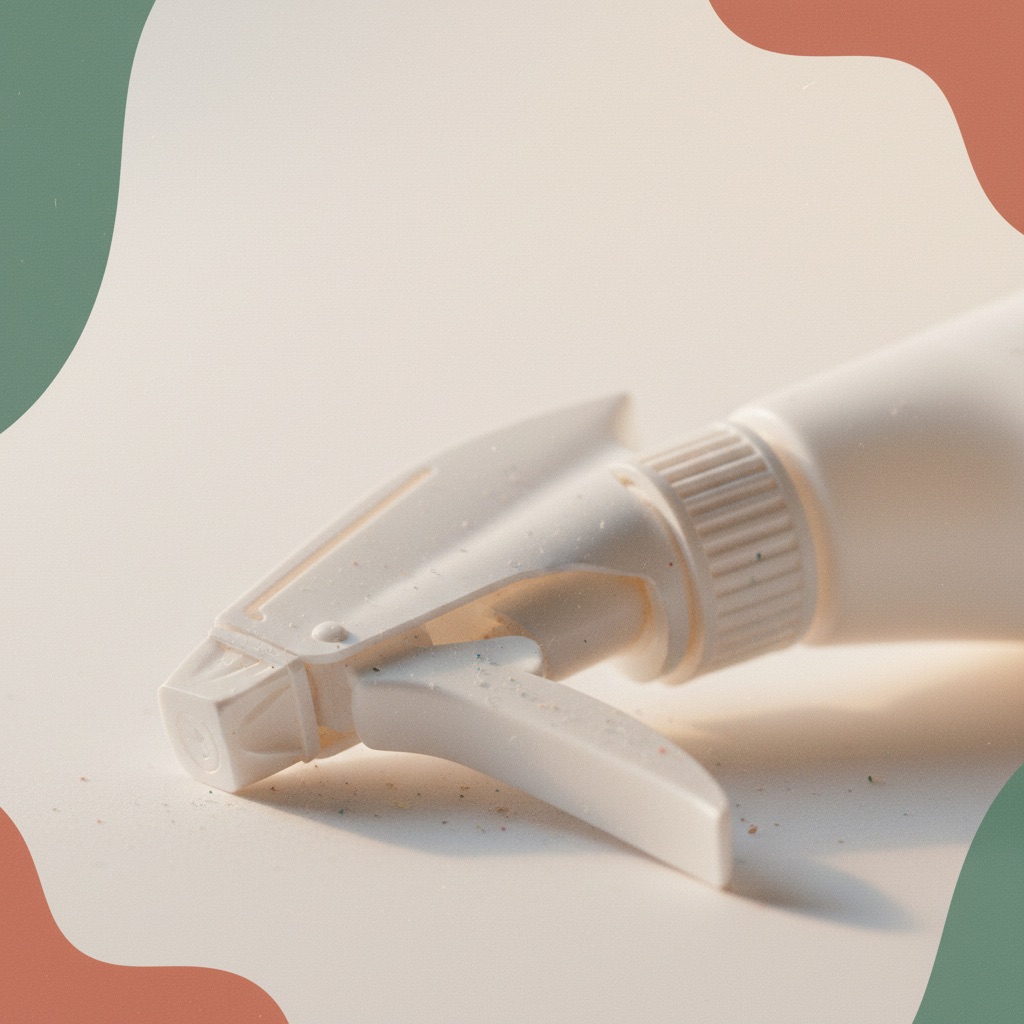
Every squeeze of a plastic trigger is a small mechanical event — and mechanical events on plastic surfaces produce particles.
— Elizabeth Uria PhD, Co-founder, Ecolosophy
What’s Actually Inside Your Spray Trigger
Pick up any spray bottle under your kitchen sink and squeeze the trigger. Simple enough. But inside that mechanism, four to seven separate plastic components are grinding against each other — a polypropylene trigger body, a nylon or stainless steel spring, a polyethylene dip tube, an acetal or polypropylene pump piston, and a plastic ball valve. Every single actuation is a small mechanical event. And mechanical events on plastic surfaces produce particles.
This isn’t speculation. It’s the basic physics of tribology — the science of friction, wear, and lubrication. When two plastic surfaces slide against each other repeatedly, they shed fragments. Some of those fragments are visible. Most are not. The ones you can’t see — below 5 millimeters, and especially below 1 micrometer — are classified as microplastics and nanoplastics, and they are now the subject of serious scientific attention.
When I was managing my Crohn’s disease and trying to reduce my total toxic load, I thought about what I was putting in my body. It took longer to think carefully about what I was breathing and what was landing on the surfaces I touched every day. The spray bottle was invisible to me as a source. It probably is to you, too.
How a Trigger Mechanism Works — and Why That Matters
A standard trigger sprayer works by drawing liquid up a dip tube via a check-ball system, then pressurizing and atomizing it through a nozzle orifice. The trigger is connected to a piston inside a small cylinder. When you squeeze, the piston compresses. When you release, a spring pushes it back. That cycle — compression, extension, repeat — creates continuous friction between the piston and cylinder wall, between the spring and its housing, and between the trigger pivot and its anchor point.
Most consumer spray bottles are designed for a lifespan of a few hundred actuations before the mechanism degrades noticeably. Cleaning bottles in active households often see 20–50 actuations per week. Do the math: a bottle used three times a week for six months has been mechanically cycled roughly 400 times. By that point, the plastic surfaces have measurable wear. Where does that wear go? Into the bottle contents. Into the mist. Into your air.
The Indoor Air Connection You’re Not Hearing About
Most conversations about microplastics focus on oceans, bottled water, or food packaging. Indoor air gets far less attention — which is a problem, because research increasingly shows your home may be one of your highest exposure environments.
A 2021 study published in Environmental Science & Technology (Zhang et al.) detected microplastics in indoor air samples, with mechanical abrasion of plastic household goods among the identified source categories. A foundational study by Dris et al. (2017) in Environmental Pollution documented microplastic fibers in both indoor and outdoor air, with indoor concentrations frequently exceeding outdoor ones — likely because indoor spaces concentrate particles without the dilution of open airflow.
The EPA has formally identified microplastics as a “contaminant of emerging concern” and as of 2025 has not established a safe indoor exposure threshold, largely because the science is still characterizing what the dose-response relationship looks like for inhaled plastic particles. That uncertainty is not reassuring. It means regulators are watching, not guiding.
Where Spray Bottles Fit in the Exposure Picture
To be clear: spray bottle triggers are not the only — or even the largest — source of indoor microplastics. Synthetic textiles, degrading foam furniture, plastic food containers, and worn floor coverings all contribute. But spray bottles have a specific characteristic that makes them worth isolating: they actively aerosolize their contents. Whatever is in the liquid, and whatever plastic particles have shed into the liquid or the mist pathway, gets launched into the breathing zone of the person using the bottle.
A standard trigger sprayer produces droplets ranging from roughly 100 to 400 microns in diameter for the bulk spray, but also generates a fine aerosol fraction — particles below 10 microns — that can remain airborne for minutes in still indoor air. If microplastic fragments are present in the mist stream, they travel with it.
Polypropylene in the Body: What the Blood Studies Show
In 2022, a study published in Environment International (Leslie et al.) detected microplastics in the blood of 17 out of 22 healthy adult volunteers. Polypropylene — the same polymer used in most spray trigger bodies — was among the plastic types identified. This was significant not because polypropylene is uniquely toxic, but because it confirmed that plastic particles from everyday exposure routes are crossing into systemic circulation.
The NIEHS has noted that the health implications of microplastic body burden remain under active investigation, with particular concern around particle-associated contaminants: the chemicals that adsorb onto plastic surfaces, including plasticizers, residual monomers, and environmental pollutants. A polypropylene particle is not just a polypropylene particle. It’s a carrier.
This is the framing that changed how I thought about cleaning products — not just what’s in the formula, but what the container itself is contributing to the exposure equation.
Comparing Your Options: Bottles, Materials, and Realistic Trade-offs
Not all spray bottles are created equal. Here’s a practical breakdown of the most common options and what the material science and available research actually support:
| Bottle Type | Trigger Material | Microplastic Abrasion Risk | Reusability | Notes |
|---|---|---|---|---|
| Standard plastic (PET/HDPE) | Polypropylene | High — large plastic surface area, frequent cycling | Low — typically 1 season | Most common under-sink bottle |
| ”Recycled plastic” bottle | Polypropylene | High — recycled resin same wear profile | Low–Medium | Marketing improvement, not functional improvement |
| Glass bottle | Polypropylene trigger | Medium — glass reservoir is inert, trigger still plastic | High | Good upgrade; trigger remains a wear point |
| Aluminum bottle | Polypropylene trigger (usually) | Medium — same caveat as glass | High | Best option if trigger mechanism is minimized or metal |
| Aluminum + metal trigger | Stainless steel spring, minimal plastic | Low — dramatically reduced plastic contact surfaces | Very High | Highest upfront cost, lowest lifetime particle generation |
| Concentrate refill system | Varies by brand | Medium–Low if bottle is reused long-term | Very High | Key variable: how often you replace the trigger |
The table makes the point plainly: the bottle material matters less than the trigger mechanism and — critically — how often you replace the whole unit. A recycled plastic bottle you replace every four months generates more cumulative trigger wear than an aluminum bottle you use for four years.
This is why concentrate-based cleaning systems have a structural advantage that goes beyond the formula inside them. When you’re not buying a new plastic trigger every few months, you are meaningfully reducing your household’s plastic wear surface over time. Our approach at Ecolosophy was built around exactly this logic — one durable bottle, filled repeatedly, rather than a new plastic mechanism with every purchase. If you’re curious what that looks like in practice, the /products/unscented-oasis-kit is a good starting point for sensitive households.
For a broader look at what else your cleaning routine may be putting into your indoor air, the Detox Journal article Breathing Easier in 2026: Your Cleaning Products Are Poisoning Your Air covers VOCs, synthetic fragrance, and aerosol exposure in detail. And if you want to understand what other undisclosed chemicals may be traveling alongside your microplastics, PFAS in Cleaning Products: The FDA Report Everyone Missed is worth reading before you buy anything new. You can also cross-reference Hidden Toxins in Cleaning Products for a fuller picture of what the label isn’t telling you.
What to Actually Do This Week
You don’t need to throw everything out today. Here’s a sequenced, practical approach:
Step 1: Audit your trigger count. Go under every sink and count how many active spray bottles you have. Note which ones are less than a year old versus older. Older triggers with visible wear on the nozzle or trigger pivot are highest priority to replace.
Step 2: Consolidate. Most households use 6–10 different spray cleaners that could be replaced by 1–2 multi-surface concentrates. Fewer bottles means fewer triggers cycling in your home.
Step 3: Invest in one durable bottle. Glass or aluminum, designed for repeated refilling. Use it until it breaks. A trigger mechanism you use for three years generates a fraction of the cumulative wear of six cheap plastic bottles cycled through in the same period.
Step 4: Improve your spray ventilation habits. Open a window when you clean. Run an exhaust fan. Give aerosols — including cleaning mist — somewhere to go other than your breathing zone. This won’t eliminate microplastic exposure, but it reduces your inhaled dose from any spray source, plastic or not.
The microplastic problem in cleaning is real, it’s documented, and it’s largely invisible because the industry has no incentive to put it on the label. But the solution isn’t complicated. It’s one good bottle, filled with something that actually works, used for as long as possible. That’s it. Start there.
Sources cited
- EPA — Microplastics in Drinking Water and the Environment — EPA Microplastics Research Overview
- Ragusa et al. (2022) — Raman microspectroscopy detection of microplastics in human blood — Environment International — Leslie et al. 2022, Environment International — polypropylene in human blood
- Dris et al. (2017) — A first overview of textile fibers, including microplastics, in indoor and outdoor environments — Environmental Pollution — Dris et al. 2017 — microplastics in indoor air
- Zhang et al. (2021) — Microplastics in indoor air — Environmental Science & Technology — Zhang et al. 2021 — microplastics in 87% of indoor air samples
- NIH National Institute of Environmental Health Sciences — Microplastics and Human Health — NIEHS — Microplastics and Human Health overview
Frequently asked
Do spray bottle triggers actually shed microplastics?
Yes. Spray triggers are assembled from multiple polypropylene and nylon parts that rub against each other with every pump. Mechanical friction on plastic surfaces is a well-documented source of microplastic particles. The smaller the particle, the longer it stays airborne and the deeper it can travel into lung tissue.
Are aluminum spray bottles actually safer?
Aluminum bottles eliminate the large plastic reservoir as an abrasion surface. However, most still use a plastic trigger mechanism. The meaningful upgrade is a reusable bottle paired with a concentrated refill system — reducing both the total plastic surface area and how often you're buying new plastic triggers.
How many microplastics are we inhaling from household sources?
Estimates vary widely, but a 2019 study in Environmental Science & Technology estimated humans ingest and inhale between 74,000 and 121,000 microplastic particles per year, with indoor air being a significant contributor. Cleaning routines — spraying, wiping, and agitating surfaces — can temporarily spike local airborne counts.
Is polypropylene dangerous?
Polypropylene itself is considered relatively inert. The concern is particle size and what adsorbs onto the surface of microplastic fragments — including plasticizers, flame retardants, and surfactant residues — which can carry toxicological risk even when the base polymer does not.
What's the simplest swap I can make right now?
Stop buying single-use plastic spray bottles. Switch to a concentrate-based system with a durable glass or aluminum bottle you refill. One good bottle used for 3–5 years generates a fraction of the plastic wear of replacing cheap triggers every few months.