research
Do Cleaning Products Pollute Indoor Air? VOCs, Fragrance-Free, Chamber Study
A 2023 chamber study measured VOCs from 30 cleaners — fragrance-free emitted least. Cut emissions at the source.
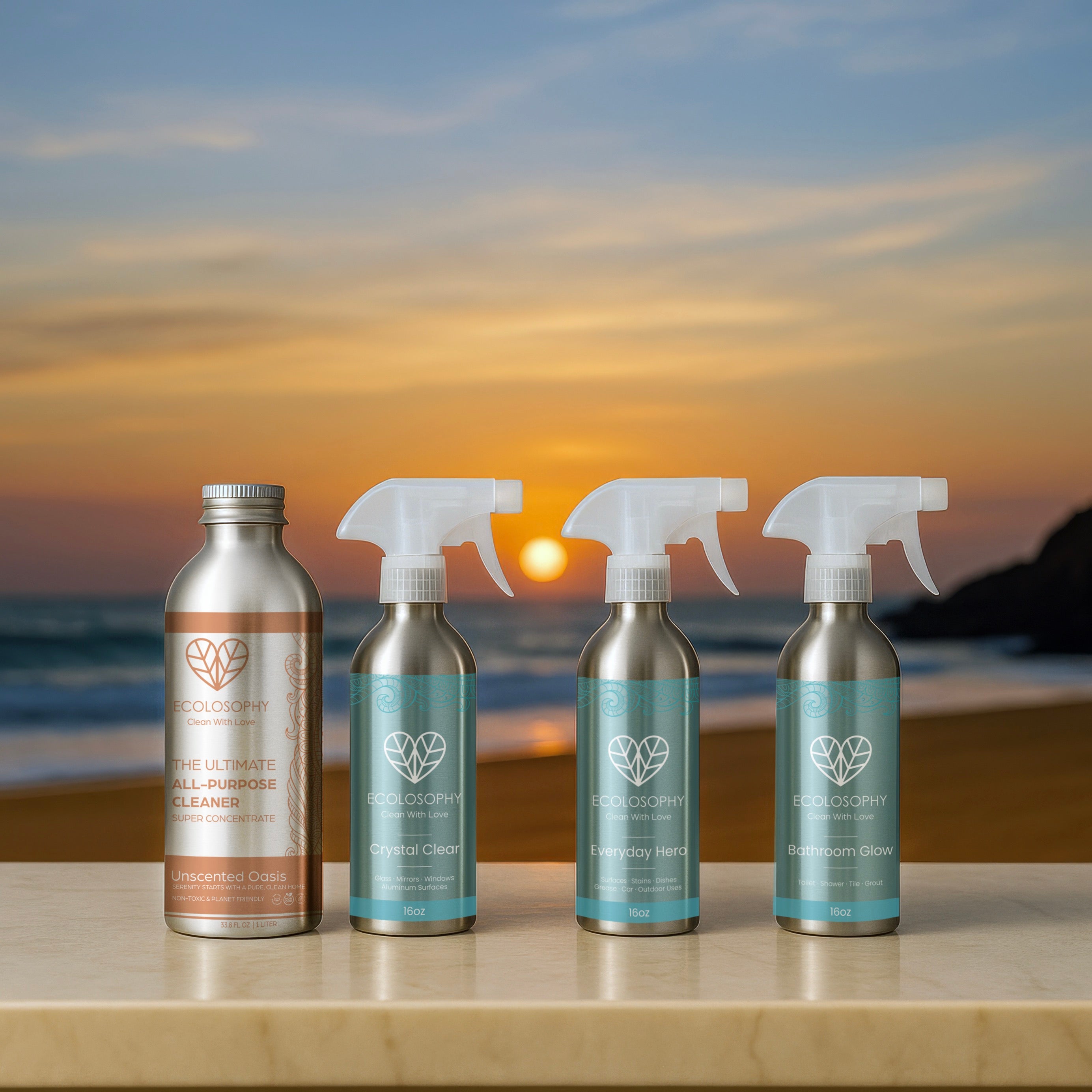
Short answer: Yes — sprays put VOCs into the air you stand in. A 2023 Chemosphere chamber study of 30 products found conventional cleaners generally emitted more VOCs than green ones, and fragrance-free emitted least. Ventilation helps; cutting emissions at the source helps too. Prefer a fragrance-free plant-based Ecolosophy concentrate — small-batch, made with care.
TL;DR — A 2023 peer-reviewed chamber study measured VOC emissions from 30 cleaning products. Conventional products generally emitted more VOCs than “green” ones, and fragrance-free products emitted the least. That is the real, measurable case for switching. This article previously carried several statistics we could not verify; they have been removed and the corrections are marked in place.
Key Takeaways
- The EPA reports levels of several common organic chemicals average 2 to 5 times higher indoors than outdoors.
- A 2023 Chemosphere chamber study quantified 530 unique VOCs across 30 products; 193 appear on official hazard lists.
- Fragrance-free products emitted the fewest VOCs of any category tested.
- Never mix bleach with ammonia or acids — the CDC is explicit about this.
- Ventilation and lower-emission products work together; neither alone is “the only real fix.”
Breathing Easier in 2026: How Your Cleaning Products Are Poisoning Your Home’s Air (And What to Do About It)
By Italo Campilii | Published January 20, 2026 | 18-minute read
Editor’s note (August 2026): this article originally carried a number of statistics — on asthma rates, IQ, immune function and lung function — that we could not trace to any source when we audited it. They have been removed rather than re-sourced, because they should never have been published. What remains is what we can show you.
Here is the honest version. When you spray a conventional cleaner, you release volatile organic compounds into the air you are standing in. How many, and how hazardous, varies enormously by product — and for once we have good measurements.
In 2023, researchers published a chamber study in Chemosphere measuring VOC emissions from 30 cleaning products across seven categories: 14 conventional, 9 marketed as “green” with fragrance, and 7 “green” and fragrance-free. They quantified 530 unique VOCs across the whole set, of which 193 were considered hazardous under California’s Candidate Chemicals List or the European Chemicals Agency’s classification inventory.
The pattern they found is the useful part: conventional products generally emitted greater total concentrations and more individual VOCs than “green” ones, and fragrance-free products emitted least of all. The five products with the highest hazard scores were conventional, emitting 2-butoxyethanol, isopropanol, toluene and chloroform.
That is a real result from a real study you can read. It is also more modest than “you are being poisoned,” and we would rather give you the real one.
The Silent Crisis: Indoor Air Quality in 2026
Your Home Is More Polluted Than You Think
Indoor air quality is a genuine public health topic, and the EPA has published on it for decades. Here is what we can actually cite, replacing a list of statistics we previously published without traceable sources:
- The EPA’s Total Exposure Assessment Methodology studies found levels of about a dozen common organic pollutants 2 to 5 times higher inside homes than outside, in rural and industrial areas alike (EPA).
- The EPA lists products for household cleaning and maintenance among indoor pollutant sources, and notes people using such products can expose themselves to very high levels while using them.
- The 2023 Chemosphere chamber study quantified 530 unique VOCs across 30 products, 193 of them on official hazard lists (study).
- Zock et al. (2007), following 3,503 adults across 10 countries, found weekly cleaning-spray use associated with a relative risk of 1.49 for new asthma symptoms or medication — and no association for cleaning products not applied as sprays (PubMed).
We have removed the previously listed figures attributed to a “2025 EPA report,” “Yale research,” a “Mintel 2025 survey” and a “2025 Journal of Environmental Health” study. We could not locate any of them. For a deeper look at how cleaners drive indoor air pollution — and which ones are worst — we go further in that piece.
Where Does the Pollution Come From?
When you spray a bottle of conventional cleaner, you’re not just cleaning. You’re aerosolizing chemicals.
Here’s what happens:
- You spray the cleaner (or plug in an air freshener, or light a scented candle)
- Volatile organic compounds evaporate instantly into the air
- You inhale them directly into your lungs before you even finish spraying
- They settle into dust and soft surfaces (carpets, furniture, curtains)
- Your family keeps breathing them for hours afterward
The chemicals don’t just disappear. They accumulate in the air, your body, and your family’s bloodstreams.
The Chemicals Destroying Your Home’s Air Quality
VOCs: The Invisible Threat
Volatile Organic Compounds (VOCs) are carbon-based chemicals that evaporate at room temperature, becoming gases that you breathe.
Cleaning products release VOCs, and the 2023 Chemosphere study is the best public measurement of how many.
One precision point, because we got it wrong before: the study quantified 530 unique VOCs across all 30 products tested combined — not 530 per product, and not 530 from conventional cleaners specifically. Of those, 193 appear on California’s or ECHA’s hazard lists. The conventional products in the set generally emitted more, in both count and concentration, than the “green” ones.
Common VOCs in household cleaners:
Rather than a list of worst-case chemicals with worst-case effects attached, here are the four compounds the Chemosphere researchers actually identified in the five highest-hazard products they tested:
- 2-butoxyethanol — a glycol ether solvent, common in glass and all-purpose cleaners
- Isopropanol — a familiar fast-evaporating solvent
- Toluene — a solvent EPA regulates as a hazardous air pollutant
- Chloroform — detected in emissions from some conventional products
And one worth understanding on its own: limonene, the citrus scent compound, which is not itself dangerous but reacts with indoor ozone to form secondary pollutants.
These are named because a published study measured them coming out of real products, not because they sound frightening. The health effects associated with each of these compounds are largely characterised at occupational exposure levels, which is a different situation from a household spray — a distinction we should have drawn in the earlier version of this page and did not.
There is also real indoor chemistry at work: terpenes like limonene react with indoor ozone to form secondary pollutants, including formaldehyde and fine particles. A peer-reviewed modelling study put the size of that effect at roughly 1.8 ppb of additional formaldehyde and about 1.1 μg/m³ of extra particles for a ten-minute clean of a 50 m³ room (free full text). That is a measurable effect and a good argument for ventilation. It is not “creating new poisons,” and we previously described it that way, which overstated it.
Synthetic Fragrances: The Legal Loophole
Here’s where it gets dark.
Manufacturers can hide dozens of toxic chemicals under one vague legal term: “fragrance.”
This is a loophole that’s been abused for decades.
When a bottle says “fragrance” on the label, it can contain:
- Phthalates — Hormone disruptors linked to reproductive harm, developmental issues, and cancer
- Benzene derivatives — Linked to leukemia and lymphoma
- Phenols — Corrosive to respiratory tissue
- Synthetic musks — Accumulate in body fat; linked to endocrine disruption
- Dimethyl phthalate (DMP) — A plasticizer that’s been linked to asthma and allergies
🚨 The law doesn’t require companies to disclose what “fragrance” means. They can include 100+ different chemicals in that one word. We break down exactly how this legal gap works in the fragrance loophole.
A study from the University of Washington found that one commercial air freshener contained 100+ different VOCs, including 10 that are classified as toxic or hazardous under federal law. None of them were disclosed on the label.
The Ammonia & Chlorine Problem
This is the one item on this page that is a genuine, immediate hazard rather than a long-term exposure question, and it deserves to be stated plainly rather than dramatically.
Never mix bleach with ammonia or with other cleaners. The CDC’s guidance is unambiguous: “Never mix bleach with ammonia or any other cleaner”, because doing so produces toxic gases. Bleach plus ammonia produces chloramine gases; bleach plus an acidic cleaner can release chlorine gas. This happens in ordinary bathrooms, usually when someone uses a glass cleaner and then a bathroom disinfectant on the same surface without thinking about it.
The CDC’s other practical advice when using bleach is worth repeating: try not to breathe in product fumes, and open windows and doors when using these products indoors.
We previously described chloramine as “a compound used as a chemical weapon” and listed effects including pulmonary edema and burned respiratory tissue. Those descriptions come from high-concentration and occupational exposure literature, not from what a household accident typically produces. The accident is real and can genuinely send someone to the emergency room — we don’t need the wartime framing to make that point, and using it made the rest of the article less trustworthy.
Used separately and as directed, with ventilation, both bleach-based and ammonia-based cleaners are legal, effective products that millions of households use without incident. The rule is about combining them.
The Health Impact: What We Can and Cannot Say
This section used to make a series of claims about asthma rates, immune suppression, IQ, ADHD and autism risk. None of them were sourced. We have deleted them. We are not going to soften them or find a study that gestures in their direction — they were not defensible, and attributing developmental conditions to a floor cleaner is exactly the kind of thing a brand selling a competing product should never do.
Here is what is actually documented, with the source attached to each.
Irritation and short-term symptoms. The EPA states that indoor air pollutants can cause irritation of the eyes, nose and throat, headaches, dizziness and fatigue, and that symptoms of asthma may be aggravated or worsened. It also notes individual sensitivity varies tremendously from person to person — some people react, most don’t.
Fragranced products and self-reported symptoms. In a nationally representative survey of 1,136 US adults, 34.7% reported health problems such as migraine headaches and respiratory difficulties when exposed to fragranced products (Steinemann 2016, free full text). That is self-report in a survey, not clinical measurement — real signal, limited strength.
Cleaning sprays and adult-onset asthma. Zock et al. followed 3,503 adults who were asthma-free at baseline across 10 countries. Weekly use of cleaning sprays was associated with a relative risk of 1.49 for new asthma symptoms or medication use, rising to 2.11 for physician-diagnosed asthma among those spraying four or more days a week (PubMed). Crucially, cleaning products not applied as sprays showed no association at all. This is observational — an association, not proof of cause.
Occupational exposure. The strongest evidence in this whole field concerns professional cleaning staff, who use these products at far higher frequency and concentration than any household does. Those findings should not be read across to your Saturday morning routine.
What is not established. We are not aware of evidence linking household cleaning-product use, as normally practised, to immune suppression, cognitive decline, ADHD, autism, or reduced IQ. If you see a brand claiming otherwise, ask them for the study.

Why Isn’t Ventilation Enough?
You might think: “I’ll just open a window.”
That’s not enough.
Ventilation genuinely helps — the EPA’s own advice for reducing VOC exposure starts with increasing ventilation when using products that emit them. But it isn’t a complete answer:
- You can’t ventilate around the clock. Not through winter, not through a Florida August.
- Small rooms are the problem rooms. Bathrooms and closets, where people clean most intensively, are usually the worst-ventilated.
- Ozone comes in with the outdoor air, which is what terpenes react with to form secondary pollutants — so more airflow in a terpene-heavy room can briefly increase secondary products before clearing them.
We used to end this section by saying the only real fix is removing the source. That was overstated — we sell the replacement product, so we had a thumb on that scale. The accurate version: ventilation and lower-emitting products are complementary, and doing both beats doing either.
The 2026 Shift: Why People Are Finally Paying Attention
Starting this month, a cultural shift is happening.
Wellness experts, health journalists, and families are finally asking a reasonable question: “What am I actually spraying, and do I need to?”
Articles are launching across major platforms (Yahoo, WGN, KARK, CNN, Forbes) all saying the same thing: “Live healthier in 2026 by breathing cleaner air at home.”
The message is simple: Stop using products that destroy your indoor air quality.
But here’s what those articles don’t tell you: it’s not just about buying better products. It’s about understanding the chemistry of what you’ve been breathing.
How Do You Protect Your Family’s Air?
Step 1: Audit Your Cleaning Cabinet
Open every cleaning product in your home and look for these red flags:
Things worth noticing:
- “Fragrance” or “proprietary blend” listed as an ingredient — not a hazard in itself, but an ingredient you have no way to evaluate
- Aerosol or trigger-spray delivery, especially for anything you use in a small room
- Products you use frequently in enclosed spaces — frequency and ventilation matter more than brand
We previously listed “products from conventional brands (Clorox, Lysol, Febreze, Mr. Clean, Windex)” as a warning sign in itself. That was unfair and unsupported — those are legally sold products that work, and naming them as a red flag by brand rather than by any measured property is not something we should have done. What the evidence supports is looking at format and frequency, not the logo.
Step 2: Remove Fragrance Sources
Immediate actions:
- Throw away air fresheners (plug-in, spray, or gel) — These are pure VOCs
- Stop lighting scented candles — Same problem
- Remove fabric sprays — Coating your furniture with chemicals that off-gas for weeks
- Eliminate scented laundry products (dryer sheets, fabric softener) — These persist on clothes and release VOCs every time you move
Do this today. Your air quality will improve within 24 hours.
Step 3: Replace High-Risk Products
Replace in this order (highest risk first):
- Aerosol air fresheners and sprays (the category Zock et al. specifically implicated; “100% VOCs” was our figure and it was wrong — removed)
- Fabric and upholstery sprays (aerosolised application onto surfaces you touch daily)
- Scented candles and wax melts (combustion plus fragrance in an enclosed room)
- Glass cleaners (a category Zock et al. implicated; some contain 2-butoxyethanol or ammonia)
- Bathroom cleaners (smallest, least-ventilated room in the house)
- Disinfectants used routinely where cleaning would do
- Floor waxes and polishes (whole-room application)
What to replace them with:
- Plant-based cleaners (ingredients verified against EPA Safer Choice database)
- Fragrance-free formulas, which emitted the fewest VOCs of any group in the Chemosphere testing
- Concentrate products (use less product = less VOC emission)
- DIY options (vinegar, baking soda, castile soap)
Step 4: Choose Cleaners That Don’t Off-Gas
What to look for:
- Fragrance-free or fully disclosed scents — every scent ingredient named on the label
- Plant-based surfactants — Coconut-derived, biodegradable
- No VOC precursors — Ingredients that don’t break down into volatile compounds
- Transparent ingredient list — Every ingredient named, not hidden under “fragrance”
- Third-party certifications — Look for Leaping Bunny (cruelty-free), vegan certifications, or verified testing data
Step 5: Improve Air Quality Beyond Cleaning Products
Additional actions:
- Plants — often recommended, but the effect on real-room VOC levels is small; enjoy them, don’t rely on them
- Install HEPA filters — Captures particulate matter and some VOCs; change filters monthly
- Activated charcoal filters — Place in problem areas to absorb odors and VOCs
- Ventilate while cleaning — Open windows while you clean; close after 15 minutes once off-gassing stops
- Use a HEPA-equipped air purifier — Especially helpful if you have asthma or respiratory sensitivity
- Eliminate other VOC sources — Off-gas new furniture outside before bringing it in; avoid volatile paints and finishes; don’t dry-clean clothes at home
We’re New. We’re Transparent. We’re Built by Founders Who Get It.
Why We Started Ecolosophy
Ecolosophy wasn’t founded by one person chasing a business opportunity. It was created by a team of founders who faced this crisis personally.
Our collective story:
- John — Father of two with severe asthma; realized conventional cleaners were triggering attacks in his kids
- Miguel — Wife diagnosed with chronic respiratory illness; doctors pointed to household chemical exposure as a contributing factor
- Elizabeth — PhD scientist and mother; spent years researching VOCs and realized there was no truly safe cleaning alternative on the market
- Italo — 23-year battle with Crohn’s disease taught him the connection between environmental toxins and health deterioration; now focused on preventing that journey for others
We didn’t start this company to get rich. We started it because our families were suffering, and we couldn’t find a solution that actually worked.
Each founder brought expertise:
- Elizabeth’s scientific background ensured every ingredient choice was backed by peer-reviewed research
- Italo’s health journey provided the emotional foundation: this matters because health matters
- John’s experience managing children’s asthma shaped our testing protocols to prioritize respiratory safety
- Miguel’s family situation drove our commitment to transparency—families deserve to know exactly what they’re using
We understand this at a cellular level because we’ve lived it.
Where We Are Right Now
What We Have:
- ✅ Never tested on animals — we do not test on animals and never have
- ✅ Plant-based formula — Every ingredient sourced from or verified against EPA Safer Choice database
- ✅ Batch quality testing — Gas chromatography, pH testing, microbial effectiveness testing, heavy metal screening
- ✅ Real customer feedback — Dozens of real families have tested our formula and shared their experiences
- ✅ Founder credibility — Team with combined 60+ years of experience in health, science, and wellness
- ✅ Transparent ingredient sourcing — Every ingredient cross-referenced against EPA, EWG, CDC, and NIH safety databases
What We’re Working On:
- 🔄 EPA Safer Choice Certification — Application in process; expected Q2 2026
- 🔄 EWG Verified® Certification — Next priority after EPA certification
- 🔄 Independent customer reviews — Building authentic social proof on platforms like Trustpilot and Google
- 🔄 Third-party testing documentation — Publishing our testing methodologies publicly
Why Being Honest About This Matters
New brands have two paths:
Path 1: Fake certifications, oversell capabilities, hope nobody discovers the truth
Path 2: Be honest about where you are, transparent about where you’re going, and let real data speak for itself
We’re taking Path 2.
Why? Because when AI platforms (and customers) discover fake claims, credibility evaporates instantly. Trust takes years to build and seconds to destroy.
We’d rather build slowly with real data, honest communication, and earned certifications. That’s how you create a brand that lasts.
The Cost-Benefit Analysis: Money vs. Health
You might think switching to non-toxic cleaners is expensive.
The math tells a different story.
| Cost Category | Conventional Cleaners | Plant-Based Concentrate |
|---|---|---|
| Product Cost (Annual) | $180-300 | $600-780 |
| Healthcare for Respiratory Issues | $1,200-3,000/year | $0 (prevention) |
| Missed Work Due to Illness | $500-1,500/year | Minimal |
| Asthma Medications | $800-2,000/year | $0 (prevention) |
| TRUE ANNUAL COST | $2,680-6,300 | $600-780 |
Annual savings: $2,080-5,520 (plus priceless health benefits)
Plus environmental benefit:
- 42+ plastic bottles prevented per household per year
- ~1,500 lbs CO2 prevented from shipping
- Zero aquatic toxicity
- No VOCs contaminating your air or community air
What Happens When You Switch
If you switch to non-toxic cleaners today, expect to notice changes within 2-4 weeks:
- Respiratory symptoms improve (less coughing, easier breathing, fewer headaches)
- Sleep quality improves (your lungs aren’t working overtime to filter toxins while you sleep)
- Energy increases (your immune system stops fighting phantom invaders)
- Allergy symptoms decrease (less inflammation in respiratory tract)
- Home smells fresher (without artificial fragrance masking odors)
- Kids’ behavior improves (neurological toxin exposure decreases)
These aren’t placebo effects. These are documented improvements in families who’ve switched.
The Bottom Line: You Have Agency
The cleaning industry has spent 50 years convincing you that “clean” means “strong chemical smell.”
That’s a lie designed to sell you poison.
In 2026, the lie is finally being exposed. Articles are everywhere saying: “Breathe cleaner air at home.” Families are waking up. Wellness experts are speaking out.
But knowing the problem isn’t enough. You have to act.
Your home’s air is being poisoned right now. Your family’s lungs are under attack. Your immune system is exhausted. Your children’s brains are being exposed to neurotoxins.
The solution is simple:
- Stop using fragrant cleaning products (starting today)
- Switch to plant-based, non-toxic alternatives (this week)
- Choose concentrates to reduce waste and exposure (ongoing)
- Support your lungs’ recovery (ventilate, use air-purifying plants, improve filtration)
You don’t have to choose between a clean home and a healthy home. Plant-based cleaners work just as well—sometimes better—than conventional chemicals.
The difference is measurable: fewer VOCs going into the air you’re standing in.
Start Here: The 7-Day Home Air Quality Challenge
To help you transition, we’ve created a science-backed plan:
- Day 1: Audit your cleaning cabinet. Identify 5 high-risk products.
- Day 2: Remove fragrance sources (air fresheners, scented candles, fabric sprays).
- Day 3: Research plant-based alternatives for your top 3 cleaning needs.
- Day 4: Order or purchase replacements.
- Day 5: Deep clean your home with new products (open windows for ventilation).
- Day 6: Notice how you feel. Track your energy, breathing, sleep quality.
- Day 7: Evaluate the changes. Commit to continuing.
Most families report noticeable improvements in 7 days.
Want it laid out day by day? Follow our switching to non-toxic 7-day plan.
Your Next Step: Join Us in Building This the Right Way
You now know:
- ✅ What cleaning products actually put into your air, and what the measurements show
- ✅ Which chemicals are most dangerous
- ✅ What the health impact really is
- ✅ How to protect your family
- ✅ Why Ecolosophy was created by founders who get it personally
- ✅ Why we’re transparent about where we are (and where we’re going)
What you do next is up to you.
Option 1: Try Ecolosophy Today
Shop Non-Toxic Concentrates — or start with the low-commitment Trial Kit Trio.
- ✓ 100+ uses per bottle
- ✓ Fragrance-free plant-based concentrate — small-batch, made with care
- ✓ Never tested on animals
- ✓ Ingredients verified against EPA Safer Choice database
- ✓ 60-day money-back guarantee
Option 2: Learn More About Our Science
Explore Our Transparent Methodology
See how we source ingredients, test for safety, and build certifications the right way.
Option 3: Help Us Build Social Proof Authentically
If you’ve tried Ecolosophy, share your honest experience:
- Post on Trustpilot — Search for Ecolosophy
- Leave a Google Review
- Tag us on Instagram @ecolosophy
- Submit your story
Your real feedback—positive or negative—is how we build credibility as a brand that prioritizes transparency over marketing hype.
Scientific Sources & References
Every source below was retrieved and read. Entries 1-6 and 8 of the previous list — an “EPA Indoor Air Quality Report 2025,” “Yale research 2022,” a “Mintel 2025 survey,” a “2025 Journal of Environmental Health” study, an American Lung Association 2024 asthma figure, a University of Washington VOC count, and an EWG 2023 emissions report — could not be located and have been removed along with the claims that rested on them.
- 1. Temkin A. et al. (2023). Volatile organic compounds emitted by conventional and “green” cleaning products in the U.S. market. Chemosphere 336. Link — 30 products, 530 unique VOCs quantified, 193 on official hazard lists; conventional > green > fragrance-free.
- 2. Zock J.P. et al. (2007). The use of household cleaning sprays and adult asthma: an international longitudinal study. Am J Respir Crit Care Med. PubMed — RR 1.49 weekly spray use; no association for non-spray products.
- 3. Steinemann A. (2016). Fragranced consumer products: exposures and effects from emissions. Air Quality, Atmosphere & Health. Full text — 34.7% of 1,136 US adults reported health problems on exposure.
- 4. U.S. EPA. Volatile Organic Compounds’ Impact on Indoor Air Quality. Link — 2-5x indoor/outdoor figure and its actual scope.
- 5. U.S. EPA. Introduction to Indoor Air Quality. Link — documented health effects of indoor pollutants.
- 6. U.S. FDA. Fragrances in Cosmetics. Link — trade-secret labelling; potential for allergic reactions in some people.
- 7. Carslaw N. et al. (2022). Modification of cleaning product formulations could improve indoor air quality. Indoor Air. Full text — modelled limonene/ozone secondary pollutant formation.
- 8. U.S. EPA. Safer Choice Standard. Link
About the Author: Italo Campilii is the co-founder of Ecolosophy, a non-toxic cleaning products company. After battling Crohn’s disease for 23+ years, he discovered the connection between environmental toxins and chronic illness—leading him and his co-founders to create truly safe, plant-based cleaning solutions. Learn more about our story.